
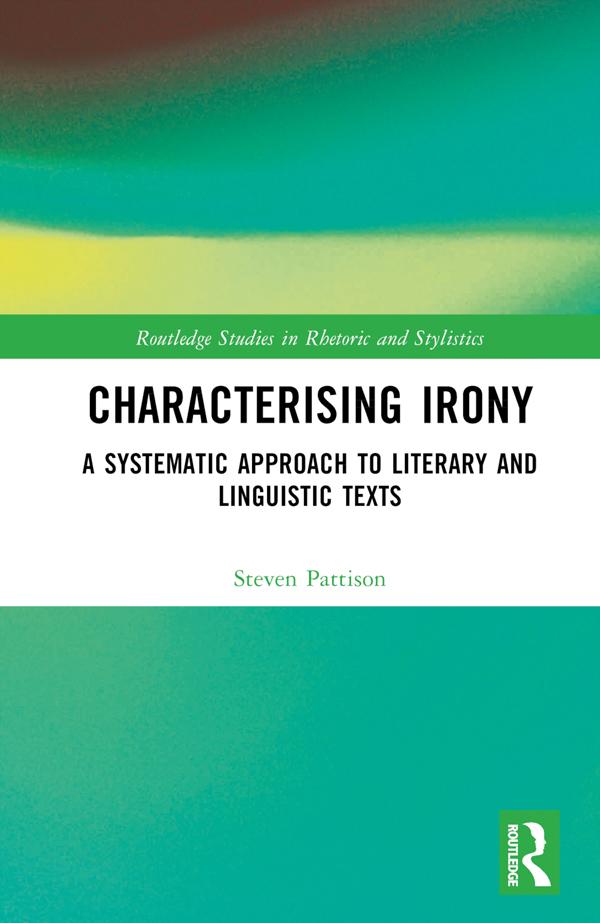
This book offers a systematic, bottom-up account of irony across both everyday contexts and literary and linguistic texts, using an empirically rigorous approach in distinguishing between central irony, non-central ironies, and non-ironies and highlighting a new way forward for irony research.
The volume considers the current landscape of irony, in which the term is used with increasing frequency with the knock-on effect of a loosening of its meaning. Pattison addresses this challenge by applying a systematic form of analysis, rooted in frameworks from pragmatics and complementary disciplines, to a database of over 500 irony candidates from a wide range of sources. The book uses these examples to illustrate the features of central ironies as well as the attributes used to differentiate between central ironies, non-central ironies, and non-ironies. These attributes are mapped across four key domains, including: difference and opposition; the role of context; how ironies are signaled; and speaker attitude and intention. Taken together, the volume puts forth a credible account for more clearly characterizing examples of irony and equips researchers with a comprehensive step-by-step method for undertaking future research.
This book is key reading for scholars in stylistics, pragmatics, literary studies, and psycholinguistics.
Betaal eenvoudig met kaart, Klarna, Apple Pay of Google Pay. Niet tevreden? Je hebt altijd 14 dagen bedenktijd. Lees meer in onze voorwaarden. Heb je vragen, mail ons dan via hello@memmo.org.
Memmo maakt studeren makkelijker – waar je ook bent ter wereld. Wij brengen je cursusboeken en slimme studietools samen op één plek: samenvattingen, quizzen, podcasts en flashcards. En Ted, je studievriend die antwoord geeft op alles wat je je afvraagt. Meer dan 50.000 studenten studeren hier al – gebouwd om je sneller te laten leren en minder stress te geven.