
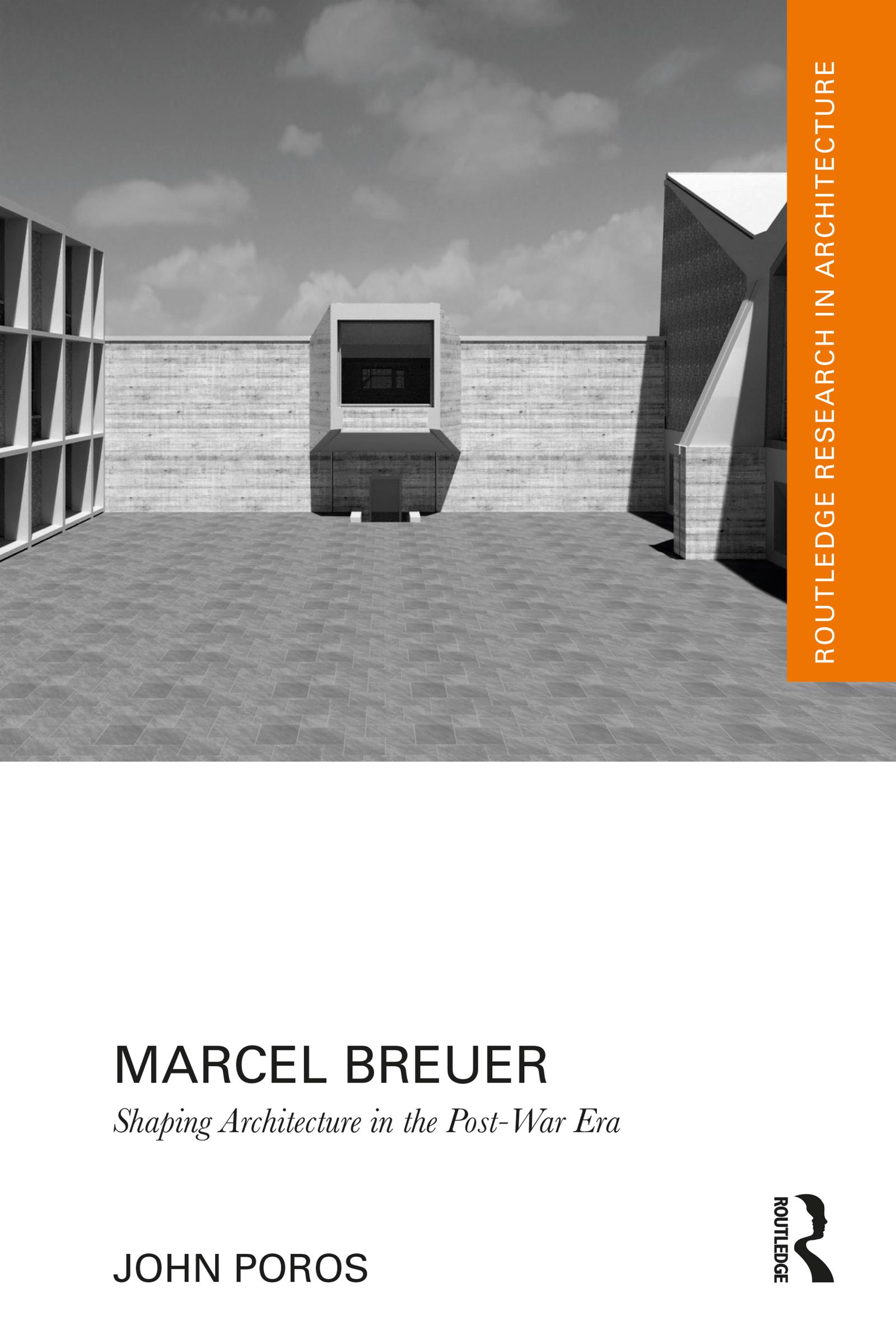
This book tracks the development of Marcel Breuer’s aesthetic clash between uniformity and singularity through the detailed examination of his seminal buildings. Each chapter examines a specific building and puts into context Breuer’s other work and the contemporary movements/architects of the post-war era such as Surrealism, Brutalism and structural expressionism. The buildings examined include the UNESCO Headquarters in Paris, France, of 1958; the IBM Research Center in Le Gaude, France, of 1962; the Annunciation Priory in Bismark, North Dakota, of 1963; and the Atlanta Central Library of 1980.
Marcel Breuer’s approach to design was inspired by the Spanish phrase, sol y sombra (sun and shadow). Sun and shadow meant for Breuer that a juxtaposition of contrasts was necessary; light glass walls and heavy concrete, masses lifted over voids, and serial precast construction resting on sculptural columns became hallmarks of Breuer’s buildings. By creating an architecture of juxtaposition, Breuer’s work can be interpreted as a surrealist recontre, as fueling a new architectural condition.
A critical evaluation of Marcel Breuer’s work, this book is written for graduate students, researchers, and academics interested in his work and how it shaped the architecture of the post-war era.
Betaal eenvoudig met kaart, Klarna, Apple Pay of Google Pay. Niet tevreden? Je hebt altijd 14 dagen bedenktijd. Lees meer in onze voorwaarden. Heb je vragen, mail ons dan via hello@memmo.org.
Memmo maakt studeren makkelijker – waar je ook bent ter wereld. Wij brengen je cursusboeken en slimme studietools samen op één plek: samenvattingen, quizzen, podcasts en flashcards. En Ted, je studievriend die antwoord geeft op alles wat je je afvraagt. Meer dan 50.000 studenten studeren hier al – gebouwd om je sneller te laten leren en minder stress te geven.