
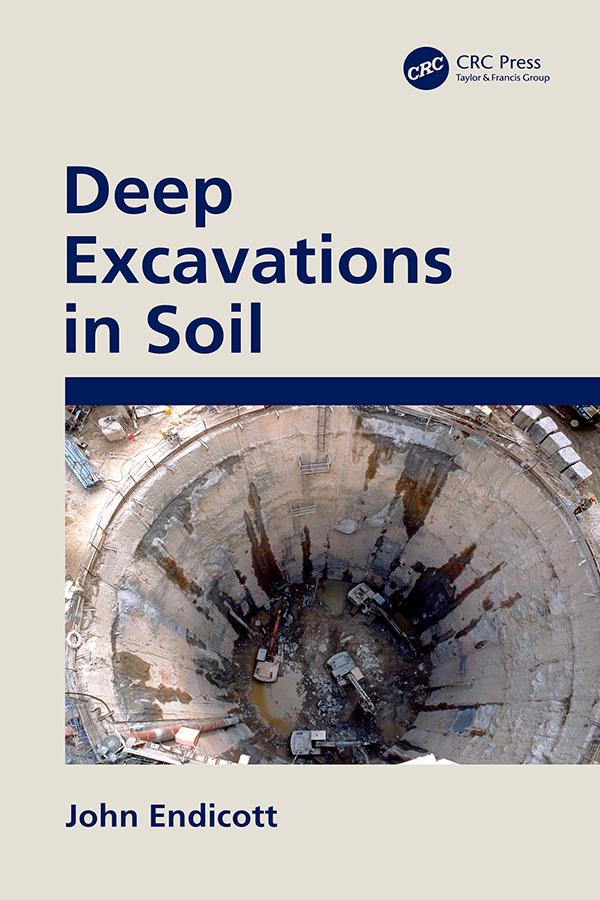
The book describes the theory and current practices for design of earth lateral support for deep excavations in soil. It addresses basic principles of soil mechanics and explains how these principles are embodied in design methods including hand calculations. It then introduces the use of numerical methods including the fundamental “beam on springs” models, and then more sophisticated computer programmes which can model soil as a continuum in two or three dimensions. Constitutive relationships are introduced that are in use for representing the behaviour of soil including a strain hardening model, and a Cam Clay model including groundwater flow and coupled consolidation.
These methods are illustrated by reference to practical applications and case histories from the author’s direct experience, and some of the pitfalls that can occur are discussed. Theory and design are strongly tied to construction practice, with emphasis on monitoring the retaining structures and movement of surrounding ground and structures, in the context of safety and the Observational Method. Examples are presented for conventional “Bottom-up” and “Top-down” sequences, along with hybrid sequences giving tips on how to optimise the design and effect economies of cost and time for construction. It is written for practising geotechnical, civil and structural engineers, and especially for senior and MSc students.
Betaal eenvoudig met kaart, Klarna, Apple Pay of Google Pay. Niet tevreden? Je hebt altijd 14 dagen bedenktijd. Lees meer in onze voorwaarden. Heb je vragen, mail ons dan via hello@memmo.org.
Memmo maakt studeren makkelijker – waar je ook bent ter wereld. Wij brengen je cursusboeken en slimme studietools samen op één plek: samenvattingen, quizzen, podcasts en flashcards. En Ted, je studievriend die antwoord geeft op alles wat je je afvraagt. Meer dan 50.000 studenten studeren hier al – gebouwd om je sneller te laten leren en minder stress te geven.