
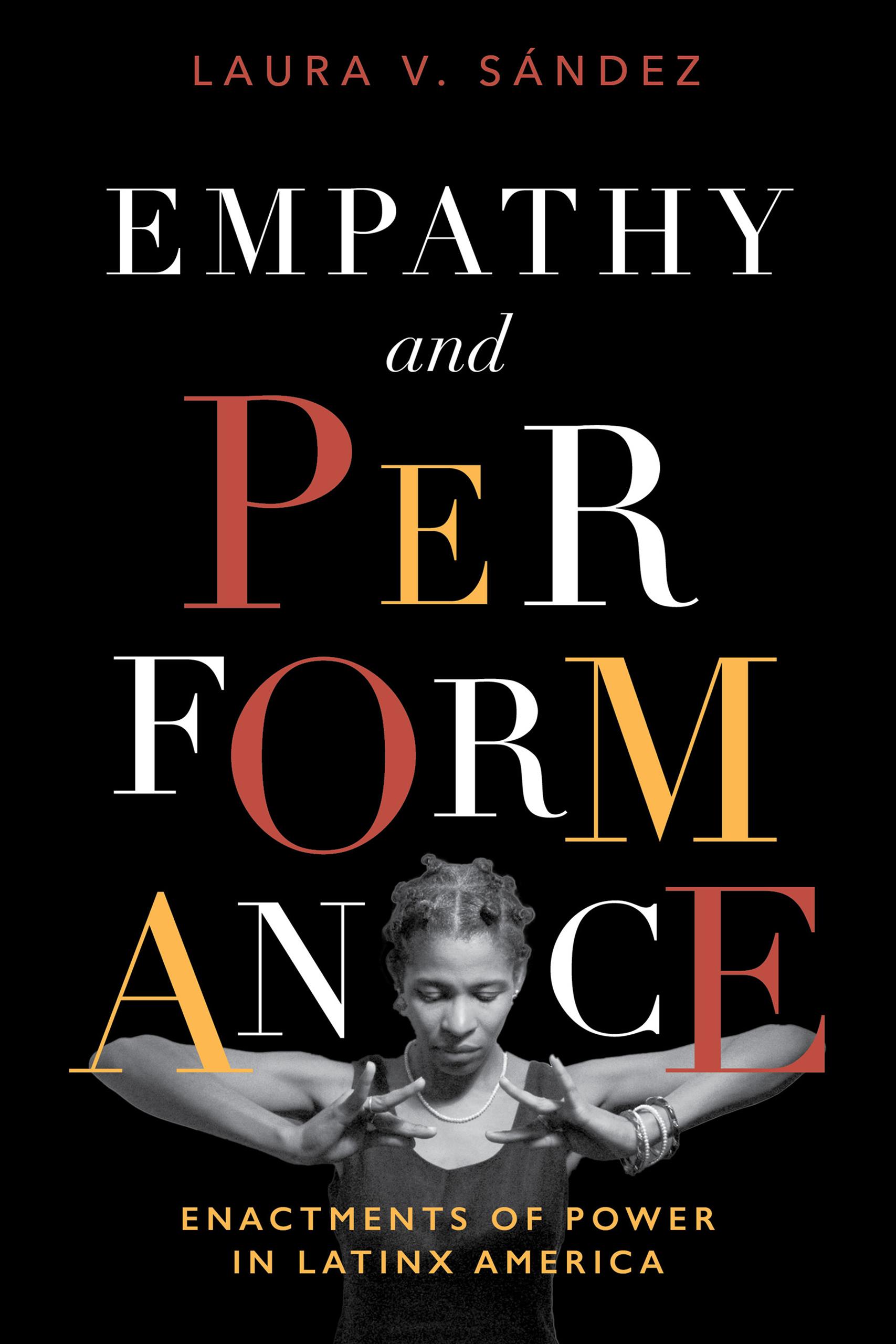
Empathy and Performance advances a study of empathy and enactments of power by examining works from author-actors whose performances explore the boundaries between two kinship positions. Author Laura V. Sández studies the dramatized dilemma of cultural understanding in “Our America,” a notion that refers first to a collective political identity marking a common belonging in the Spanish-speaking America but also alludes to current struggles in the contemporary US. This book sees empathy as an affective response grounded in subjectivity and kinship. Sández argues that to conceptualize empathy one needs to understand how subjects organize, classify, and limit themselves, not only as agents, but also as interpreters. What sort of affiliations do these performances promote? How do they break, reinforce, or queer societal expectations about the Latinx body, the white body, or simply, the staged body?
To survey different answers to these queries, Sández studies Indigurrito (Nao Bustamante); Dominicanish (Josefina Báez); ¡Bienvenidos Blancos! or Welcome White People! (Alex Torra); the apology delivered by the group Veterans Stand with Standing Rock during protests against the Dakota Access Pipeline; and Kukuli Velarde’s body of work, from We, the Colonized Ones to A Mi Vida. In these artistic enactments, which range from 1992 to 2021, the historical construct of boundaries and bodies becomes evident. Following recent work on empathy by Lanzoni, Maibom, Calloway-Thomas, Bloom, Hogan, and Matravers, among others, Sández examines in-group/out-group divisions, the establishment of identity categories through performance, and the exploration of subaltern identities.
To survey different answers to these queries, Sández studies Indigurrito (Nao Bustamante); Dominicanish (Josefina Báez); ¡Bienvenidos Blancos! or Welcome White People! (Alex Torra); the apology delivered by the group Veterans Stand with Standing Rock during protests against the Dakota Access Pipeline; and Kukuli Velarde’s body of work, from We, the Colonized Ones to A Mi Vida. In these artistic enactments, which range from 1992 to 2021, the historical construct of boundaries and bodies becomes evident. Following recent work on empathy by Lanzoni, Maibom, Calloway-Thomas, Bloom, Hogan, and Matravers, among others, Sández examines in-group/out-group divisions, the establishment of identity categories through performance, and the exploration of subaltern identities.
Betaal eenvoudig met kaart, Klarna, Apple Pay of Google Pay. Niet tevreden? Je hebt altijd 14 dagen bedenktijd. Lees meer in onze voorwaarden. Heb je vragen, mail ons dan via hello@memmo.org.
Memmo maakt studeren makkelijker – waar je ook bent ter wereld. Wij brengen je cursusboeken en slimme studietools samen op één plek: samenvattingen, quizzen, podcasts en flashcards. En Ted, je studievriend die antwoord geeft op alles wat je je afvraagt. Meer dan 50.000 studenten studeren hier al – gebouwd om je sneller te laten leren en minder stress te geven.
Misschien vind je dit ook leuk
Koop het boek0