
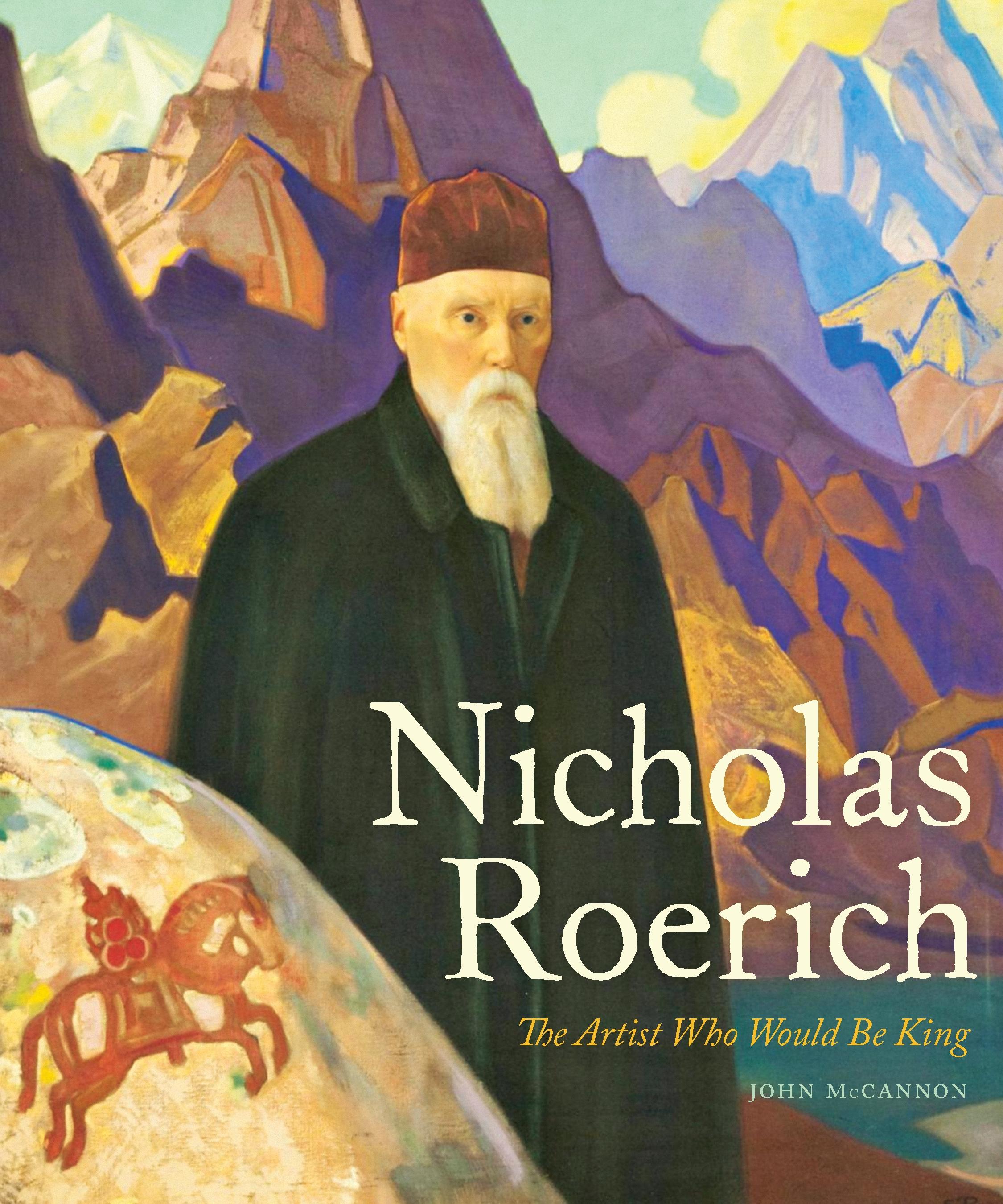
Russian painter, explorer, and mystic Nicholas Roerich (1874–1947) ranks as one of the twentieth century’s great enigmas. Despite mystery and scandal, he left a deep, if understudied, cultural imprint on Russia, Europe, India, and America. As a painter and set designer Roerich was a key figure in Russian art. He became a major player in Diaghilev’s Ballets Russes, and with Igor Stravinsky he cocreated The Rite of Spring, a landmark work in the emergence of artistic modernity. His art, his adventures, and his peace activism earned the friendship and admiration of such diverse luminaries as Albert Einstein, Eleanor Roosevelt, H. G. Wells, Jawaharlal Nehru, Raisa Gorbacheva, and H. P. Lovecraft.
But the artist also had a darker side. Stravinsky once said of Roerich that “he ought to have been a mystic or a spy.” He was certainly the former and close enough to the latter to blur any distinction. His travels to Asia, supposedly motivated by artistic interests and archaeological research, were in fact covert attempts to create a pan-Buddhist state encompassing Siberia, Mongolia, and Tibet. His activities in America touched Franklin Delano Roosevelt’s cabinet with scandal and, behind the scenes, affected the course of three US presidential elections.
In his lifetime, Roerich baffled foreign affairs ministries and intelligence services in half a dozen countries. He persuaded thousands that he was a humanitarian and divinely inspired thinker—but convinced just as many that he was a fraud or a madman. His story reads like an epic work of fiction and is all the more remarkable for being true. John McCannon’s engaging and scrupulously researched narrative moves beyond traditional perceptions of Roerich as a saint or a villain to show that he was, in many ways, both in equal measure.
But the artist also had a darker side. Stravinsky once said of Roerich that “he ought to have been a mystic or a spy.” He was certainly the former and close enough to the latter to blur any distinction. His travels to Asia, supposedly motivated by artistic interests and archaeological research, were in fact covert attempts to create a pan-Buddhist state encompassing Siberia, Mongolia, and Tibet. His activities in America touched Franklin Delano Roosevelt’s cabinet with scandal and, behind the scenes, affected the course of three US presidential elections.
In his lifetime, Roerich baffled foreign affairs ministries and intelligence services in half a dozen countries. He persuaded thousands that he was a humanitarian and divinely inspired thinker—but convinced just as many that he was a fraud or a madman. His story reads like an epic work of fiction and is all the more remarkable for being true. John McCannon’s engaging and scrupulously researched narrative moves beyond traditional perceptions of Roerich as a saint or a villain to show that he was, in many ways, both in equal measure.
Categorie: Biografi & Memoarer
e-ISBN: 9780822989134
Betaal eenvoudig met kaart, Klarna, Apple Pay of Google Pay. Niet tevreden? Je hebt altijd 14 dagen bedenktijd. Lees meer in onze voorwaarden. Heb je vragen, mail ons dan via hello@memmo.org.
Memmo maakt studeren makkelijker – waar je ook bent ter wereld. Wij brengen je cursusboeken en slimme studietools samen op één plek: samenvattingen, quizzen, podcasts en flashcards. En Ted, je studievriend die antwoord geeft op alles wat je je afvraagt. Meer dan 50.000 studenten studeren hier al – gebouwd om je sneller te laten leren en minder stress te geven.
Misschien vind je dit ook leuk
Koop het boek0