
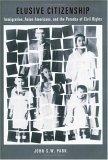
Since the late nineteenth century, federal and state rules governing immigration and naturalization have placed persons of Asian ancestry outside the boundaries of formal membership. A review of leading cases in American constitutional law regarding Asians would suggest that initially, Asian immigrants tended to evade exclusionary laws through deliberate misrepresentations of their identities or through extralegal means. Eventually, many of these immigrants and their descendants came to accept prevailing legal norms governing their citizenship in the United States. In many cases, this involved embracing notions of white supremacy.
John S. W. Park argues that American rules governing citizenship and belonging remain fundamentally unjust, even though they suggest the triumph of a "civil rights" vision, where all citizens share the same basic rights. By continuing to privilege members over non-members in ways that are politically popular, these rules mask injustices that violate principles of fairness. Importantly, Elusive Citizenship also suggests that politically and socially, full membership in American society remains closely linked with participation in exclusionary practices that isolate racial minorities in America.
Betaal eenvoudig met kaart, Klarna, Apple Pay of Google Pay. Niet tevreden? Je hebt altijd 14 dagen bedenktijd. Lees meer in onze voorwaarden. Heb je vragen, mail ons dan via hello@memmo.org.
Memmo maakt studeren makkelijker – waar je ook bent ter wereld. Wij brengen je cursusboeken en slimme studietools samen op één plek: samenvattingen, quizzen, podcasts en flashcards. En Ted, je studievriend die antwoord geeft op alles wat je je afvraagt. Meer dan 50.000 studenten studeren hier al – gebouwd om je sneller te laten leren en minder stress te geven.