
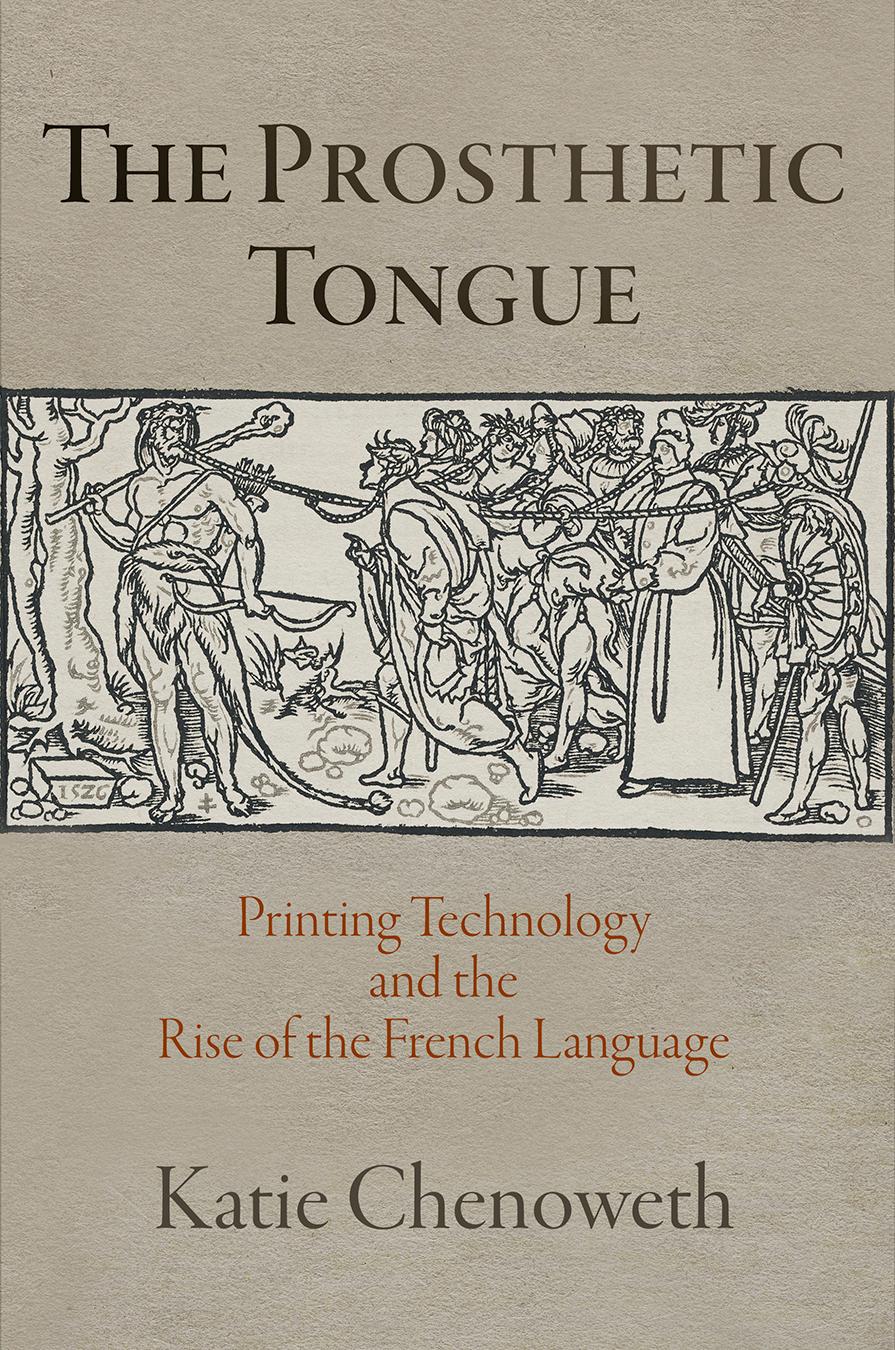
Of all the cultural "revolutions" brought about by the development of printing technology during the sixteenth century, perhaps the most remarkable but least understood is the purported rise of European vernacular languages. It is generally accepted that the invention of printing constitutes an event in the history of language that has profoundly shaped modernity, and yet the exact nature of this transformation—the mechanics of the event—has remained curiously unexamined.
In The Prosthetic Tongue, Katie Chenoweth explores the relationship between printing and the vernacular as it took shape in sixteenth-century France and charts the technological reinvention of French across a range of domains, from typography, orthography, and grammar to politics, pedagogy, and poetics. Under François I, the king known in his own time as the "Father of Letters," both printing and vernacular language emerged as major cultural and political forces. Beginning in 1529, French underwent a remarkable transformation, as printers and writers began to reimagine their mother tongue as mechanically reproducible. The first accent marks appeared in French texts, the first French grammar books and dictionaries were published, phonetic spelling reforms were debated, modern Roman typefaces replaced gothic scripts, and French was codified as a legal idiom.
This was, Chenoweth argues, a veritable "new media" moment, in which the print medium served as the underlying material apparatus and conceptual framework for a revolutionary reinvention of the vernacular. Rather than tell the story of the origin of the modern French language, however, she seeks to destabilize this very notion of "origin" by situating the cultural formation of French in a scene of media technology and reproducibility. No less than the paper book issuing from sixteenth-century printing presses, the modern French language is a product of the age of mechanical reproduction.
Betaal eenvoudig met kaart, Klarna, Apple Pay of Google Pay. Niet tevreden? Je hebt altijd 14 dagen bedenktijd. Lees meer in onze voorwaarden. Heb je vragen, mail ons dan via hello@memmo.org.
Memmo maakt studeren makkelijker – waar je ook bent ter wereld. Wij brengen je cursusboeken en slimme studietools samen op één plek: samenvattingen, quizzen, podcasts en flashcards. En Ted, je studievriend die antwoord geeft op alles wat je je afvraagt. Meer dan 50.000 studenten studeren hier al – gebouwd om je sneller te laten leren en minder stress te geven.