
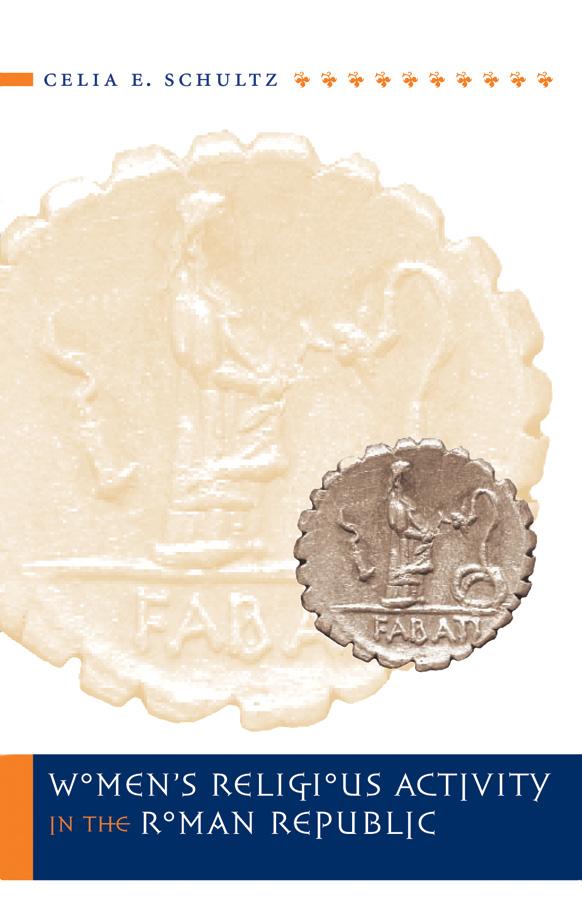
Expanding the discussion of religious participation of women in ancient Rome, Celia E. Schultz demonstrates that in addition to observances of marriage, fertility, and childbirth, there were more — and more important — religious opportunities available to Roman women than are commonly considered.
Based on research in ancient literature, inscriptions, and archaeological remains from the fifth to the first century B.C.E., Schultz’s study shows that women honored gods unaffiliated with domestic matters, including Hercules and Jupiter; they took part in commercial, military, and political rites; they often worshipped alongside men; and they were not confined to the private sphere, the traditional domain of women. The Vestal Virgins did not stand alone but were instead the most prominent members of a group of women who held high-profile religious positions: priestesses of Ceres, Liber, and Venus; the flaminica Dialis and the regina sacrorum; other cult officials; and aristocratic matrons who often took leading roles in religious observances even though they were not priestesses. Schultz argues that women were vital participants — both professional and nonprofessional — in the religion of the Roman Republic and that social and marital status, in addition to gender, were important factors in determining their opportunities for religious participation in the public sphere.
Based on research in ancient literature, inscriptions, and archaeological remains from the fifth to the first century B.C.E., Schultz’s study shows that women honored gods unaffiliated with domestic matters, including Hercules and Jupiter; they took part in commercial, military, and political rites; they often worshipped alongside men; and they were not confined to the private sphere, the traditional domain of women. The Vestal Virgins did not stand alone but were instead the most prominent members of a group of women who held high-profile religious positions: priestesses of Ceres, Liber, and Venus; the flaminica Dialis and the regina sacrorum; other cult officials; and aristocratic matrons who often took leading roles in religious observances even though they were not priestesses. Schultz argues that women were vital participants — both professional and nonprofessional — in the religion of the Roman Republic and that social and marital status, in addition to gender, were important factors in determining their opportunities for religious participation in the public sphere.
Pagina's: 248
Categorie: Arkeologi & Antikvetenskap
e-ISBN: 9780807877258
Verzendgewicht: 1.2 kg
Verzending binnen: 1-2 dagen
Betaal eenvoudig met kaart, Klarna, Apple Pay of Google Pay. Niet tevreden? Je hebt altijd 14 dagen bedenktijd. Lees meer in onze voorwaarden. Heb je vragen, mail ons dan via hello@memmo.org.
Memmo maakt studeren makkelijker – waar je ook bent ter wereld. Wij brengen je cursusboeken en slimme studietools samen op één plek: samenvattingen, quizzen, podcasts en flashcards. En Ted, je studievriend die antwoord geeft op alles wat je je afvraagt. Meer dan 50.000 studenten studeren hier al – gebouwd om je sneller te laten leren en minder stress te geven.
Misschien vind je dit ook leuk
Koop het boek0