
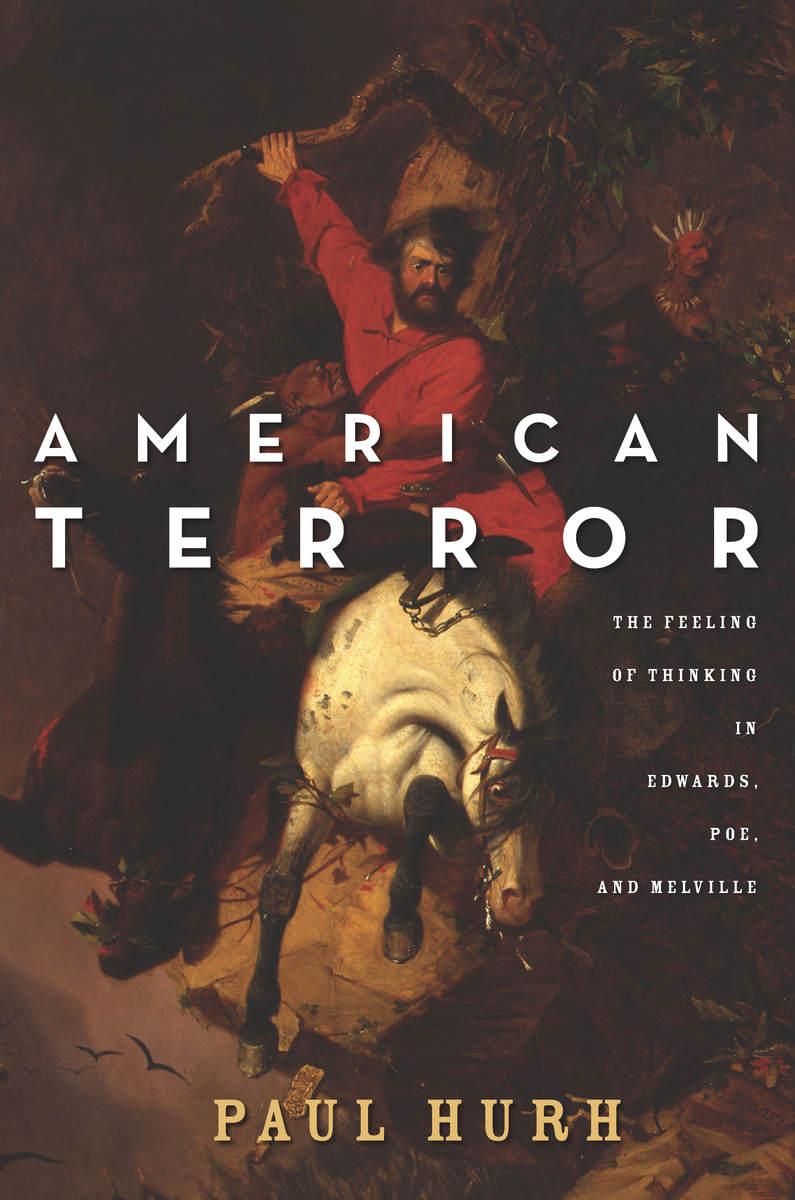
If America is a nation founded upon Enlightenment ideals, then why are so many of its most celebrated pieces of literature so dark? American Terror returns to the question of American literature's distinctive tone of terror through a close study of three authors—Jonathan Edwards, Edgar Allan Poe, and Herman Melville—who not only wrote works of terror, but who defended, theorized, and championed it.
Combining updated historical perspectives with close reading, Paul Hurh shows how these authors developed terror as a special literary affect informed by the way the concept of thinking becomes, in the wake of Enlightenment empiricism, increasingly defined by a set of austere mechanic processes, such as the scientific method and the algebraic functions of analytical logic. Rather than trying to find a feeling that would transcend thinking by subtending reason to emotion, these writers found in terror the feeling of thinking, the peculiar feeling of reason's authority over emotional schemes. In so doing, they grappled with a shared set of enduring questions: What is the difference between thinking and feeling? Why does it seem impossible to reason oneself out of an irrational fear? And what becomes of the freedom of the will when we discover that affects can push it around?
Betaal eenvoudig met kaart, Klarna, Apple Pay of Google Pay. Niet tevreden? Je hebt altijd 14 dagen bedenktijd. Lees meer in onze voorwaarden. Heb je vragen, mail ons dan via hello@memmo.org.
Memmo maakt studeren makkelijker – waar je ook bent ter wereld. Wij brengen je cursusboeken en slimme studietools samen op één plek: samenvattingen, quizzen, podcasts en flashcards. En Ted, je studievriend die antwoord geeft op alles wat je je afvraagt. Meer dan 50.000 studenten studeren hier al – gebouwd om je sneller te laten leren en minder stress te geven.