
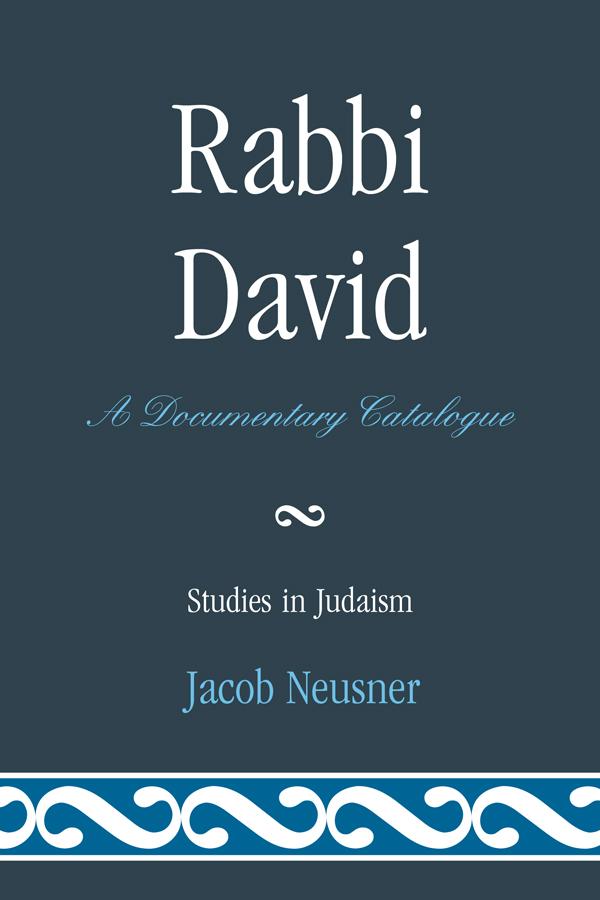
Rabbinic documents of David, progenitor of the Messiah, carry forward the scriptural narrative of David the king. But he also is turned by Rabbinic writings of late antiquity—from the Mishnah through the Yerushalmi and the Bavli—into a sage. Consequently, the Rabbis’ Messiah is a rabbi. How did this transformation come about? Of what kinds of writings does it consist? What sequence of writings conveyed the transformation? And most important: what do we learn about the movement from one set of Israelite writings to take over, or submit to the values of, another set of writings? These are the questions answered here for David, king of Israel.
Rabbi David proves that the first exposition of the figure of Rabbi David in a program of elaboration and of protracted exposition of law and Scripture is found in the Bavli. Prior to the closure of that document, that is, in the Rabbinic documents that came to closure before the Bavli, we do not find an elaborate exposition of the figure of David as a rabbi. By contrast, in the Bavli, ample canonical evidence attests to the sages’ transformation of David, king of Israel, into a rabbi. So while bits and pieces of Rabbi David find their way into most of the canonical documents, we find the elaborately spelled out Rabbi David to begin with in the Bavli, now represented as a disciple of sages and a devotee of study of the Torah. That usage attracts attention because when we encounter David in Rabbinic literature—as in all other Judaic canons, not only Rabbinic—this signals we are meeting the embodiment of the Messiah. The representation of the kings of Israel in the Davidic line as heirs of David forms a chapter in exposing the Messianic message of Rabbinic Judaism.
Rabbi David proves that the first exposition of the figure of Rabbi David in a program of elaboration and of protracted exposition of law and Scripture is found in the Bavli. Prior to the closure of that document, that is, in the Rabbinic documents that came to closure before the Bavli, we do not find an elaborate exposition of the figure of David as a rabbi. By contrast, in the Bavli, ample canonical evidence attests to the sages’ transformation of David, king of Israel, into a rabbi. So while bits and pieces of Rabbi David find their way into most of the canonical documents, we find the elaborately spelled out Rabbi David to begin with in the Bavli, now represented as a disciple of sages and a devotee of study of the Torah. That usage attracts attention because when we encounter David in Rabbinic literature—as in all other Judaic canons, not only Rabbinic—this signals we are meeting the embodiment of the Messiah. The representation of the kings of Israel in the Davidic line as heirs of David forms a chapter in exposing the Messianic message of Rabbinic Judaism.
Pagina's: 218
Categorie: Religion & Teologi
e-ISBN: 9780761858485
Verzendgewicht: 1.2 kg
Verzending binnen: 1-2 dagen
Betaal eenvoudig met kaart, Klarna, Apple Pay of Google Pay. Niet tevreden? Je hebt altijd 14 dagen bedenktijd. Lees meer in onze voorwaarden. Heb je vragen, mail ons dan via hello@memmo.org.
Memmo maakt studeren makkelijker – waar je ook bent ter wereld. Wij brengen je cursusboeken en slimme studietools samen op één plek: samenvattingen, quizzen, podcasts en flashcards. En Ted, je studievriend die antwoord geeft op alles wat je je afvraagt. Meer dan 50.000 studenten studeren hier al – gebouwd om je sneller te laten leren en minder stress te geven.