
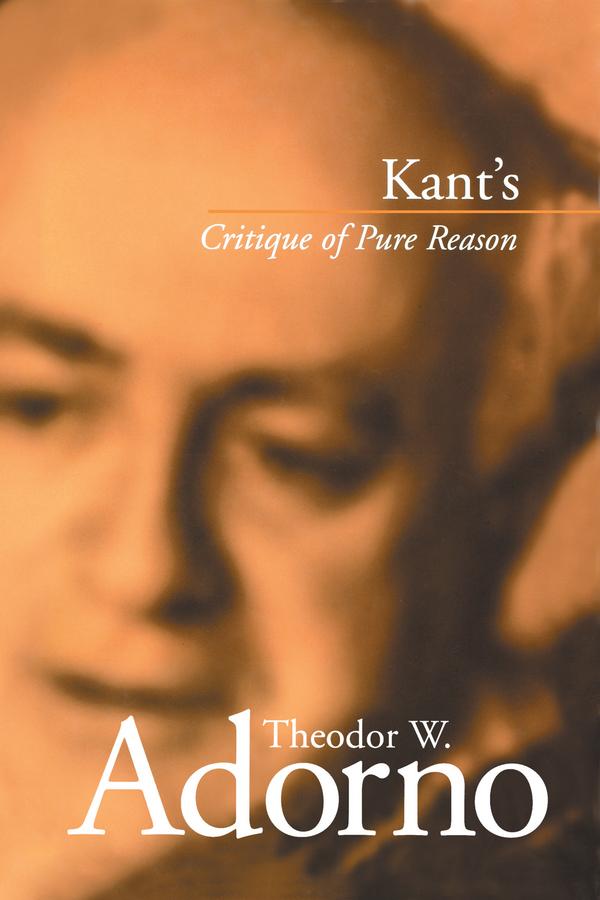
Kant is a pivotal thinker in Adorno's intellectual world. Yet although he wrote monographs on Hegel, Husserl and Kierkegaard, the closest he came to an extended discussion of Kant are two lecture courses, one concentrating on the Critique of Pure Reason and the other on the Critique of Practical Reason. This new volume by Adorno comprises his lectures on the former.
Adorno attempts to make Kant's thought comprehensible to students by focusing on what he regards as problematic aspects of Kant's philosophy. Adorno examines his dualism and what he calls the Kantian 'block': the contradictions arising from Kant's resistance to the idealism that his successors, Fichte, Schelling and Hegel, saw as the inevitable outcome of his ideas. But these lectures also provide an accessible introduction to and rationale for Adorno's own philosophy as expounded in Negative Dialectics and his other major writings. Adorno's view of Kant forms an integral part of his own philosophy, since he argues that the way out of the Kantian contradictions is to show the necessity of the dialectical thinking that Kant himself spurned. This in turn enables Adorno to criticize Anglo-Saxon scientistic or positivist thought, as well as the philosophy of existentialism.
This book will be of great interest to those working in philosophy and in social and political thought, and it will be essential reading for anyone interested in the foundations of Adorno's own work.
Adorno attempts to make Kant's thought comprehensible to students by focusing on what he regards as problematic aspects of Kant's philosophy. Adorno examines his dualism and what he calls the Kantian 'block': the contradictions arising from Kant's resistance to the idealism that his successors, Fichte, Schelling and Hegel, saw as the inevitable outcome of his ideas. But these lectures also provide an accessible introduction to and rationale for Adorno's own philosophy as expounded in Negative Dialectics and his other major writings. Adorno's view of Kant forms an integral part of his own philosophy, since he argues that the way out of the Kantian contradictions is to show the necessity of the dialectical thinking that Kant himself spurned. This in turn enables Adorno to criticize Anglo-Saxon scientistic or positivist thought, as well as the philosophy of existentialism.
This book will be of great interest to those working in philosophy and in social and political thought, and it will be essential reading for anyone interested in the foundations of Adorno's own work.
Betaal eenvoudig met kaart, Klarna, Apple Pay of Google Pay. Niet tevreden? Je hebt altijd 14 dagen bedenktijd. Lees meer in onze voorwaarden. Heb je vragen, mail ons dan via hello@memmo.org.
Memmo maakt studeren makkelijker – waar je ook bent ter wereld. Wij brengen je cursusboeken en slimme studietools samen op één plek: samenvattingen, quizzen, podcasts en flashcards. En Ted, je studievriend die antwoord geeft op alles wat je je afvraagt. Meer dan 50.000 studenten studeren hier al – gebouwd om je sneller te laten leren en minder stress te geven.