
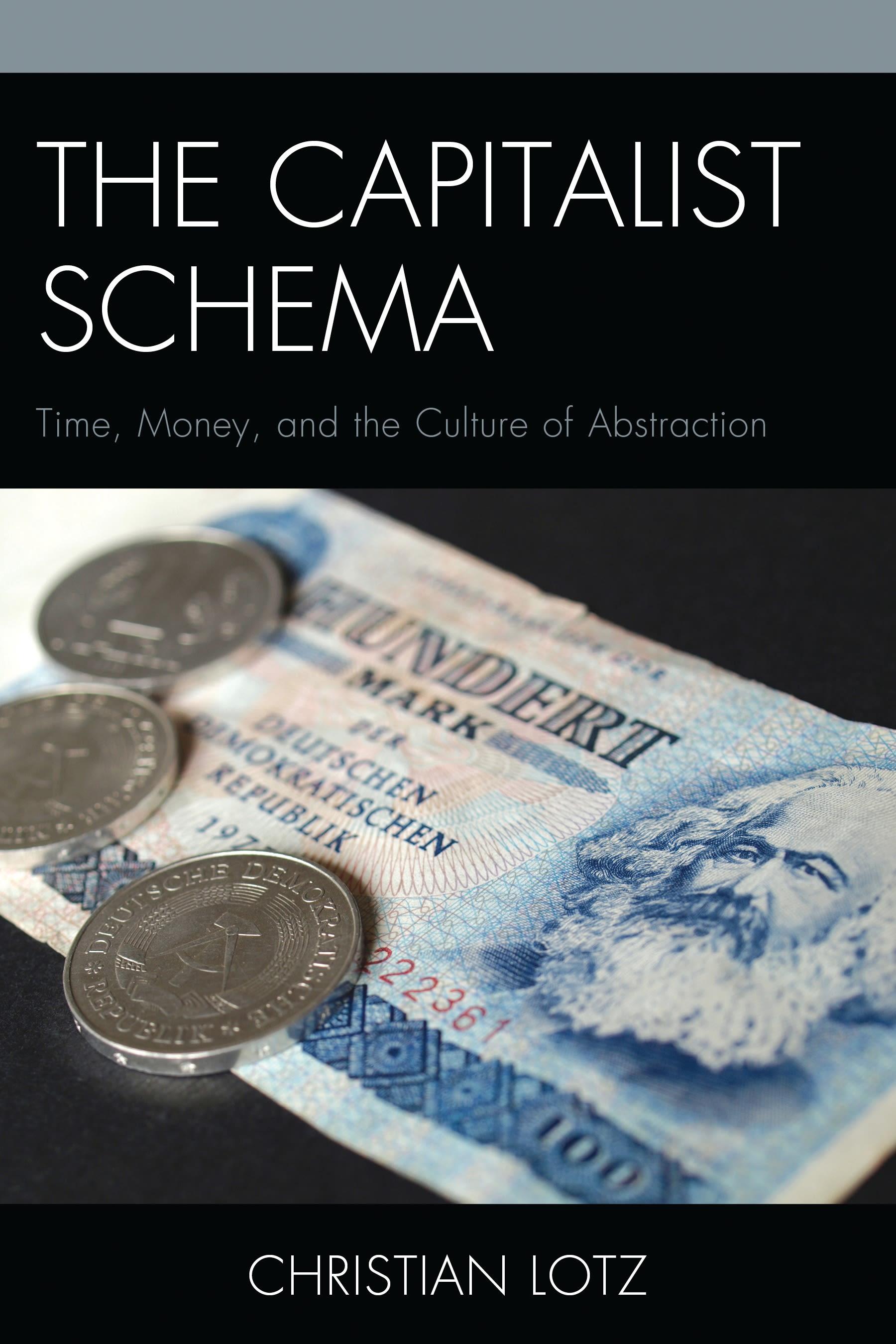
Christian Lotz argues that Immanuel Kant’s idea of a mental schematism, which gives the human mind access to a stable reality, can be interpreted as a social concept, which, using Karl Marx, the author identifies as money. Money and its “fluid” form, capital, constitute sociality in capitalism and make access to social reality possible. Money, in other words, makes life in capitalism meaningful and frames all social relations. Following Marx, Lotz argues that money is the true Universal of modern life and that, as such, we are increasingly subjected to its control.
As money and capital are closely linked to time, Lotz argues that in capitalism money also constitutes past and future “social horizons” by turning both into “monetized” horizons. Everything becomes faster, global, and more abstract. Our lives, as a consequence, become more mobile, “fluid,” unstable, and precarious. Lotz presents analyses of credit, debt, and finance as examples of how money determines the meaning of future and past, imagination, and memory, and that this results in individuals becoming increasingly integrated into and dependent upon the capitalist world. This integration and dependence increases with the event of electronics industries and brain-science industries that channel all human desires towards profits, growth, and money. In this way, the book offers a critical extension of Theodor Adorno’s analysis of exchange and the culture industry as the basis of modern societies. Lotz argues—paradoxically with and against Adorno—that we should return to the basic insights of Marx’s philosophy, given that the principle of exchange is only possible on the basis of more fundamental social and economic categories, such as money.
As money and capital are closely linked to time, Lotz argues that in capitalism money also constitutes past and future “social horizons” by turning both into “monetized” horizons. Everything becomes faster, global, and more abstract. Our lives, as a consequence, become more mobile, “fluid,” unstable, and precarious. Lotz presents analyses of credit, debt, and finance as examples of how money determines the meaning of future and past, imagination, and memory, and that this results in individuals becoming increasingly integrated into and dependent upon the capitalist world. This integration and dependence increases with the event of electronics industries and brain-science industries that channel all human desires towards profits, growth, and money. In this way, the book offers a critical extension of Theodor Adorno’s analysis of exchange and the culture industry as the basis of modern societies. Lotz argues—paradoxically with and against Adorno—that we should return to the basic insights of Marx’s philosophy, given that the principle of exchange is only possible on the basis of more fundamental social and economic categories, such as money.
Betaal eenvoudig met kaart, Klarna, Apple Pay of Google Pay. Niet tevreden? Je hebt altijd 14 dagen bedenktijd. Lees meer in onze voorwaarden. Heb je vragen, mail ons dan via hello@memmo.org.
Memmo maakt studeren makkelijker – waar je ook bent ter wereld. Wij brengen je cursusboeken en slimme studietools samen op één plek: samenvattingen, quizzen, podcasts en flashcards. En Ted, je studievriend die antwoord geeft op alles wat je je afvraagt. Meer dan 50.000 studenten studeren hier al – gebouwd om je sneller te laten leren en minder stress te geven.