
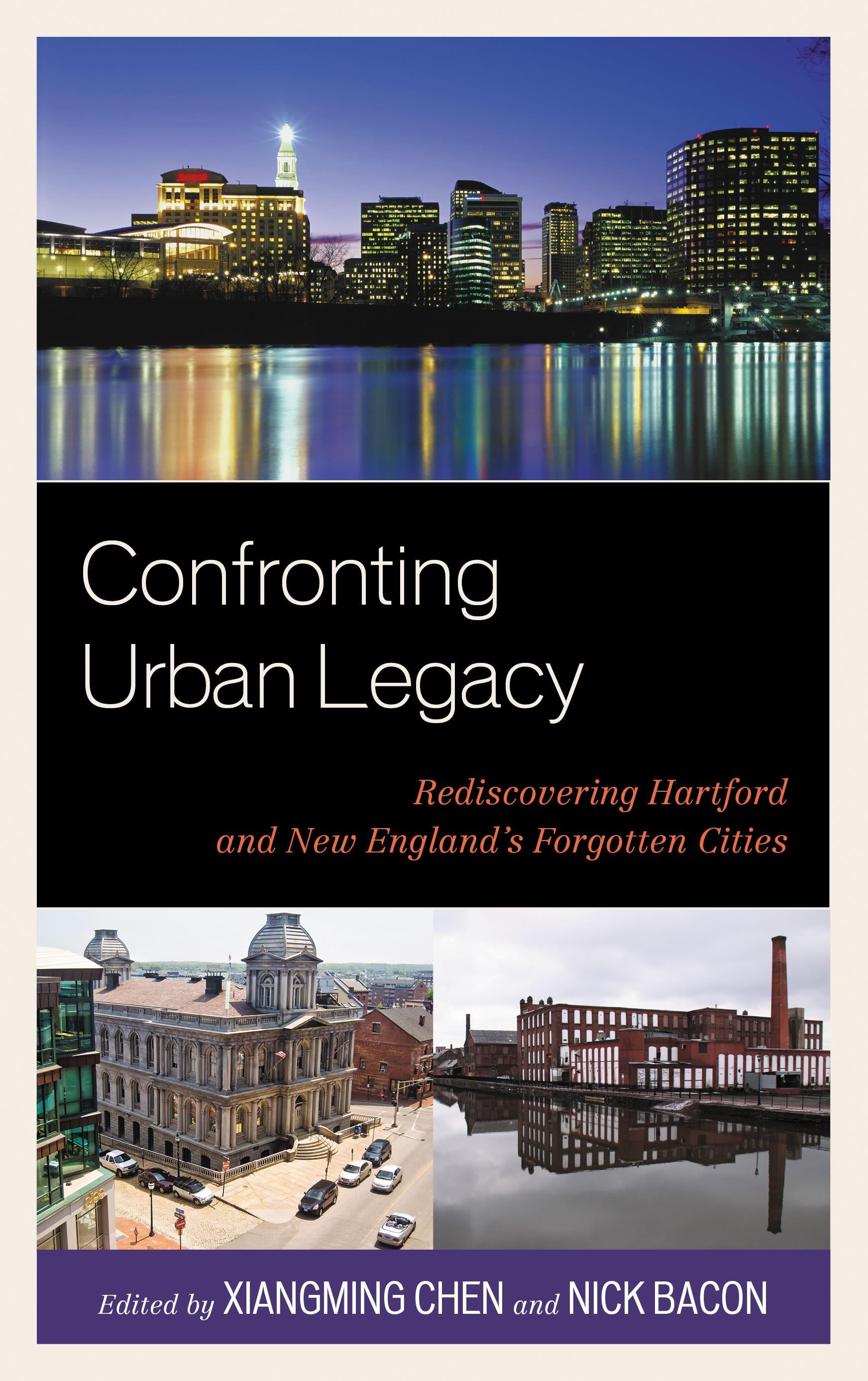
Confronting Urban Legacy fills a critical lacuna in urban scholarship. As almost all of the literature focuses on global cities and megacities, smaller, secondary cities, which actually hold the majority of the world’s population, are either critically misunderstood or unexamined in their entirety. This neglect not only biases scholars’ understanding of social and spatial dynamics toward very large global cities but also maintains a void in students’ learning. This book specifically explores the transformative relationship between globalization and urban transition in Hartford, Connecticut, while including crucial comparative chapters on other forgotten New England cities: Portland, Maine, along with Lawrence and Springfield, Massachusetts. Hartford’s transformation carries a striking imprint of globalization that has been largely missed: from its 17th century roots as New England first inland colonial settlement, to its emergence as one of the world’s most prosperous manufacturing and insurance metropolises, to its present configuration as one of America’s poorest post-industrial cities, which by still retaining a globally lucrative FIRE Sector is nevertheless surrounded by one of the nation’s most prosperous metropolitan regions.
The myriad of dilemmas confronting Hartford calls for this book to take an interdisciplinary approach. The editors’ introduction places Hartford in a global comparative perspective; Part I provides rich historical delineations of the many rises and (not quite) falls of Hartford; Part II offers a broad contemporary treatment of Hartford by dissecting recent immigration and examining the demographic and educational dimensions of the city-suburban divide; and Part III unpacks Hartford’s current social, economic, and political situation and discusses what the city could become. Using the lessons from this book on Hartford and other underappreciated secondary cities in New England, urban scholars, leaders, and residents alike can gain a number of essential insights—both theoretical and practical.
The myriad of dilemmas confronting Hartford calls for this book to take an interdisciplinary approach. The editors’ introduction places Hartford in a global comparative perspective; Part I provides rich historical delineations of the many rises and (not quite) falls of Hartford; Part II offers a broad contemporary treatment of Hartford by dissecting recent immigration and examining the demographic and educational dimensions of the city-suburban divide; and Part III unpacks Hartford’s current social, economic, and political situation and discusses what the city could become. Using the lessons from this book on Hartford and other underappreciated secondary cities in New England, urban scholars, leaders, and residents alike can gain a number of essential insights—both theoretical and practical.
Pagina's: 324
Categorie: Arkitektur & Stadsplanering
e-ISBN: 9780739149447
Verzendgewicht: 1.2 kg
Verzending binnen: 1-2 dagen
Betaal eenvoudig met kaart, Klarna, Apple Pay of Google Pay. Niet tevreden? Je hebt altijd 14 dagen bedenktijd. Lees meer in onze voorwaarden. Heb je vragen, mail ons dan via hello@memmo.org.
Memmo maakt studeren makkelijker – waar je ook bent ter wereld. Wij brengen je cursusboeken en slimme studietools samen op één plek: samenvattingen, quizzen, podcasts en flashcards. En Ted, je studievriend die antwoord geeft op alles wat je je afvraagt. Meer dan 50.000 studenten studeren hier al – gebouwd om je sneller te laten leren en minder stress te geven.