
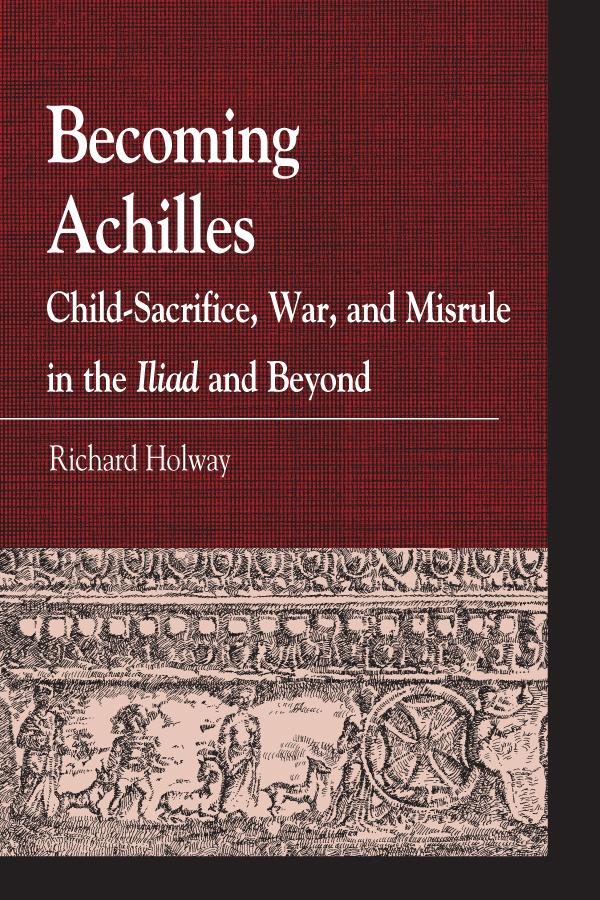
Viewing the Iliad and myth through the lens of modern psychology, in Becoming Achilles: Child-Sacrifice, War, and Misrule in the Iliad and Beyond,Richard Holway shows how the epic underwrites individual and communal catharsis and denial. Sacrificial childrearing generates but also threatens agonistic, glory-seeking ancient Greek cultures. Not only aggression but knowledge of sacrificial parenting must be purged.
Just as Zeus contrives to have threats to his regime play out harmlessly (to him) in the mortal realm, so the Iliad dramatizes threats to Archaic and later Greek cultures in the safe arena of poetic performance. The epic represents in displaced form destructive mother-son and father-daughter liaisons and resulting strife within and between generations.
Holway calls into question the Iliad’s (and many scholars’) presentation of Achilles as a hero who speaks truth to power, learns through suffering, and exemplifies kingly virtues that Agamemnon lacks. So too the Iliad’s cathartic process, whether conceived as purging innate aggression or arriving at moral clarity. Instead, Holway argues, Achilles (and Socrates) try to prove they are not what at bottom they experience themselves to be—needy, defenseless children, who fear to acknowledge, much less speak out against, parents' use of them to meet parents' needs.
What emerges from Holway’s analysis is not only a new reading of the Iliad, from its first word to its last, but a revised account of the family dynamics underlying ancient Greek cultures.
Just as Zeus contrives to have threats to his regime play out harmlessly (to him) in the mortal realm, so the Iliad dramatizes threats to Archaic and later Greek cultures in the safe arena of poetic performance. The epic represents in displaced form destructive mother-son and father-daughter liaisons and resulting strife within and between generations.
Holway calls into question the Iliad’s (and many scholars’) presentation of Achilles as a hero who speaks truth to power, learns through suffering, and exemplifies kingly virtues that Agamemnon lacks. So too the Iliad’s cathartic process, whether conceived as purging innate aggression or arriving at moral clarity. Instead, Holway argues, Achilles (and Socrates) try to prove they are not what at bottom they experience themselves to be—needy, defenseless children, who fear to acknowledge, much less speak out against, parents' use of them to meet parents' needs.
What emerges from Holway’s analysis is not only a new reading of the Iliad, from its first word to its last, but a revised account of the family dynamics underlying ancient Greek cultures.
Pagina's: 270
Categorie: Arkeologi & Antikvetenskap
e-ISBN: 9780739146927
Verzendgewicht: 1.2 kg
Verzending binnen: 1-2 dagen
Betaal eenvoudig met kaart, Klarna, Apple Pay of Google Pay. Niet tevreden? Je hebt altijd 14 dagen bedenktijd. Lees meer in onze voorwaarden. Heb je vragen, mail ons dan via hello@memmo.org.
Memmo maakt studeren makkelijker – waar je ook bent ter wereld. Wij brengen je cursusboeken en slimme studietools samen op één plek: samenvattingen, quizzen, podcasts en flashcards. En Ted, je studievriend die antwoord geeft op alles wat je je afvraagt. Meer dan 50.000 studenten studeren hier al – gebouwd om je sneller te laten leren en minder stress te geven.