
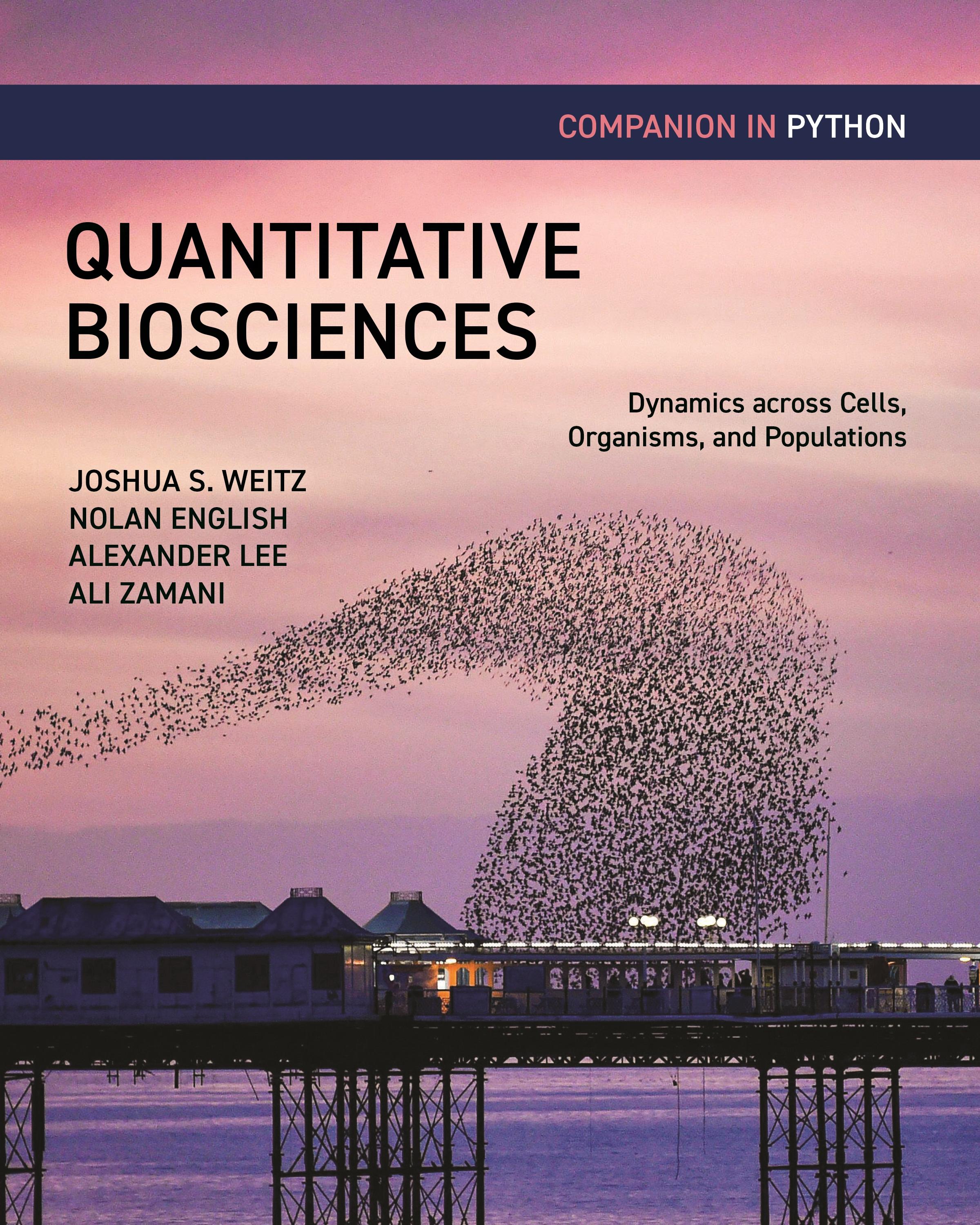
A hands-on lab guide in the Python programming language that enables students in the life sciences to reason quantitatively about living systems across scales
This lab guide accompanies the textbook Quantitative Biosciences, providing students with the skills they need to translate biological principles and mathematical concepts into computational models of living systems. This hands-on guide uses a case study approach organized around central questions in the life sciences, introducing landmark advances in the field while teaching students—whether from the life sciences, physics, computational sciences, engineering, or mathematics—how to reason quantitatively in the face of uncertainty.
- Draws on real-world case studies in molecular and cellular biosciences, organismal behavior and physiology, and populations and ecological communities
- Encourages good coding practices, clear and understandable modeling, and accessible presentation of results
- Helps students to develop a diverse repertoire of simulation approaches, enabling them to model at the appropriate scale
- Builds practical expertise in a range of methods, including sampling from probability distributions, stochastic branching processes, continuous time modeling, Markov chains, bifurcation analysis, partial differential equations, and agent-based simulations
- Bridges the gap between the classroom and research discovery, helping students to think independently, troubleshoot and resolve problems, and embark on research of their own
- Stand-alone computational lab guides for Quantitative Biosciences also available in R and MATLAB
Betaal eenvoudig met kaart, Klarna, Apple Pay of Google Pay. Niet tevreden? Je hebt altijd 14 dagen bedenktijd. Lees meer in onze voorwaarden. Heb je vragen, mail ons dan via hello@memmo.org.
Memmo maakt studeren makkelijker – waar je ook bent ter wereld. Wij brengen je cursusboeken en slimme studietools samen op één plek: samenvattingen, quizzen, podcasts en flashcards. En Ted, je studievriend die antwoord geeft op alles wat je je afvraagt. Meer dan 50.000 studenten studeren hier al – gebouwd om je sneller te laten leren en minder stress te geven.