
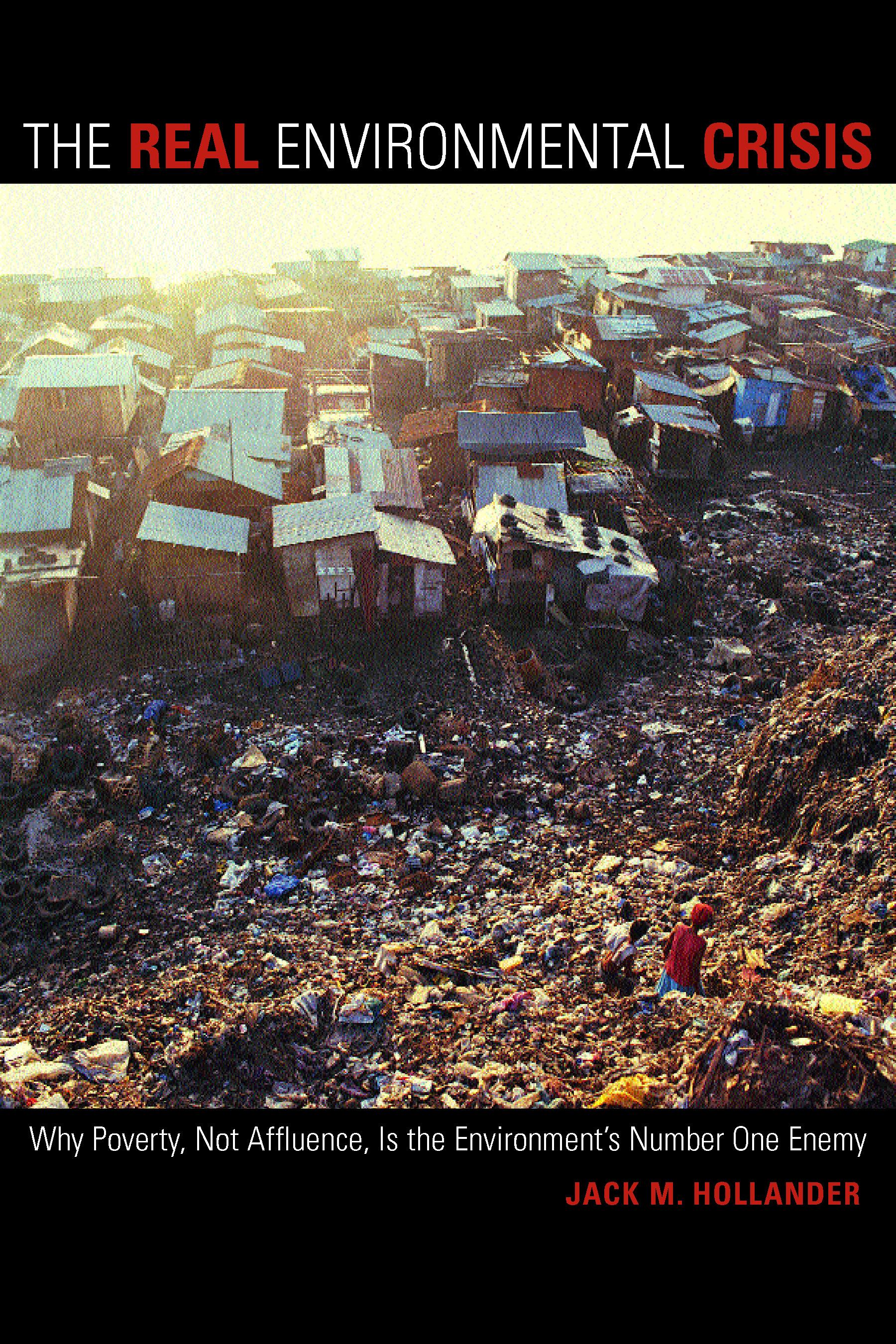
Drawing a completely new road map toward a sustainable future, Jack M. Hollander contends that our most critical environmental problem is global poverty. His balanced, authoritative, and lucid book challenges widely held beliefs that economic development and affluence pose a major threat to the world's environment and resources. Pointing to the great strides that have been made toward improving and protecting the environment in the affluent democracies, Hollander makes the case that the essential prerequisite for sustainability is a global transition from poverty to affluence, coupled with a transition to freedom and democracy.
The Real Environmental Crisis takes a close look at the major environment and resource issues—population growth; climate change; agriculture and food supply; our fisheries, forests, and fossil fuels; water and air quality; and solar and nuclear power. In each case, Hollander finds compelling evidence that economic development and technological advances can relieve such problems as food shortages, deforestation, air pollution, and land degradation, and provide clean water, adequate energy supplies, and improved public health. The book also tackles issues such as global warming, genetically modified foods, automobile and transportation technologies, and the highly significant Endangered Species Act, which Hollander asserts never would have been legislated in a poor country whose citizens struggle just to survive.
Hollander asks us to look beyond the media's doomsday rhetoric about the state of the environment, for much of it is simply not true, and to commit much more of our resources where they will do the most good—to lifting the world's population out of poverty.
The Real Environmental Crisis takes a close look at the major environment and resource issues—population growth; climate change; agriculture and food supply; our fisheries, forests, and fossil fuels; water and air quality; and solar and nuclear power. In each case, Hollander finds compelling evidence that economic development and technological advances can relieve such problems as food shortages, deforestation, air pollution, and land degradation, and provide clean water, adequate energy supplies, and improved public health. The book also tackles issues such as global warming, genetically modified foods, automobile and transportation technologies, and the highly significant Endangered Species Act, which Hollander asserts never would have been legislated in a poor country whose citizens struggle just to survive.
Hollander asks us to look beyond the media's doomsday rhetoric about the state of the environment, for much of it is simply not true, and to commit much more of our resources where they will do the most good—to lifting the world's population out of poverty.
Betaal eenvoudig met kaart, Klarna, Apple Pay of Google Pay. Niet tevreden? Je hebt altijd 14 dagen bedenktijd. Lees meer in onze voorwaarden. Heb je vragen, mail ons dan via hello@memmo.org.
Memmo maakt studeren makkelijker – waar je ook bent ter wereld. Wij brengen je cursusboeken en slimme studietools samen op één plek: samenvattingen, quizzen, podcasts en flashcards. En Ted, je studievriend die antwoord geeft op alles wat je je afvraagt. Meer dan 50.000 studenten studeren hier al – gebouwd om je sneller te laten leren en minder stress te geven.
Misschien vind je dit ook leuk
Koop het boek0