
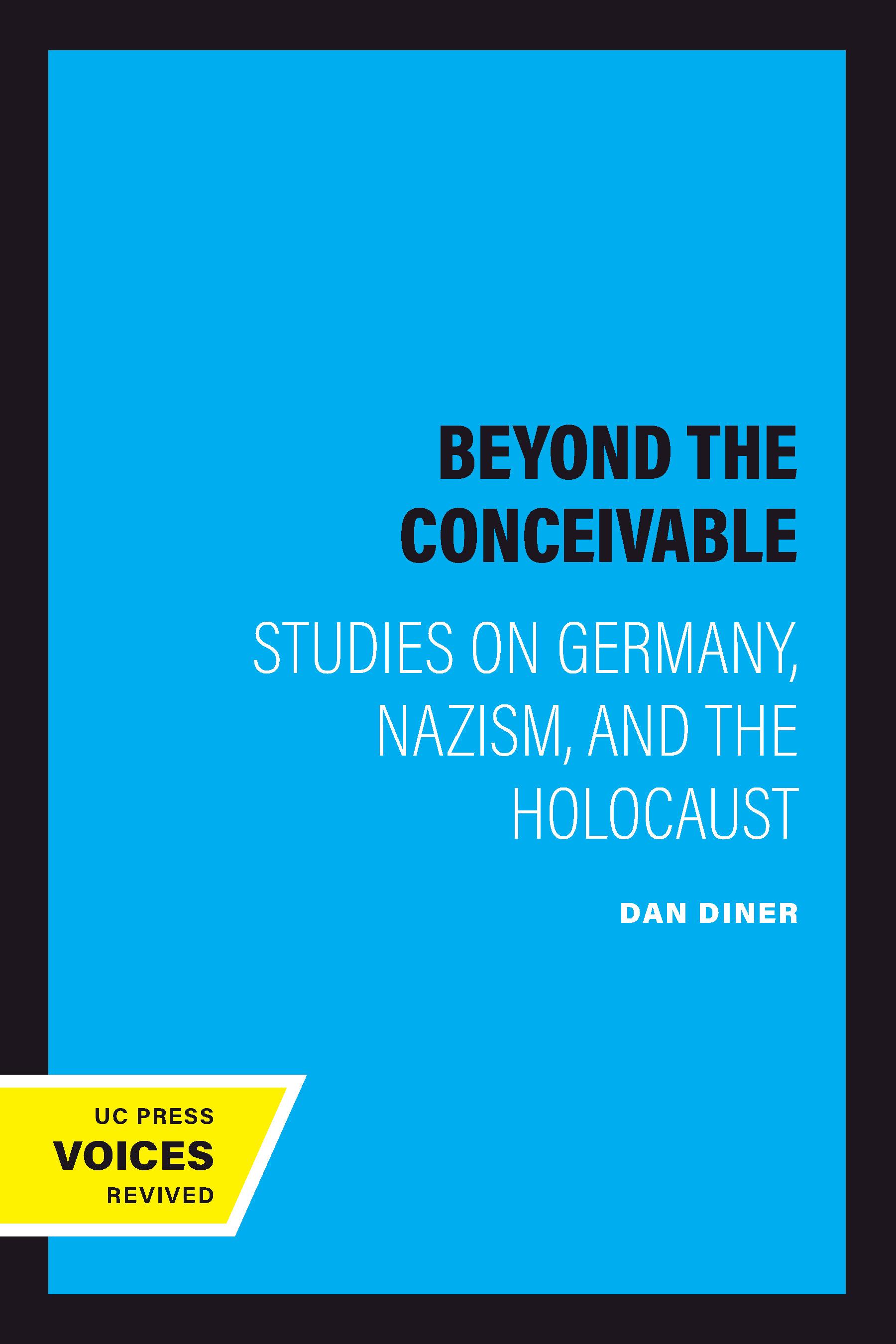
The major essays of Dan Diner, who is widely read and quoted in Germany and Israel, are finally collected in an English edition. They reflect the author’s belief that the Holocaust transcends traditional patterns of historical understanding and requires an epistemologically distinct approach. One can no longer assume that actors as well as historians are operating in the same conceptual universe, sharing the same criteria of rational discourse. This is particularly true of victims and perpetrators, whose memories shape the distortions of historical narrative in ways often diametrically opposed.
The essays are divided into three groups. The first group talks about anti-Semitism in the context of the 1930s and the ideologies that drove the Nazi regime. The second group concentrates on the almost unbelievably different perceptions of the "Final Solution," with particularly illuminating discussions of the Judenrat, or Jewish council. The third group considers the Holocaust as the subject of narrative and historical memory. Diner focuses above all on perspectives: the very notions of rationality and irrationality are seen to be changeable, depending on who is applying them. And because neither rational nor irrational motives can be universally assigned to participants in the Holocaust, Diner proposes, from the perspective of the victims, the idea of the counterrational. His work is directed toward developing a theory of Holocaust historiography and offers, clearly and coherently, the highest level of reflection on these problems.
The major essays of Dan Diner, who is widely read and quoted in Germany and Israel, are finally collected in an English edition. They reflect the author’s belief that the Holocaust transcends traditional patterns of historical understanding and requires a
The essays are divided into three groups. The first group talks about anti-Semitism in the context of the 1930s and the ideologies that drove the Nazi regime. The second group concentrates on the almost unbelievably different perceptions of the "Final Solution," with particularly illuminating discussions of the Judenrat, or Jewish council. The third group considers the Holocaust as the subject of narrative and historical memory. Diner focuses above all on perspectives: the very notions of rationality and irrationality are seen to be changeable, depending on who is applying them. And because neither rational nor irrational motives can be universally assigned to participants in the Holocaust, Diner proposes, from the perspective of the victims, the idea of the counterrational. His work is directed toward developing a theory of Holocaust historiography and offers, clearly and coherently, the highest level of reflection on these problems.
The major essays of Dan Diner, who is widely read and quoted in Germany and Israel, are finally collected in an English edition. They reflect the author’s belief that the Holocaust transcends traditional patterns of historical understanding and requires a
Betaal eenvoudig met kaart, Klarna, Apple Pay of Google Pay. Niet tevreden? Je hebt altijd 14 dagen bedenktijd. Lees meer in onze voorwaarden. Heb je vragen, mail ons dan via hello@memmo.org.
Memmo maakt studeren makkelijker – waar je ook bent ter wereld. Wij brengen je cursusboeken en slimme studietools samen op één plek: samenvattingen, quizzen, podcasts en flashcards. En Ted, je studievriend die antwoord geeft op alles wat je je afvraagt. Meer dan 50.000 studenten studeren hier al – gebouwd om je sneller te laten leren en minder stress te geven.
Misschien vind je dit ook leuk
Koop het boek0