
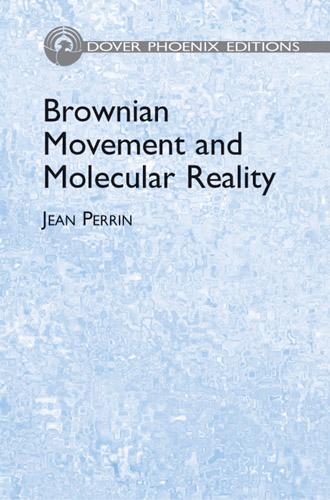
How do we know that molecules really exist? An important clue came from Brownian movement, a concept developed in 1827 by botanist Robert Brown, who noticed that tiny objects like pollen grains shook and moved erratically when viewed under a microscope. Nearly 80 years later, in 1905, Albert Einstein explained this "Brownian motion" as the result of bombardment by molecules. Einstein offered a quantitative explanation by mathematically estimating the average distance covered by the particles over time as a result of molecular bombardment. Four years later, Jean Baptiste Perrin wrote Brownian Movement and Molecular Reality, a work that explains his painstaking measurements of the displacements of particles of a resin suspended in water — experiments that yielded average displacements in excellent accord with Einstein's theoretical prediction.
The studies of Einstein and Perrin provided some of the first concrete evidence for the existence of molecules. Perrin, whose name is familiar to all who employ his methods for calculations in molecular dynamics, received the 1926 Nobel Prize in physics. In this classic paper, he introduced the concept of Avogadro's number, along with other groundbreaking work. Originally published in the French journal Annates de chimie et de physique, it was translated into English by Frederick Soddy to enduring influence and acclaim.
Betaal eenvoudig met kaart, Klarna, Apple Pay of Google Pay. Niet tevreden? Je hebt altijd 14 dagen bedenktijd. Lees meer in onze voorwaarden. Heb je vragen, mail ons dan via hello@memmo.org.
Memmo maakt studeren makkelijker – waar je ook bent ter wereld. Wij brengen je cursusboeken en slimme studietools samen op één plek: samenvattingen, quizzen, podcasts en flashcards. En Ted, je studievriend die antwoord geeft op alles wat je je afvraagt. Meer dan 50.000 studenten studeren hier al – gebouwd om je sneller te laten leren en minder stress te geven.