
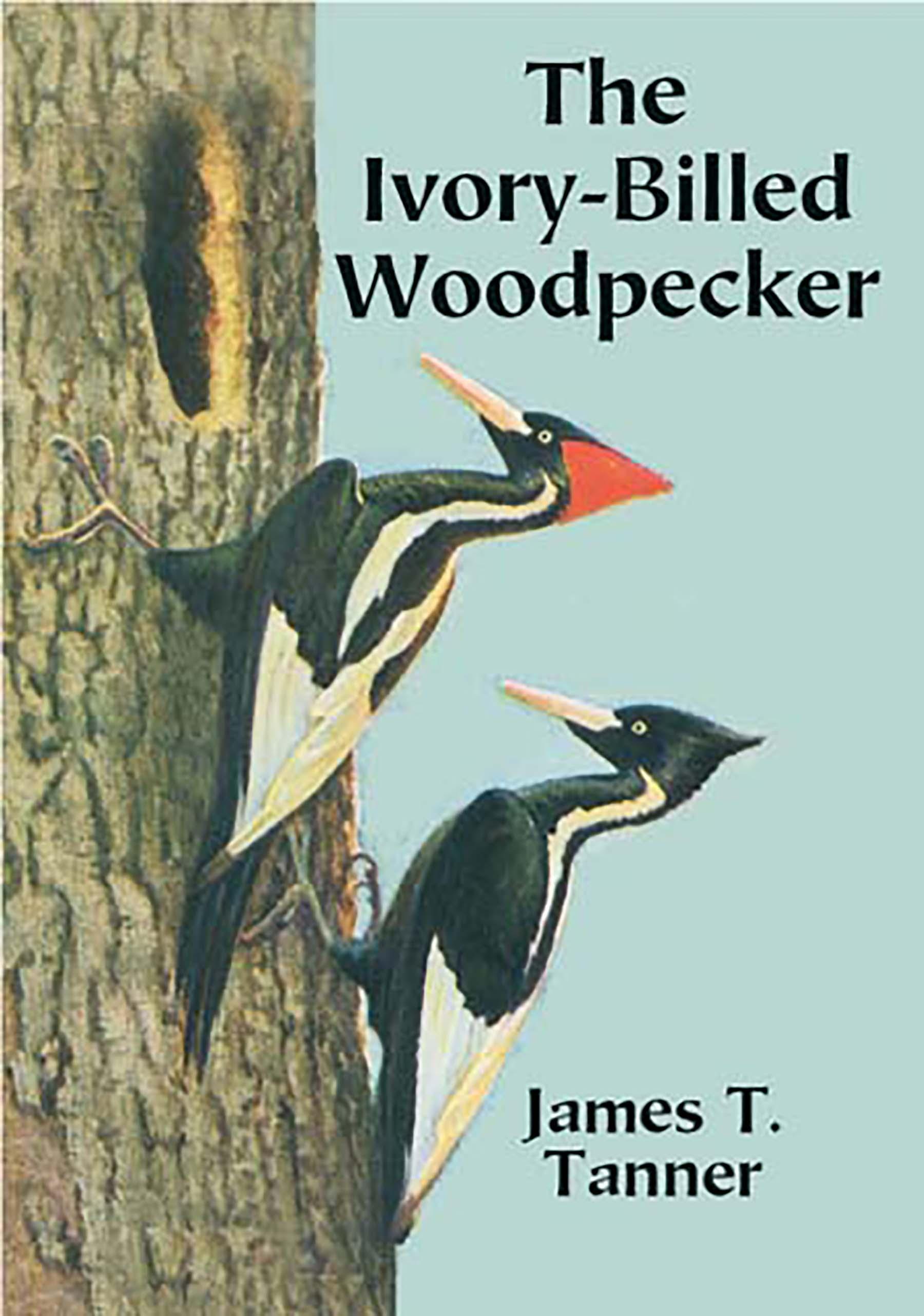
Long thought extinct, the elusive Ivory-billed Woodpecker was finally officially declared so in 2021. But in 1999, the birding community was galvanized at the news of a sighting by a hunter in a Louisiana forest. A series of expeditions continued to search for the rare bird, and all seekers relied on this elegant treatise. Written by James Tanner as his doctoral thesis, it was published by the National Audubon Society in 1942, when a few of the species could still be found in the cypress and bottomland forests of the southern United States.
The book opens with a general description of the Ivory-bill, explaining how to distinguish it from its more commonly encountered cousin, the Pileated Woodpecker. It then plots the species’ original distribution pattern; tells the history of its disappearance and the story of its distribution as of 1940; discusses the population density and range of individual birds; food and feeding habits; daily routine in the non-nesting season; voice; reactions to human presence; roosting; reproductive and nesting habits; care of the young; and causes of nesting failure. In conclusion, the author outlines both a general and a specific program for conserving the species. An appendix covers nomenclature, related species, plumages, anatomy, and measurements, and lists the scientific names of birds, mammals, and reptiles mentioned in the text. A model of patient, exacting field research, this book offers fact-filled and engrossing reading for birders and other nature lovers.
The book opens with a general description of the Ivory-bill, explaining how to distinguish it from its more commonly encountered cousin, the Pileated Woodpecker. It then plots the species’ original distribution pattern; tells the history of its disappearance and the story of its distribution as of 1940; discusses the population density and range of individual birds; food and feeding habits; daily routine in the non-nesting season; voice; reactions to human presence; roosting; reproductive and nesting habits; care of the young; and causes of nesting failure. In conclusion, the author outlines both a general and a specific program for conserving the species. An appendix covers nomenclature, related species, plumages, anatomy, and measurements, and lists the scientific names of birds, mammals, and reptiles mentioned in the text. A model of patient, exacting field research, this book offers fact-filled and engrossing reading for birders and other nature lovers.
Betaal eenvoudig met kaart, Klarna, Apple Pay of Google Pay. Niet tevreden? Je hebt altijd 14 dagen bedenktijd. Lees meer in onze voorwaarden. Heb je vragen, mail ons dan via hello@memmo.org.
Memmo maakt studeren makkelijker – waar je ook bent ter wereld. Wij brengen je cursusboeken en slimme studietools samen op één plek: samenvattingen, quizzen, podcasts en flashcards. En Ted, je studievriend die antwoord geeft op alles wat je je afvraagt. Meer dan 50.000 studenten studeren hier al – gebouwd om je sneller te laten leren en minder stress te geven.
Misschien vind je dit ook leuk
Koop het boek0