
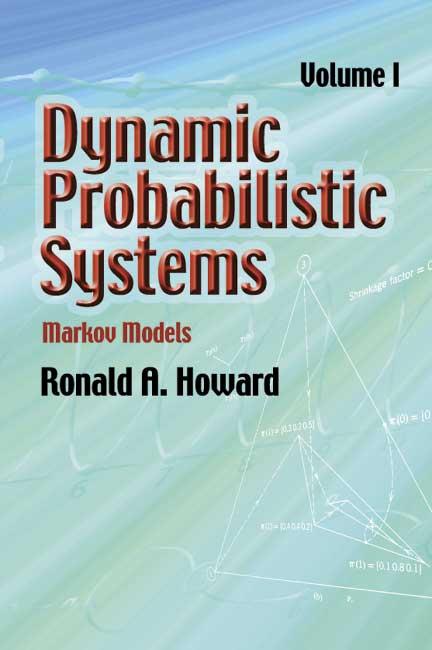
This book is an integrated work published in two volumes. The first volume treats the basic Markov process and its variants; the second, semi-Markov and decision processes. Its intent is to equip readers to formulate, analyze, and evaluate simple and advanced Markov models of systems, ranging from genetics and space engineering to marketing. More than a collection of techniques, it constitutes a guide to the consistent application of the fundamental principles of probability and linear system theory.
Author Ronald A. Howard, Professor of Management Science and Engineering at Stanford University, begins with the basic Markov model, proceeding to systems analyses of linear processes and Markov processes, transient Markov processes and Markov process statistics, and statistics and inference. Subsequent chapters explore recurrent events and random walks, Markovian population models, and time-varying Markov processes. Volume I concludes with a pair of helpful indexes.
Author Ronald A. Howard, Professor of Management Science and Engineering at Stanford University, begins with the basic Markov model, proceeding to systems analyses of linear processes and Markov processes, transient Markov processes and Markov process statistics, and statistics and inference. Subsequent chapters explore recurrent events and random walks, Markovian population models, and time-varying Markov processes. Volume I concludes with a pair of helpful indexes.
Betaal eenvoudig met kaart, Klarna, Apple Pay of Google Pay. Niet tevreden? Je hebt altijd 14 dagen bedenktijd. Lees meer in onze voorwaarden. Heb je vragen, mail ons dan via hello@memmo.org.
Memmo maakt studeren makkelijker – waar je ook bent ter wereld. Wij brengen je cursusboeken en slimme studietools samen op één plek: samenvattingen, quizzen, podcasts en flashcards. En Ted, je studievriend die antwoord geeft op alles wat je je afvraagt. Meer dan 50.000 studenten studeren hier al – gebouwd om je sneller te laten leren en minder stress te geven.
Misschien vind je dit ook leuk
Koop het boek0