
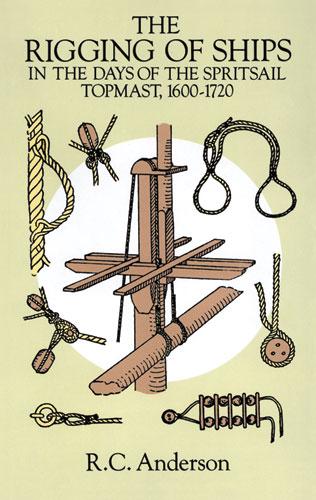
For ship model-makers and students and enthusiasts of historic sailing ships, this generously illustrated book is essential reading and a valuable reference. It describes and depicts in detail how seventeenth-century English, French, Dutch, and other European trading ships and warships were rigged from stem to stern throughout this colorful period in maritime history.
The book begins in 1600, the earliest date of our detailed knowledge of ships’ rigging, and the earliest to which that characteristic seventeenth-century fitting, the spritsail topmast, has been traced. It ends in 1720, roughly the time when the spritsail topmast was superseded by the jib boom and other innovations of eighteenth-century rigging. The book’s 12 chapters cover every aspect of the ship’s rigging of the period, from the lower masts and bowsprit to the running rigging of the topsails and topgallants. Over 350 fine line drawings illustrate every item used in the rigging. Twenty-five halftones, extensively annotated, illustrate typical ships that plied the seas in the days of the bowsprit mast — English merchantmen and gun ships, French and Dutch men-of-war, and more.
In compiling this volume, R. C. Anderson consulted not only the literature of the period, listed in the extensive bibliography, but also famous ship models created throughout the seventeenth century — some with contemporary rigging in almost perfect condition. The result is an indispensable resource for model builders, maritime historians, sailing ship buffs — anyone interested in authentic documentation of ships’ rigging during a crucial period in the history of sailing vessels.
The book begins in 1600, the earliest date of our detailed knowledge of ships’ rigging, and the earliest to which that characteristic seventeenth-century fitting, the spritsail topmast, has been traced. It ends in 1720, roughly the time when the spritsail topmast was superseded by the jib boom and other innovations of eighteenth-century rigging. The book’s 12 chapters cover every aspect of the ship’s rigging of the period, from the lower masts and bowsprit to the running rigging of the topsails and topgallants. Over 350 fine line drawings illustrate every item used in the rigging. Twenty-five halftones, extensively annotated, illustrate typical ships that plied the seas in the days of the bowsprit mast — English merchantmen and gun ships, French and Dutch men-of-war, and more.
In compiling this volume, R. C. Anderson consulted not only the literature of the period, listed in the extensive bibliography, but also famous ship models created throughout the seventeenth century — some with contemporary rigging in almost perfect condition. The result is an indispensable resource for model builders, maritime historians, sailing ship buffs — anyone interested in authentic documentation of ships’ rigging during a crucial period in the history of sailing vessels.
Betaal eenvoudig met kaart, Klarna, Apple Pay of Google Pay. Niet tevreden? Je hebt altijd 14 dagen bedenktijd. Lees meer in onze voorwaarden. Heb je vragen, mail ons dan via hello@memmo.org.
Memmo maakt studeren makkelijker – waar je ook bent ter wereld. Wij brengen je cursusboeken en slimme studietools samen op één plek: samenvattingen, quizzen, podcasts en flashcards. En Ted, je studievriend die antwoord geeft op alles wat je je afvraagt. Meer dan 50.000 studenten studeren hier al – gebouwd om je sneller te laten leren en minder stress te geven.
Misschien vind je dit ook leuk
Koop het boek0