
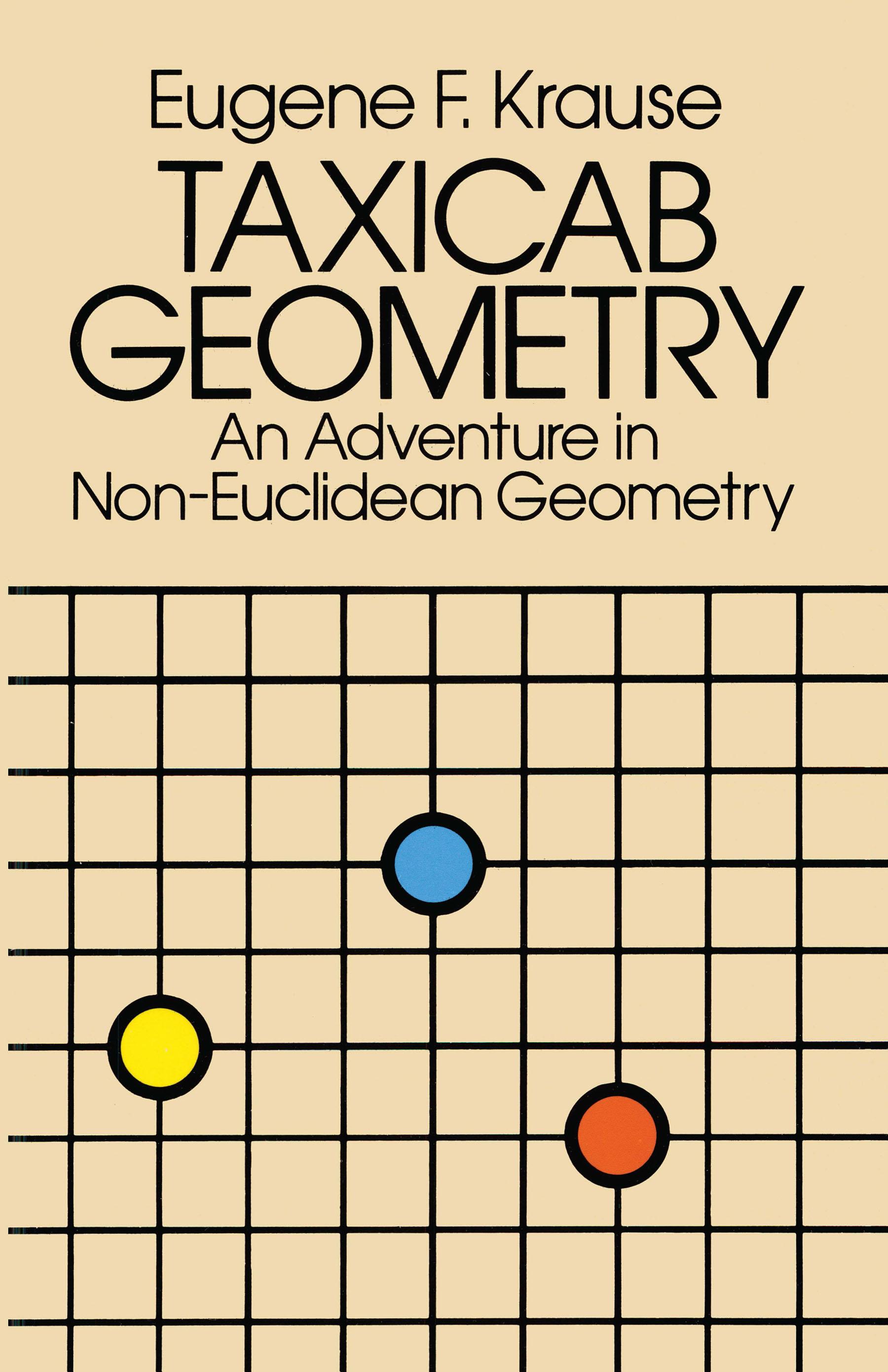
This entertaining, stimulating textbook offers anyone familiar with Euclidean geometry — undergraduate math students, advanced high school students, and puzzle fans of any age — an opportunity to explore taxicab geometry, a simple, non-Euclidean system that helps put Euclidean geometry in sharper perspective.
In taxicab geometry, the shortest distance between two points is not a straight line. Distance is not measured as the crow flies, but as a taxicab travels the "grid" of the city street, from block to block, vertically and horizontally, until the destination is reached. Because of this non-Euclidean method of measuring distance, some familiar geometric figures are transmitted: for example, circles become squares.
However, taxicab geometry has important practical applications. As Professor Krause points out, "While Euclidean geometry appears to be a good model of the 'natural' world, taxicab geometry is a better model of the artificial urban world that man has built."
As a result, the book is replete with practical applications of this non-Euclidean system to urban geometry and urban planning — from deciding the optimum location for a factory or a phone booth, to determining the most efficient routes for a mass transit system.
The underlying emphasis throughout this unique, challenging textbook is on how mathematicians think, and how they apply an apparently theoretical system to the solution of real-world problems.
Betaal eenvoudig met kaart, Klarna, Apple Pay of Google Pay. Niet tevreden? Je hebt altijd 14 dagen bedenktijd. Lees meer in onze voorwaarden. Heb je vragen, mail ons dan via hello@memmo.org.
Memmo maakt studeren makkelijker – waar je ook bent ter wereld. Wij brengen je cursusboeken en slimme studietools samen op één plek: samenvattingen, quizzen, podcasts en flashcards. En Ted, je studievriend die antwoord geeft op alles wat je je afvraagt. Meer dan 50.000 studenten studeren hier al – gebouwd om je sneller te laten leren en minder stress te geven.