
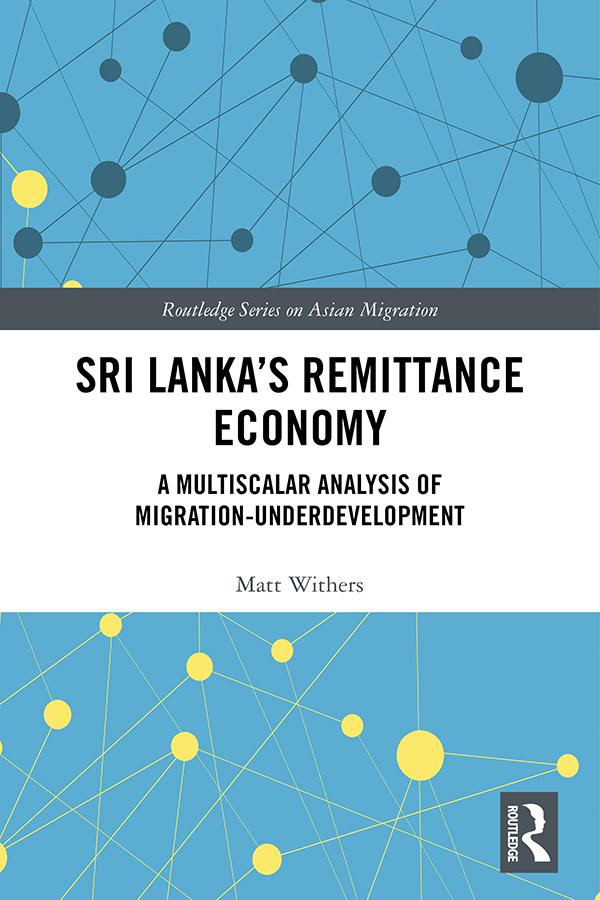
Employing a multiscalar approach to migration outcomes, spanning individual households, local communities, the macroeconomy and global patterns of capital accumulation, this book demonstrates how cumulatively causal processes at structural, institutional and agency levels have forged a precariously remittance-dependent economy in Sri Lanka.
This book combines historical-structural analysis with qualitative research to contend that remittance inflows have reinforced patterns of uneven development in Sri Lanka. At the heart of this argument is a bold critique of remittance capital that inverts the migration–development nexus which has come to dominate international policymaking, with implications for Sri Lanka and other ‘remittance economies’ throughout the Global South. The author contends that temporary labour migration from Sri Lanka is a process of ‘migration-underdevelopment’, in which remittance inflows – ubiquitously considered a key source of capital for developing economies – are reinforcing of uneven development at multiple scales and produce unsustainable development outcomes.
Offering a uniquely systematic critique of remittances as a source of developmental capital for countries of origin, such as Sri Lanka, this book will be of interest to academics in the field of development studies, migration studies and Asian studies.
Betaal eenvoudig met kaart, Klarna, Apple Pay of Google Pay. Niet tevreden? Je hebt altijd 14 dagen bedenktijd. Lees meer in onze voorwaarden. Heb je vragen, mail ons dan via hello@memmo.org.
Memmo maakt studeren makkelijker – waar je ook bent ter wereld. Wij brengen je cursusboeken en slimme studietools samen op één plek: samenvattingen, quizzen, podcasts en flashcards. En Ted, je studievriend die antwoord geeft op alles wat je je afvraagt. Meer dan 50.000 studenten studeren hier al – gebouwd om je sneller te laten leren en minder stress te geven.