
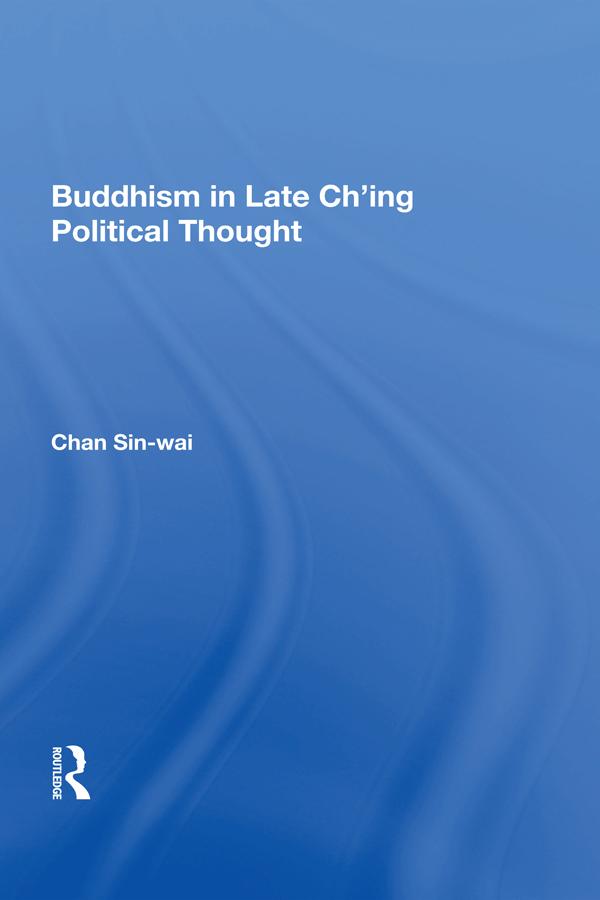
This book is a revised version of the doctoral thesis I presented to the School of Oriental and African Studies, University of London, in 1977. It is basically an attempt to study the religious, cultural and political significance of Buddhism in late Ch'ing intellectual thought through an examination of the writings of a few influential figures like liang Ch'i-ch'ao, K'ang Yu-wei, Chang Ping-lin, and particularly T'an Ssu-t'ung. My findings reveal that Buddhism came to play a part in these reformers' thought as a result of several factors: the rekindled interest in Buddhism brought about through the efforts of laymen such as Yang Wen-hui, the need to find a counter-balance to Christianity, the search for a new unifying ideology for China as Confucianism crumbled before the challenge from the West, and the immense potentiality of Buddhism to cater for the intellectuals' diverse cultural and political purposes. The masterpiece of T'an Ssu-t'ung, entitled An Exposition of Benevolence (Jen-hsiieh), is chosen here to exemplify the use of Buddhism in late Ch'ing political thought. Buddhism not only served as the all-embracing school of his eclectic synthesis, it also formed the foundation of the major concepts in the treatise, and was closely related to his radical thinking.
Pagina's: 204
Categorie: Historia
e-ISBN: 9780429717987
Verzendgewicht: 1.2 kg
Verzending binnen: 1-2 dagen
Betaal eenvoudig met kaart, Klarna, Apple Pay of Google Pay. Niet tevreden? Je hebt altijd 14 dagen bedenktijd. Lees meer in onze voorwaarden. Heb je vragen, mail ons dan via hello@memmo.org.
Memmo maakt studeren makkelijker – waar je ook bent ter wereld. Wij brengen je cursusboeken en slimme studietools samen op één plek: samenvattingen, quizzen, podcasts en flashcards. En Ted, je studievriend die antwoord geeft op alles wat je je afvraagt. Meer dan 50.000 studenten studeren hier al – gebouwd om je sneller te laten leren en minder stress te geven.
Misschien vind je dit ook leuk
Koop het boek0