
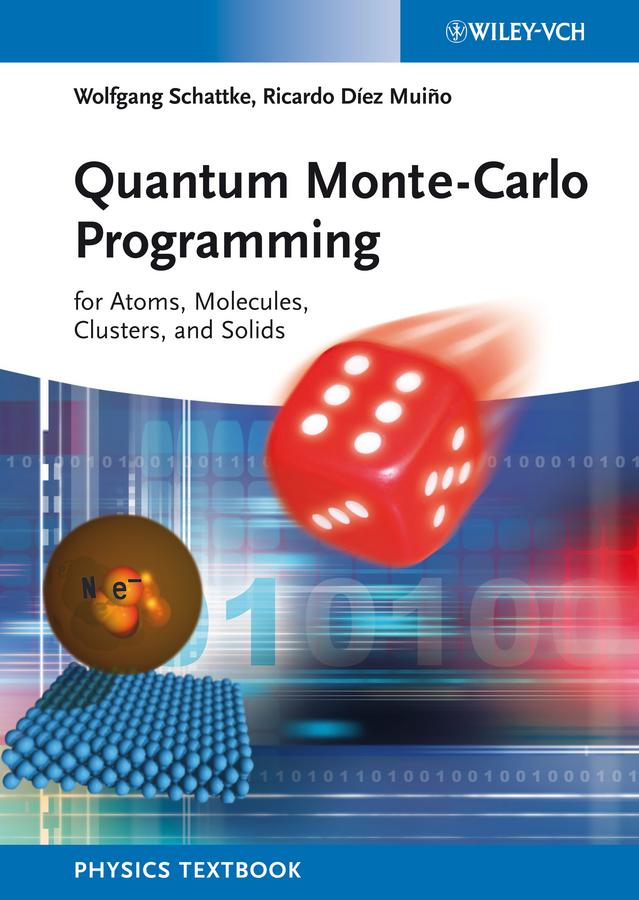
Quantum Monte Carlo is a large class of computer algorithms that simulate quantum systems to solve many body systems in order to investigate the electronic structure of many-body systems. This book presents a numeric approach to determine the electronic structure of atoms, molecules and solids.
Because of the simplicity of its theoretical concept, the authors focus on the variational Quantum-Monte-Carlo (VQMC) scheme. The reader is enabled to proceed from simple examples as the hydrogen atom to advanced ones as the Lithium solid. Several intermediate steps cover the Hydrogen molecule, how to deal with a two electron systems, going over to three electrons, and expanding to an arbitrary number of electrons to finally treat the three-dimensional periodic array of Lithium atoms in a crystal.
The exmples in the field of VQMC are followed by the subject of diffusion Monte-Calro (DMC) which covers a common example, the harmonic ascillator.
The book is unique as it provides both theory and numerical programs. It includes rather practical advices to do what is usually described in a theoretical textbook, and presents in more detail the physical understanding of what the manual of a code usually promises as result. Detailed derivations can be found at the appendix, and the references are chosen with respect to their use for specifying details or getting an deeper understanding .
The authors address an introductory readership in condensed matter physics, computational phyiscs, chemistry and materials science. As the text is intended to open the reader's view towards various possibilities of choices of computing schemes connected with the method of QMC, it might also become a welcome literature for researchers who would like to know more about QMC methods.
The book is accompanied with a collection of programs, routines, and data. To download the codes, please follow http://www.wiley-vch.de/books/sample/3527408517_codes.tar.gz
Because of the simplicity of its theoretical concept, the authors focus on the variational Quantum-Monte-Carlo (VQMC) scheme. The reader is enabled to proceed from simple examples as the hydrogen atom to advanced ones as the Lithium solid. Several intermediate steps cover the Hydrogen molecule, how to deal with a two electron systems, going over to three electrons, and expanding to an arbitrary number of electrons to finally treat the three-dimensional periodic array of Lithium atoms in a crystal.
The exmples in the field of VQMC are followed by the subject of diffusion Monte-Calro (DMC) which covers a common example, the harmonic ascillator.
The book is unique as it provides both theory and numerical programs. It includes rather practical advices to do what is usually described in a theoretical textbook, and presents in more detail the physical understanding of what the manual of a code usually promises as result. Detailed derivations can be found at the appendix, and the references are chosen with respect to their use for specifying details or getting an deeper understanding .
The authors address an introductory readership in condensed matter physics, computational phyiscs, chemistry and materials science. As the text is intended to open the reader's view towards various possibilities of choices of computing schemes connected with the method of QMC, it might also become a welcome literature for researchers who would like to know more about QMC methods.
The book is accompanied with a collection of programs, routines, and data. To download the codes, please follow http://www.wiley-vch.de/books/sample/3527408517_codes.tar.gz
Paga facilmente con carta, Klarna, Apple Pay o Google Pay. Non sei soddisfatto? Hai sempre 14 giorni per il rimborso. Leggi di più nei nostri termini. Per qualsiasi domanda, scrivici a hello@memmo.org.
Memmo rende lo studio più facile, ovunque tu sia nel mondo. Qui trovi i tuoi libri di testo e strumenti di studio intelligenti, tutto in un unico posto: riassunti, quiz, podcast e flashcard. E poi c'è Ted, il tuo compagno di studio che risponde a ogni tua domanda. Oltre 50.000 studenti studiano già qui: è stato creato per aiutarti a imparare più velocemente e a stressarti meno.