
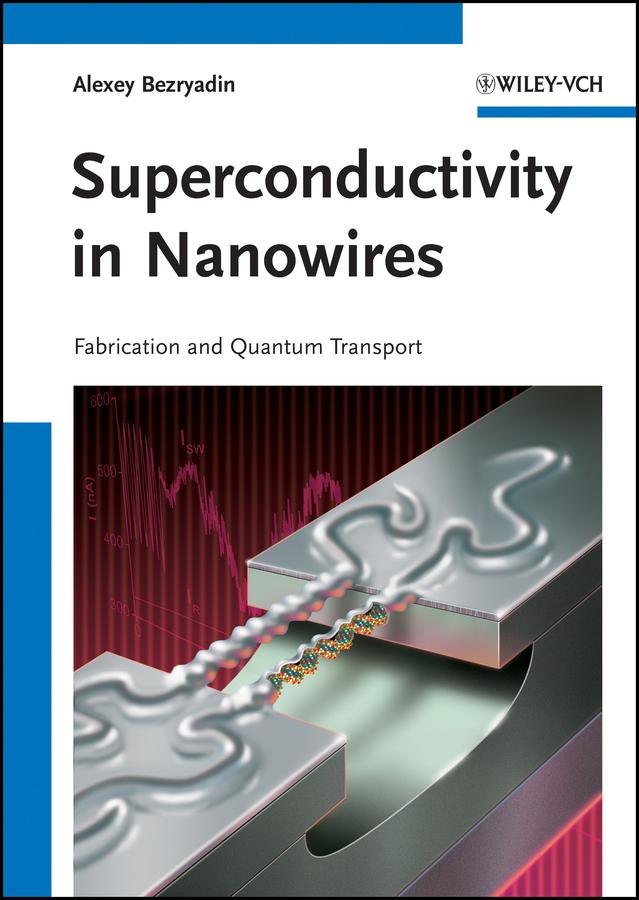
The importance and actuality of nanotechnology is unabated and will be for years to come. A main challenge is to understand the various properties of certain nanostructures, and how to generate structures with specific properties for use in actual applications in Electrical Engineering and Medicine.
One of the most important structures are nanowires, in particular superconducting ones. They are highly promising for future electronics, transporting current without resistance and at scales of a few nanometers. To fabricate wires to certain defined standards however, is a major challenge, and so is the investigation and understanding of these properties in the first place. A promising approach is to use carbon nanotubes as well as DNA structures as templates.
Many fundamental theoretical questions are still unanswered, e.g. related to the role of quantum fluctuations. This work is tackling them and provides a detailed analysis of the transport properties of such ultrathin wires. It presents an account of theoretical models, charge transport experiments, and also conveys the latest experimental findings regarding fabrication, measurements, and theoretical analysis. In particular, it is the only available resource for the approach of using DNA and carbon nanotubes for nanowire fabrication.
It is intended for graduate students and young researchers interested in nanoscale superconductivity. The readers are assumed to have knowledge of the basics of quantum mechanics and superconductivity.
One of the most important structures are nanowires, in particular superconducting ones. They are highly promising for future electronics, transporting current without resistance and at scales of a few nanometers. To fabricate wires to certain defined standards however, is a major challenge, and so is the investigation and understanding of these properties in the first place. A promising approach is to use carbon nanotubes as well as DNA structures as templates.
Many fundamental theoretical questions are still unanswered, e.g. related to the role of quantum fluctuations. This work is tackling them and provides a detailed analysis of the transport properties of such ultrathin wires. It presents an account of theoretical models, charge transport experiments, and also conveys the latest experimental findings regarding fabrication, measurements, and theoretical analysis. In particular, it is the only available resource for the approach of using DNA and carbon nanotubes for nanowire fabrication.
It is intended for graduate students and young researchers interested in nanoscale superconductivity. The readers are assumed to have knowledge of the basics of quantum mechanics and superconductivity.
Paga facilmente con carta, Klarna, Apple Pay o Google Pay. Non sei soddisfatto? Hai sempre 14 giorni per il rimborso. Leggi di più nei nostri termini. Per qualsiasi domanda, scrivici a hello@memmo.org.
Memmo rende lo studio più facile, ovunque tu sia nel mondo. Qui trovi i tuoi libri di testo e strumenti di studio intelligenti, tutto in un unico posto: riassunti, quiz, podcast e flashcard. E poi c'è Ted, il tuo compagno di studio che risponde a ogni tua domanda. Oltre 50.000 studenti studiano già qui: è stato creato per aiutarti a imparare più velocemente e a stressarti meno.