
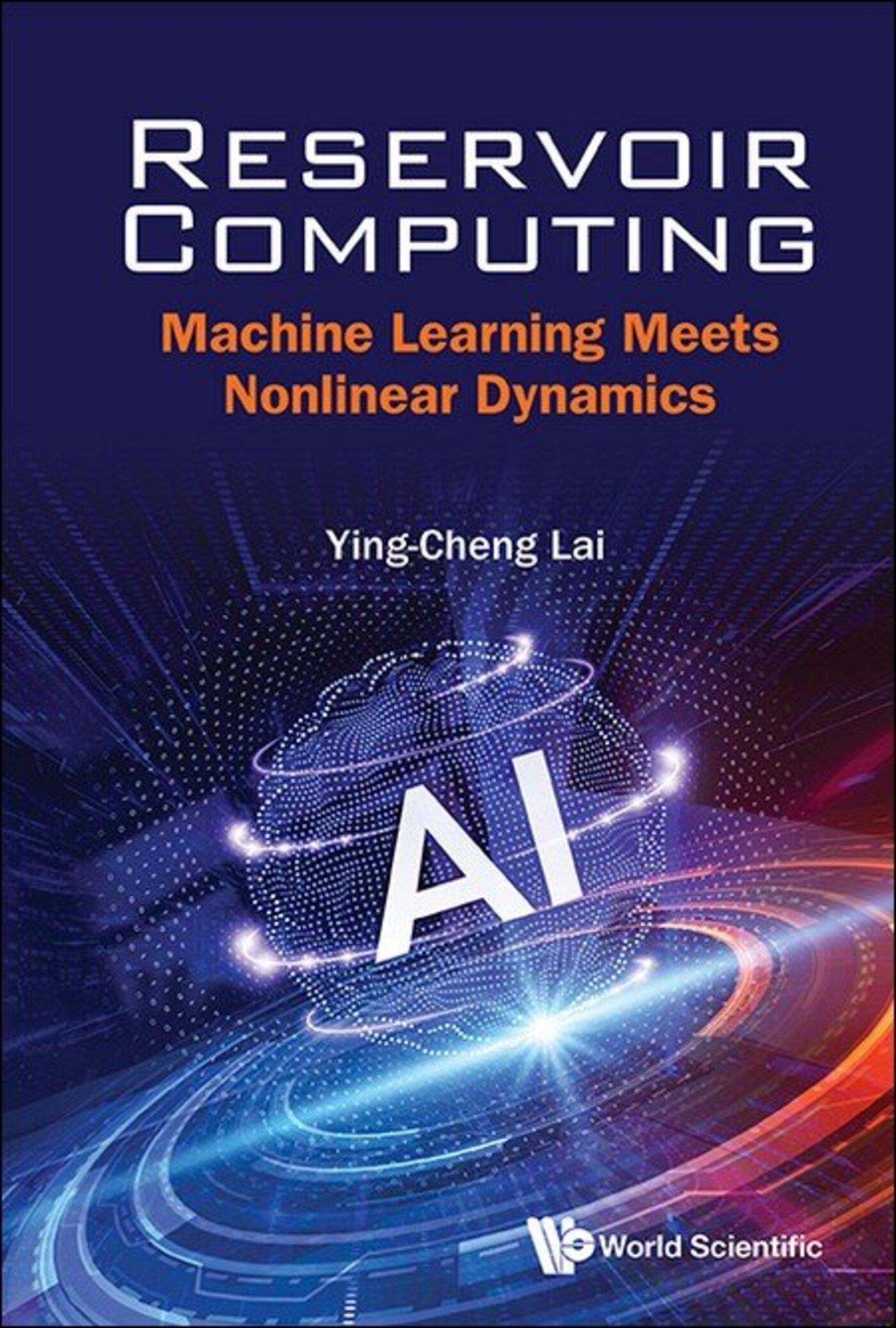
This book presents a comprehensive exploration of reservoir computing as a powerful, data-driven framework for modeling, predicting, and controlling complex nonlinear dynamical systems. Grounded in the foundational principles of chaos theory and neural computation, the text establishes reservoir computing as a computationally efficient method that learns a system's dynamics purely from time-series data, without requiring knowledge of the underlying governing equations. The core of the work demonstrates the framework's remarkable success in forecasting chaotic behavior, moving beyond short-term prediction to achieve the long-term reconstruction of a system's characteristic attractor and the creation of faithful 'digital twins.' Through rigorous analysis and diverse examples, from canonical chaotic systems to complex spatiotemporal dynamics, the book validates reservoir computing as a robust tool for scientific modeling.
Building on this predictive foundation, the text ventures into advanced, high-impact applications, most notably the formidable challenge of forecasting catastrophic 'tipping points' from seemingly stable data, with a compelling case study on the potential collapse of the Atlantic Meridional Overturning Circulation. The book highlights the versatility of the approach through applications in real-time robotic control, dynamic memory storage, parameter tracking in non-stationary systems, and robust weak-signal extraction in extreme noise. Furthermore, it addresses practical limitations such as data scarcity and noisy environments, while also looking to the future by exploring the frontiers of physical and quantum reservoir computing and surveying other state-of-the-art machine learning models including Transformers, Kolmogorov-Arnold networks, Long Short-Term Memory networks, and reinforcement learning. This positions data-driven methods at the vanguard of modern scientific inference, analysis, and control.
Designed for graduate students and researchers, this interdisciplinary work emphasizes the synergy between data-driven machine-learning models and nonlinear dynamics, showing how reservoir computing offers powerful tools to decode, predict, and control the behavior of complex systems across science and engineering domains.
Contents:
- Preface
- About the Author
- Introduction
- Nonlinear Dynamics and Chaos: A Primer
- Basic Concepts of Machine Learning
- Fundamental Principles of Reservoir Computing
- State and Statistical Prediction of Chaos
- Data Assimilation and Long-Term State Prediction of Chaotic Systems
- Harnessing Noise: Stochastic Resonance in Reservoir Computing
- Adaptable Reservoir Computing
- Predicting Critical Transitions with Adaptable Reservoir Computing
- Anticipating Tipping with Adaptable Reservoir Computing
- Digital Twins of Nonlinear Dynamical Systems
- Reservoir Computing-Based Parameter Tracking
- Reservoir Computing-Based Control of Nonlinear Dynamical Systems
- Reservoir Computing-Based Hopfield Associative Memory
- Unsupervised Learning for Predicting Critical Transitions
- Meta-Learning: Predicting Dynamics and Quantum Scars with Small Datasets
- Reservoir Computing-Based Detection of Weak Physical Signals
- Physical Reservoir Computing
- Quantum Reservoir Computing
- Beyond Reservoir Computing
- References
- Index
Readership: Faculty, researchers, engineers and graduate students in the fields of machine learning and nonlinear dynamics.
Payez facilement par carte, Klarna, Apple Pay ou Google Pay. Pas satisfait ? Vous avez toujours une garantie de remboursement de 14 jours. En savoir plus dans nos conditions. Si vous avez des questions, envoyez-nous un e-mail à hello@memmo.org.
Memmo facilite tes études, où que tu sois dans le monde. On rassemble tes manuels de cours et des outils d'étude intelligents au même endroit : résumés, quiz, podcasts et flashcards. Et il y a Ted, ton compagnon d'étude qui répond à toutes tes questions. Plus de 50 000 étudiants étudient déjà ici – conçu pour t'aider à apprendre plus vite et à moins stresser.