
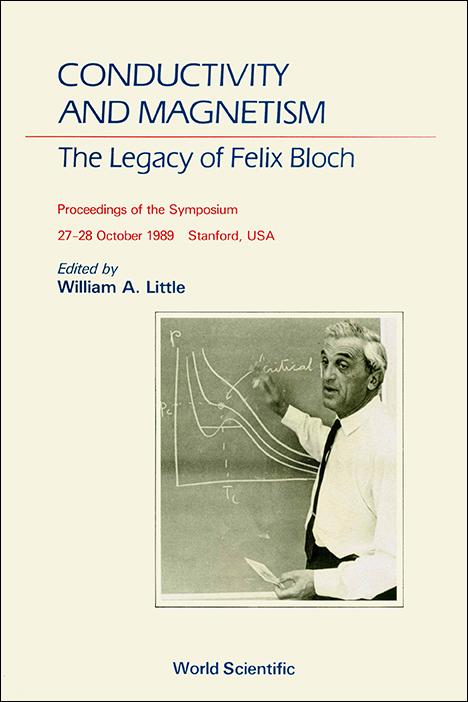
Felix Bloch was one of the foremost scientists of the 20th century. His work on the theory of metals in 1929 laid the cornerstone for the development of semiconductors and his work on magnetism was crucial for the development of a basic understanding of ferromagnetism. Nuclear Magnetic Resonance, which he discovered in 1946, and for which he shared the Nobel Prize with Edward Purcell in 1952, has become the most important spectroscopic tool in Chemistry. The year 1989 marks the sixtieth year since Bloch's paper on the Theory of Metals. This Symposium celebrated the occasion by gathering a group of distinguished scientists who presented overviews of the past, present and future of several major areas of Physics, Chemistry, Engineering, Computer Science, Biology and Medicine, many of which trace their origins to Bloch's influence.
Payez facilement par carte, Klarna, Apple Pay ou Google Pay. Pas satisfait ? Vous avez toujours une garantie de remboursement de 14 jours. En savoir plus dans nos conditions. Si vous avez des questions, envoyez-nous un e-mail à hello@memmo.org.
Memmo facilite tes études, où que tu sois dans le monde. On rassemble tes manuels de cours et des outils d'étude intelligents au même endroit : résumés, quiz, podcasts et flashcards. Et il y a Ted, ton compagnon d'étude qui répond à toutes tes questions. Plus de 50 000 étudiants étudient déjà ici – conçu pour t'aider à apprendre plus vite et à moins stresser.
Tu pourrais aussi aimer
Acheter le livre0