
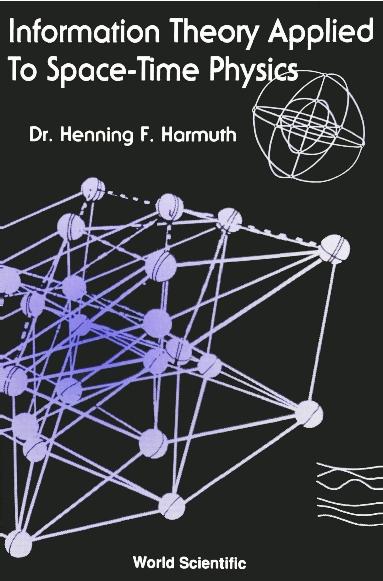
The success of Newton's mechanic, Maxwell's electrodynamic, Einstein's theories of relativity, and quantum mechanics is a strong argument for the space-time continuum. Nevertheless, doubts have been expressed about the use of a continuum in a science squarely based on observation and measurement. An exact science requires that qualitative arguments must be reduced to quantitative statements. The observability of a continuum can be reduced from qualitative arguments to quantitative statements by means of information theory.Information theory was developed during the last decades within electrical communications, but it is almost unknown in physics. The closest approach to information theory in physics is the calculus of propositions, which has been used in books on the frontier of quantum mechanics and the general theory of relativity. Principles of information theory are discussed in this book. The ability to think readily in terms of a finite number of discrete samples is developed over many years of using information theory and digital computers, just as the ability to think readily in terms of a continuum is developed by long use of differential calculus.
Payez facilement par carte, Klarna, Apple Pay ou Google Pay. Pas satisfait ? Vous avez toujours une garantie de remboursement de 14 jours. En savoir plus dans nos conditions. Si vous avez des questions, envoyez-nous un e-mail à hello@memmo.org.
Memmo facilite tes études, où que tu sois dans le monde. On rassemble tes manuels de cours et des outils d'étude intelligents au même endroit : résumés, quiz, podcasts et flashcards. Et il y a Ted, ton compagnon d'étude qui répond à toutes tes questions. Plus de 50 000 étudiants étudient déjà ici – conçu pour t'aider à apprendre plus vite et à moins stresser.
Tu pourrais aussi aimer
Acheter le livre0