
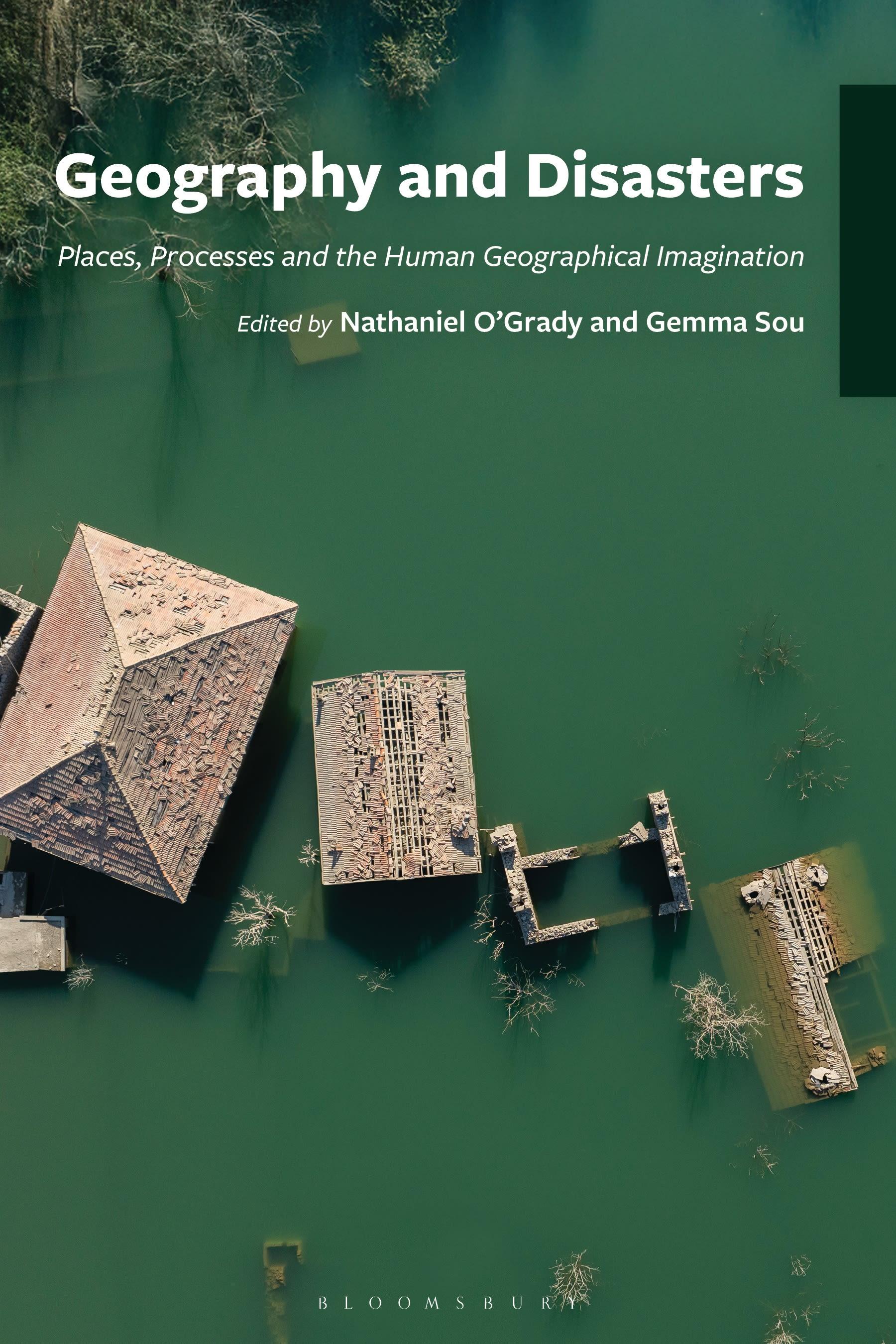
Drawing on global case studies, this is the first book to outline and elaborate on the ways that human geography has extended our understanding of disasters.
Every chapter analyses disasters through the lens of a different theoretical framework common to geography, including assemblage theory, post-colonialism, urban political ecology, governmentality, affect theory and scale. The case studies in the collection range from hurricane risk in the Caribbean and volcano eruptions in Chile to floods in India and many more. Thinking of them as processes rather than individual events, each contributor conceptualizes disasters as always-already entangled in the continual making and remaking of collective life.
Overall, the chapters present a “pluriversal” perspective that mirrors geography's methodological sensitivity to how disasters are shaped by the in-situ conditions in which they unfold. Following such a perspective, the volume both clarifies, and stays attuned to, the multiple, often cross-cutting, spatial and temporal registers upon which disasters are experienced. In doing so, the contributors also expand upon geography's appreciation for how disasters arise from, but also actively contribute to, the material configuration and reconfiguration of space over time. This emphasis allows each chapter to address the complicated ways in which different political issues underpin disasters in different ways. Providing inspiration for future scholars in geography and further afield, the collection is essential reading for those interested in developing more advanced understandings of disasters and how they continue to affect us today.
Every chapter analyses disasters through the lens of a different theoretical framework common to geography, including assemblage theory, post-colonialism, urban political ecology, governmentality, affect theory and scale. The case studies in the collection range from hurricane risk in the Caribbean and volcano eruptions in Chile to floods in India and many more. Thinking of them as processes rather than individual events, each contributor conceptualizes disasters as always-already entangled in the continual making and remaking of collective life.
Overall, the chapters present a “pluriversal” perspective that mirrors geography's methodological sensitivity to how disasters are shaped by the in-situ conditions in which they unfold. Following such a perspective, the volume both clarifies, and stays attuned to, the multiple, often cross-cutting, spatial and temporal registers upon which disasters are experienced. In doing so, the contributors also expand upon geography's appreciation for how disasters arise from, but also actively contribute to, the material configuration and reconfiguration of space over time. This emphasis allows each chapter to address the complicated ways in which different political issues underpin disasters in different ways. Providing inspiration for future scholars in geography and further afield, the collection is essential reading for those interested in developing more advanced understandings of disasters and how they continue to affect us today.
Payez facilement par carte, Klarna, Apple Pay ou Google Pay. Pas satisfait ? Vous avez toujours une garantie de remboursement de 14 jours. En savoir plus dans nos conditions. Si vous avez des questions, envoyez-nous un e-mail à hello@memmo.org.
Memmo facilite tes études, où que tu sois dans le monde. On rassemble tes manuels de cours et des outils d'étude intelligents au même endroit : résumés, quiz, podcasts et flashcards. Et il y a Ted, ton compagnon d'étude qui répond à toutes tes questions. Plus de 50 000 étudiants étudient déjà ici – conçu pour t'aider à apprendre plus vite et à moins stresser.