
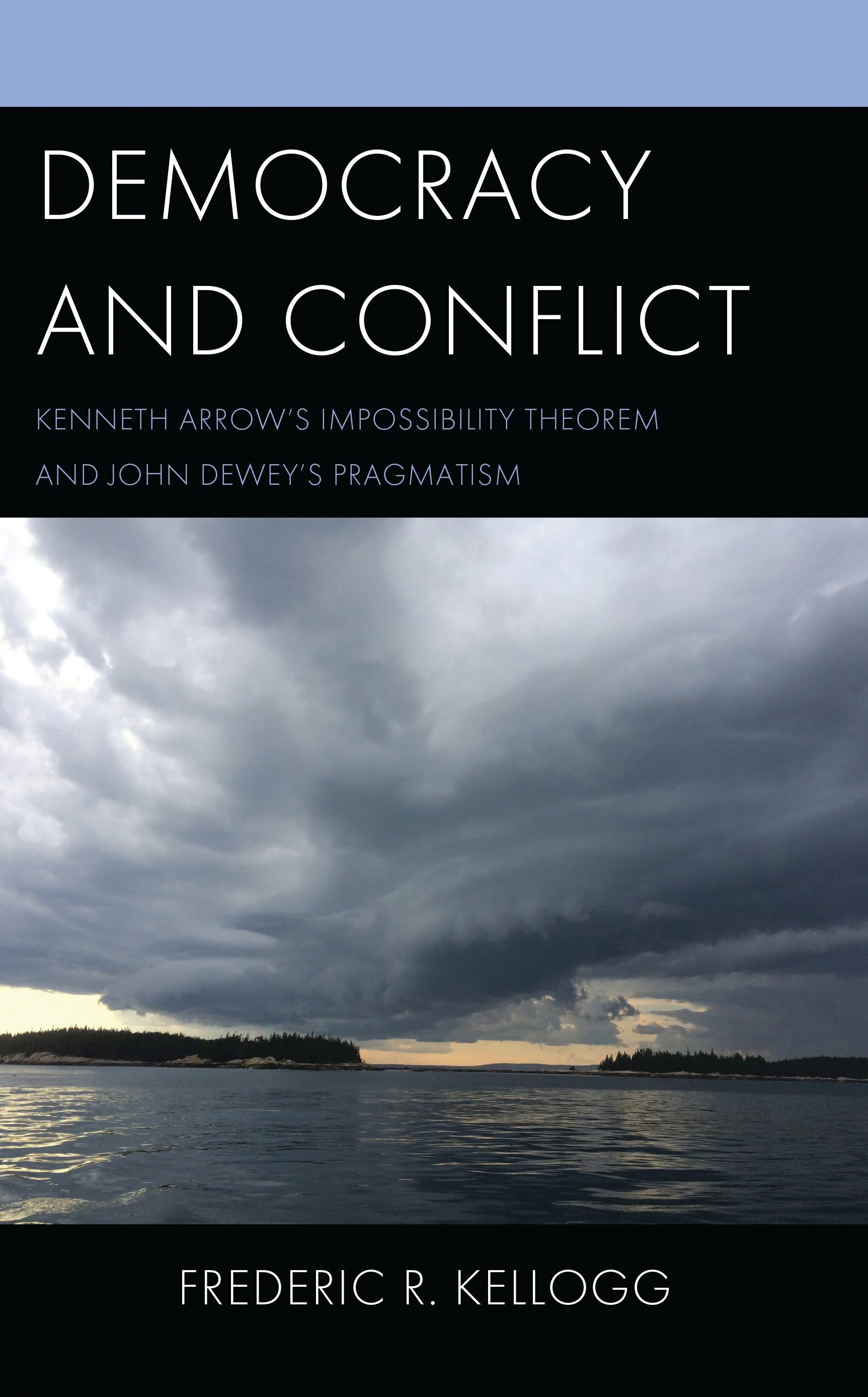
The economist Kenneth Arrow proved in 1951 that a society of diverse individual preferences could only by ordered by dictatorship. His impossibility theorem is still an axiom of contemporary welfare economics and has never been seriously challenged. The American philosopher John Dewey, who died in 1952, had claimed that voting and electoral mechanisms do not define democratic self-government. His broad conception of social conflict addresses preference diversity and resolves Arrow’s impossibility.
Since the 1980s, political scientists have focused on decision through democratic “deliberation.” Dewey saw that conversation alone is inadequate for resolution of conflicts in a democracy. Conflict is accompanied by discourse, but preferences are grounded in habits. Social habits resist adjustment in response to discourse alone, but demonstrably adjust in the process of conflict resolution, Preference conflict is distinguished from Marxist and later models, as a discovery and transformation process. It advances an original, updated theory of social conflict in a democracy relevant to today's problematic situations from discrimination to climate change and political polarization.
Since the 1980s, political scientists have focused on decision through democratic “deliberation.” Dewey saw that conversation alone is inadequate for resolution of conflicts in a democracy. Conflict is accompanied by discourse, but preferences are grounded in habits. Social habits resist adjustment in response to discourse alone, but demonstrably adjust in the process of conflict resolution, Preference conflict is distinguished from Marxist and later models, as a discovery and transformation process. It advances an original, updated theory of social conflict in a democracy relevant to today's problematic situations from discrimination to climate change and political polarization.
Payez facilement par carte, Klarna, Apple Pay ou Google Pay. Pas satisfait ? Vous avez toujours une garantie de remboursement de 14 jours. En savoir plus dans nos conditions. Si vous avez des questions, envoyez-nous un e-mail à hello@memmo.org.
Memmo facilite tes études, où que tu sois dans le monde. On rassemble tes manuels de cours et des outils d'étude intelligents au même endroit : résumés, quiz, podcasts et flashcards. Et il y a Ted, ton compagnon d'étude qui répond à toutes tes questions. Plus de 50 000 étudiants étudient déjà ici – conçu pour t'aider à apprendre plus vite et à moins stresser.