
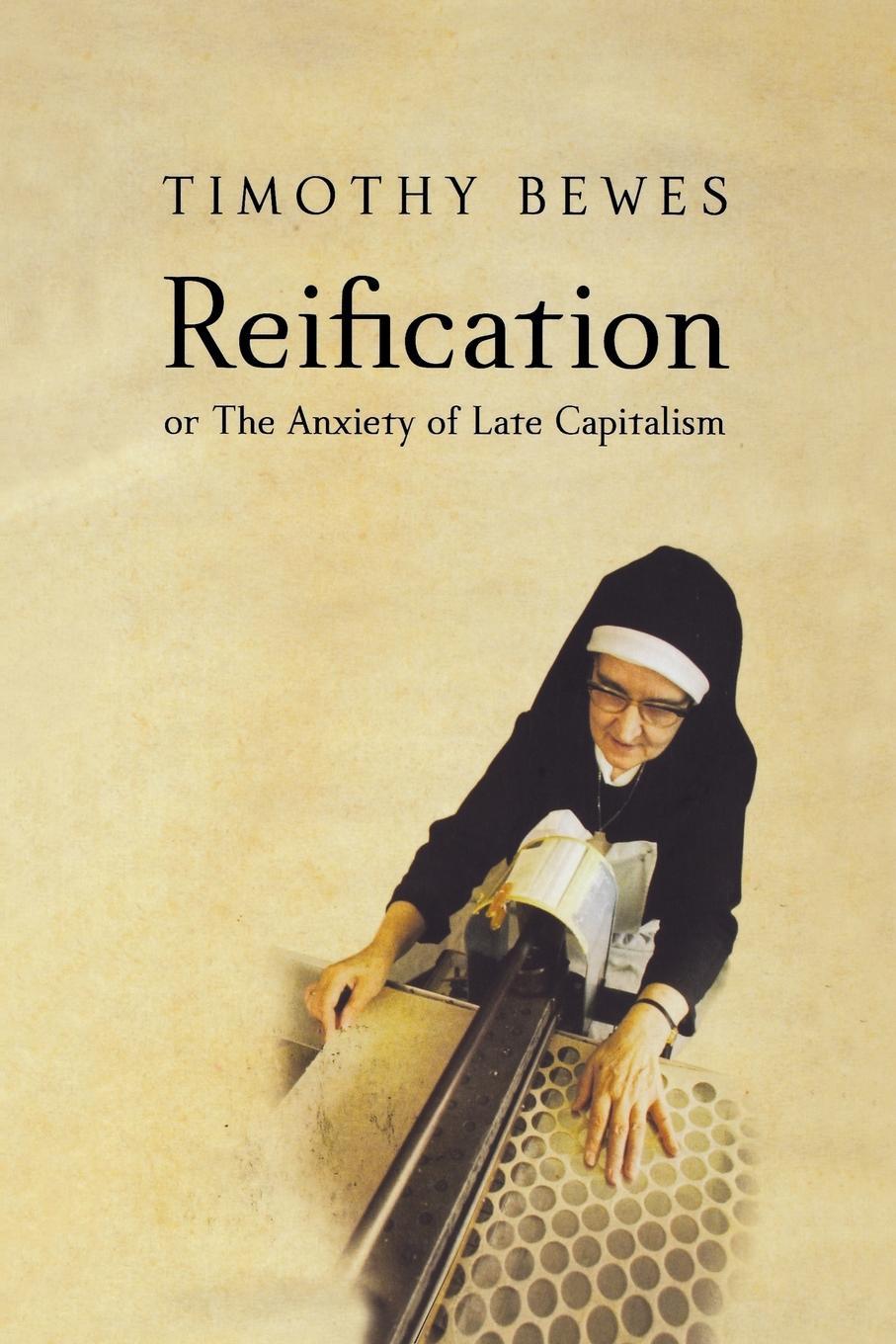
Of all the concepts which have emerged to describe the effects of capitalism on the human world, none is more graphic or easily grasped than "reification"-the process by which men and women are turned into objects, things. Arising out of Marx's account of commodity fetishism, the concept of reification offers an unrivalled tool with which to explain the real consequences of the power of capital on consciousness itself.
Symptoms of reification are proliferating around us-from the branding of goods and services to racial and sexual stereotypes, all forms of religious faith, the growth of nationalism, and recent concepts like "spin" and "globalization." At such a time, the term ought to enjoy greater critical currency than ever. Recent thinkers, however, have expressed deep reservations about the concept, and the term has become marginalized in the humanities and social societies.
Eschewing this trend, Timothy Bewes opens up a new formulation of the concept, claiming that, in the highly reflective age of "late capitalism," reification is best understood as a form of social and cultural anxiety: further, that such an understanding returns the concept to its origins in the work of Georg Luk�cs. Drawing upon writers including Kierkegaard, Herman Melville, Proust and Flannery O'Connor, he outlines a theory of reification which promises to unite politics with truth, art with experience, and philosophy with real life.
Symptoms of reification are proliferating around us-from the branding of goods and services to racial and sexual stereotypes, all forms of religious faith, the growth of nationalism, and recent concepts like "spin" and "globalization." At such a time, the term ought to enjoy greater critical currency than ever. Recent thinkers, however, have expressed deep reservations about the concept, and the term has become marginalized in the humanities and social societies.
Eschewing this trend, Timothy Bewes opens up a new formulation of the concept, claiming that, in the highly reflective age of "late capitalism," reification is best understood as a form of social and cultural anxiety: further, that such an understanding returns the concept to its origins in the work of Georg Luk�cs. Drawing upon writers including Kierkegaard, Herman Melville, Proust and Flannery O'Connor, he outlines a theory of reification which promises to unite politics with truth, art with experience, and philosophy with real life.
Payez facilement par carte, Klarna, Apple Pay ou Google Pay. Pas satisfait ? Vous avez toujours une garantie de remboursement de 14 jours. En savoir plus dans nos conditions. Si vous avez des questions, envoyez-nous un e-mail à hello@memmo.org.
Memmo facilite tes études, où que tu sois dans le monde. On rassemble tes manuels de cours et des outils d'étude intelligents au même endroit : résumés, quiz, podcasts et flashcards. Et il y a Ted, ton compagnon d'étude qui répond à toutes tes questions. Plus de 50 000 étudiants étudient déjà ici – conçu pour t'aider à apprendre plus vite et à moins stresser.
Tu pourrais aussi aimer
Acheter le livre0