
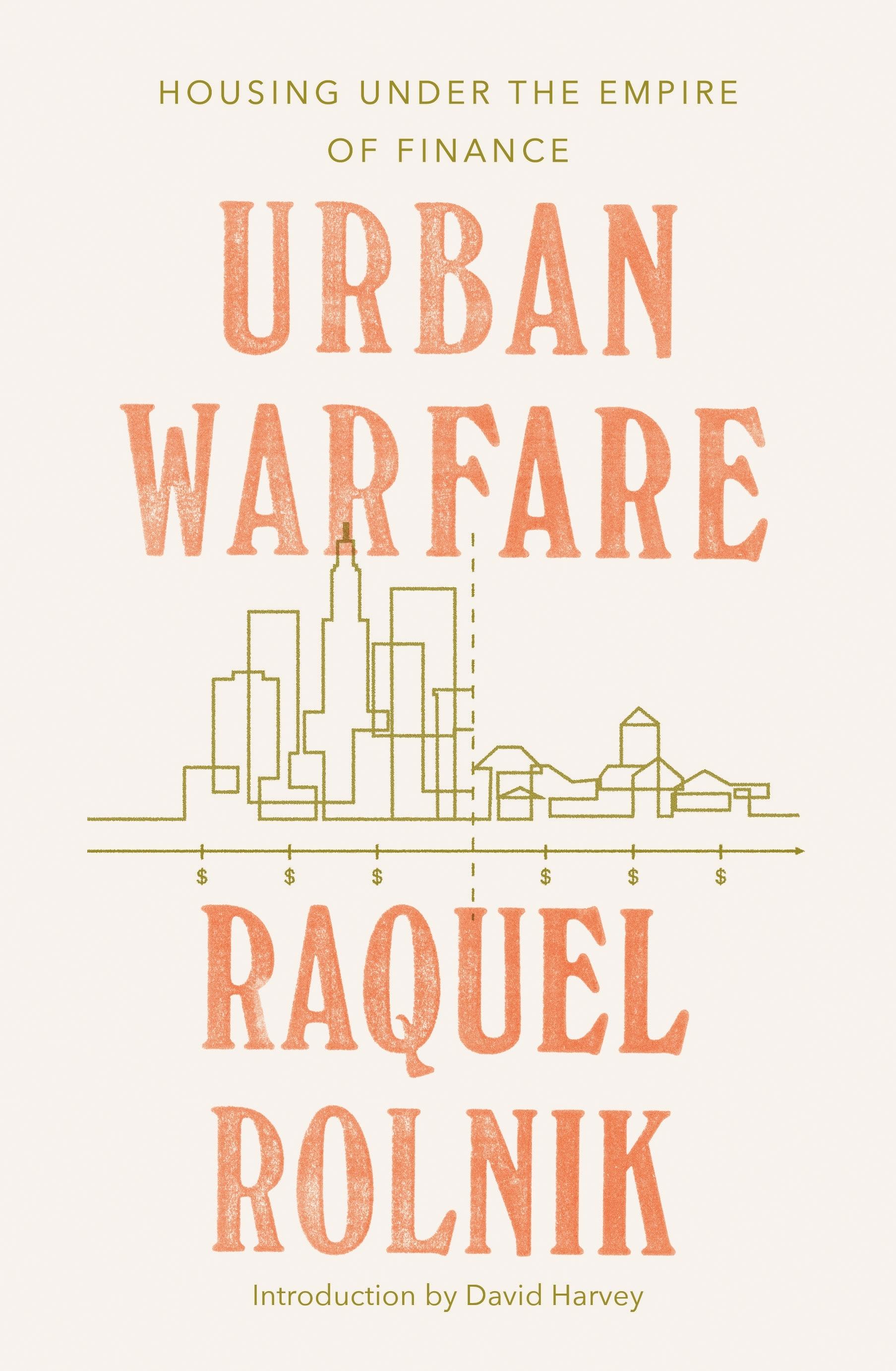
In Urban Warfare, Rolnik charts how the financialisation of housing has become a global crisis, as models of home ownership, originating in the US and UK, are being exported around the world. These developments were largely organised by htosw who benefit the most: construction companies and banks, supported by government-facilitated schemes, such as 'the right to buy', subsidies, and micro-financing.
Using examples ranging from Kazakhstan, Indonesia, Chile, Israel, Haiti, the UK and especially Brazil, Rolnik shows how our homes and neighbourhoods have effectively become the "last subprime frontiers of capitalism". This neoliberal colonialism is experienced on the scale of the city but also within our everyday lives. Yet since the financial crisis and wider urban politics that have left millions homeless, forced from their homes because of urban development politics, and mega-events such as the Rio World Cup in 2013. These narratives are weaved together with theoretical reflections and empirical evidence to explain the crisis in depth. In response, Rolnik restates the political need for activism and resistance. Examining in detail the June Days protests in Rio, 2013-14, she shows that housing remains an essential, and global, struggle.
Using examples ranging from Kazakhstan, Indonesia, Chile, Israel, Haiti, the UK and especially Brazil, Rolnik shows how our homes and neighbourhoods have effectively become the "last subprime frontiers of capitalism". This neoliberal colonialism is experienced on the scale of the city but also within our everyday lives. Yet since the financial crisis and wider urban politics that have left millions homeless, forced from their homes because of urban development politics, and mega-events such as the Rio World Cup in 2013. These narratives are weaved together with theoretical reflections and empirical evidence to explain the crisis in depth. In response, Rolnik restates the political need for activism and resistance. Examining in detail the June Days protests in Rio, 2013-14, she shows that housing remains an essential, and global, struggle.
Payez facilement par carte, Klarna, Apple Pay ou Google Pay. Pas satisfait ? Vous avez toujours une garantie de remboursement de 14 jours. En savoir plus dans nos conditions. Si vous avez des questions, envoyez-nous un e-mail à hello@memmo.org.
Memmo facilite tes études, où que tu sois dans le monde. On rassemble tes manuels de cours et des outils d'étude intelligents au même endroit : résumés, quiz, podcasts et flashcards. Et il y a Ted, ton compagnon d'étude qui répond à toutes tes questions. Plus de 50 000 étudiants étudient déjà ici – conçu pour t'aider à apprendre plus vite et à moins stresser.
Tu pourrais aussi aimer
Acheter le livre0