
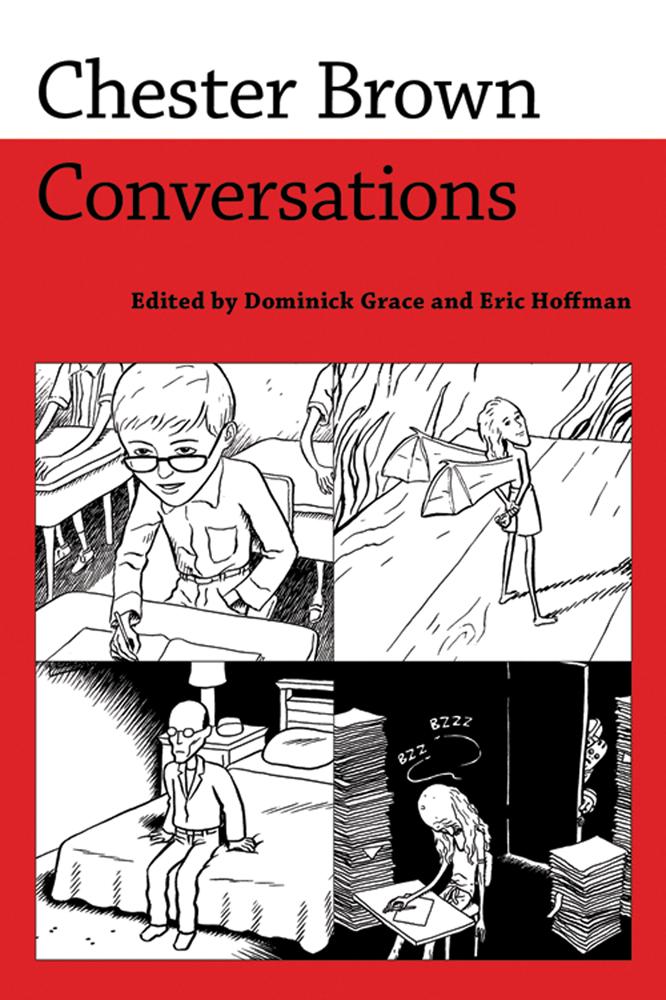
The early 1980s saw a revolution in mainstream comics—in subject matter, artistic integrity, and creators' rights—as new methods of publishing and distribution broadened the possibilities. Among those artists utilizing these new methods, Chester Brown (b. 1960) quickly developed a cult following due to the undeniable quality and originality of his Yummy Fur (1983–1994).
Chester Brown: Conversations collects interviews covering all facets of the cartoonist's long career and includes several pieces from now-defunct periodicals and fanzines. It also includes original annotations from Chester Brown, provided especially for this book, in which he adds context, second thoughts, and other valuable insights into the interviews. Brown was among a new generation of artists whose work dealt with decidedly nonmainstream subjects. By the 1980s comics were, to quote a by-now well-worn phrase, “not just for kids anymore,” and subsequent censorious attacks by parents concerned about the more salacious material being published by the major publishers—subjects that routinely included adult language, realistic violence, drug use, and sexual content—began to roil the industry. Yummy Fur came of age during this storm and its often-offensive content, including dismembered, talking penises, led to controversy and censorship.
With Brown's highly unconventional adaptations of the Gospels, and such comics memoirs as The Playboy(1991/1992) and I Never Liked You (1991–1994), Brown gradually moved away from the surrealistic, humor-oriented strips toward autobiographical material far more restrained and elegiac in tone than his earlier strips. This work was followed by Louis Riel (1999–2003), Brown's critically acclaimed comic book biography of the controversial nineteenth-century Canadian revolutionary, and Paying for It (2011), his best-selling memoir on the life of a john.
Chester Brown: Conversations collects interviews covering all facets of the cartoonist's long career and includes several pieces from now-defunct periodicals and fanzines. It also includes original annotations from Chester Brown, provided especially for this book, in which he adds context, second thoughts, and other valuable insights into the interviews. Brown was among a new generation of artists whose work dealt with decidedly nonmainstream subjects. By the 1980s comics were, to quote a by-now well-worn phrase, “not just for kids anymore,” and subsequent censorious attacks by parents concerned about the more salacious material being published by the major publishers—subjects that routinely included adult language, realistic violence, drug use, and sexual content—began to roil the industry. Yummy Fur came of age during this storm and its often-offensive content, including dismembered, talking penises, led to controversy and censorship.
With Brown's highly unconventional adaptations of the Gospels, and such comics memoirs as The Playboy(1991/1992) and I Never Liked You (1991–1994), Brown gradually moved away from the surrealistic, humor-oriented strips toward autobiographical material far more restrained and elegiac in tone than his earlier strips. This work was followed by Louis Riel (1999–2003), Brown's critically acclaimed comic book biography of the controversial nineteenth-century Canadian revolutionary, and Paying for It (2011), his best-selling memoir on the life of a john.
Payez facilement par carte, Klarna, Apple Pay ou Google Pay. Pas satisfait ? Vous avez toujours une garantie de remboursement de 14 jours. En savoir plus dans nos conditions. Si vous avez des questions, envoyez-nous un e-mail à hello@memmo.org.
Memmo facilite tes études, où que tu sois dans le monde. On rassemble tes manuels de cours et des outils d'étude intelligents au même endroit : résumés, quiz, podcasts et flashcards. Et il y a Ted, ton compagnon d'étude qui répond à toutes tes questions. Plus de 50 000 étudiants étudient déjà ici – conçu pour t'aider à apprendre plus vite et à moins stresser.
Tu pourrais aussi aimer
Acheter le livre0