
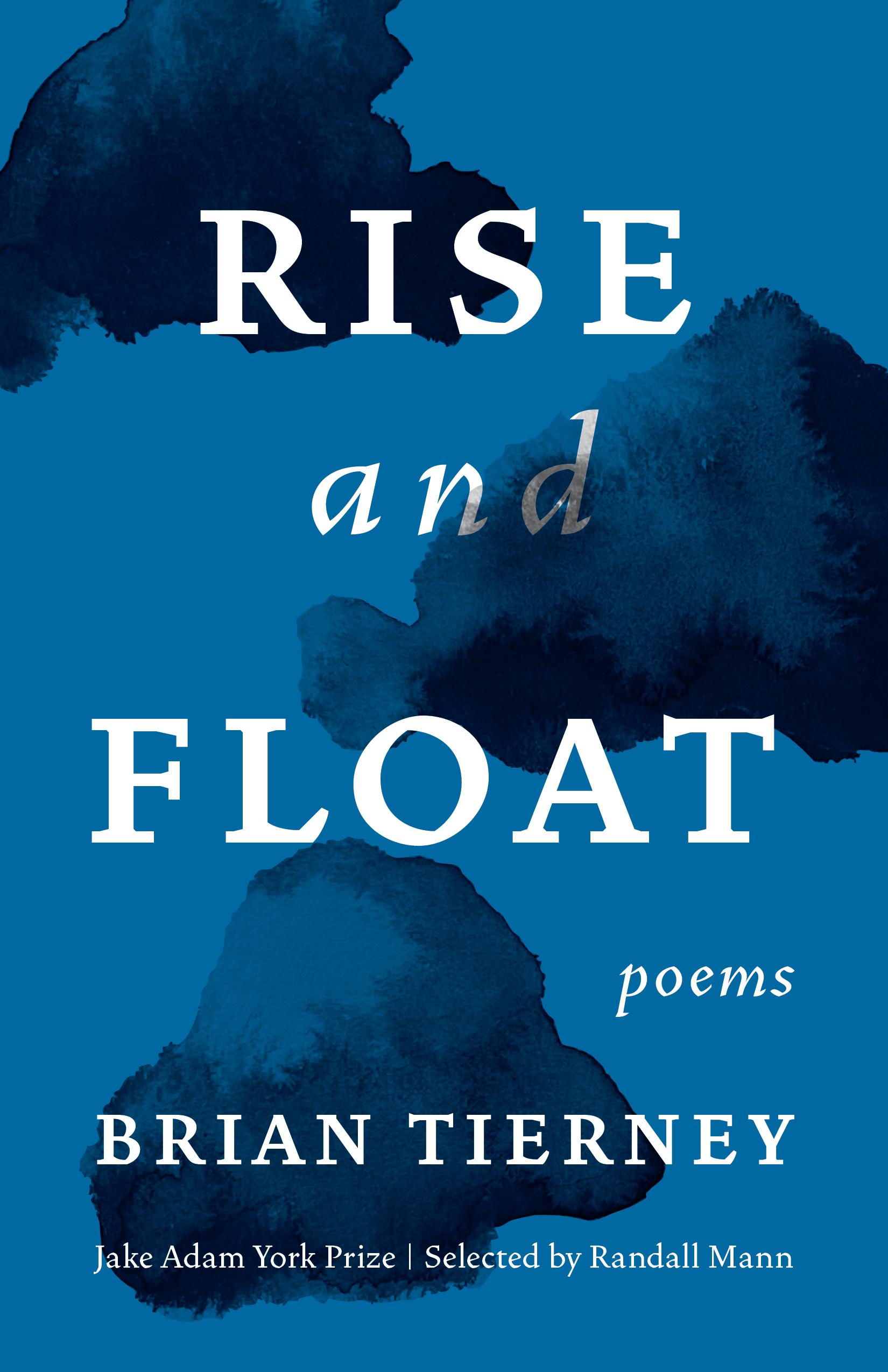
Chosen by Randall Mann as a winner of the Jake Adam York Prize, Brian Tierney’s Rise and Float depicts the journey of a poet working—remarkably, miraculously—to make our most profound, private wounds visible on the page.
With the “corpse of Frost” under his heel, Tierney reckons with a life that resists poetic rendition. The transgenerational impact of mental illness, a struggle with disordered eating, a father’s death from cancer, the loss of loved ones to addiction and suicide—all of these compound to “month after / month” and “dream / after dream” of struck-through lines. Still, Tierney commands poetry’s cathartic potential through searing images: wallpaper peeling like “wrist skin when a grater slips,” a “laugh as good as a scream,” pears as hard as a tumor. These poems commune with their ghosts not to overcome, but to release.
The course of Rise and Float is not straightforward. Where one poem gently confesses to “trying, these days, to believe again / in people,” another concedes that “defeat / sometimes is defeat / without purpose.” Look: the chair is just a chair.” But therein lies the beauty of this collection: in the proximity (and occasional overlap) of these voices, we see something alluringly, openly human. Between a boy “torn open” by dogs and a suicide, “two beautiful teenagers are kissing.” Between screams, something intimate—hope, however difficult it may be.
With the “corpse of Frost” under his heel, Tierney reckons with a life that resists poetic rendition. The transgenerational impact of mental illness, a struggle with disordered eating, a father’s death from cancer, the loss of loved ones to addiction and suicide—all of these compound to “month after / month” and “dream / after dream” of struck-through lines. Still, Tierney commands poetry’s cathartic potential through searing images: wallpaper peeling like “wrist skin when a grater slips,” a “laugh as good as a scream,” pears as hard as a tumor. These poems commune with their ghosts not to overcome, but to release.
The course of Rise and Float is not straightforward. Where one poem gently confesses to “trying, these days, to believe again / in people,” another concedes that “defeat / sometimes is defeat / without purpose.” Look: the chair is just a chair.” But therein lies the beauty of this collection: in the proximity (and occasional overlap) of these voices, we see something alluringly, openly human. Between a boy “torn open” by dogs and a suicide, “two beautiful teenagers are kissing.” Between screams, something intimate—hope, however difficult it may be.
Payez facilement par carte, Klarna, Apple Pay ou Google Pay. Pas satisfait ? Vous avez toujours une garantie de remboursement de 14 jours. En savoir plus dans nos conditions. Si vous avez des questions, envoyez-nous un e-mail à hello@memmo.org.
Memmo facilite tes études, où que tu sois dans le monde. On rassemble tes manuels de cours et des outils d'étude intelligents au même endroit : résumés, quiz, podcasts et flashcards. Et il y a Ted, ton compagnon d'étude qui répond à toutes tes questions. Plus de 50 000 étudiants étudient déjà ici – conçu pour t'aider à apprendre plus vite et à moins stresser.
Tu pourrais aussi aimer
Acheter le livre0