
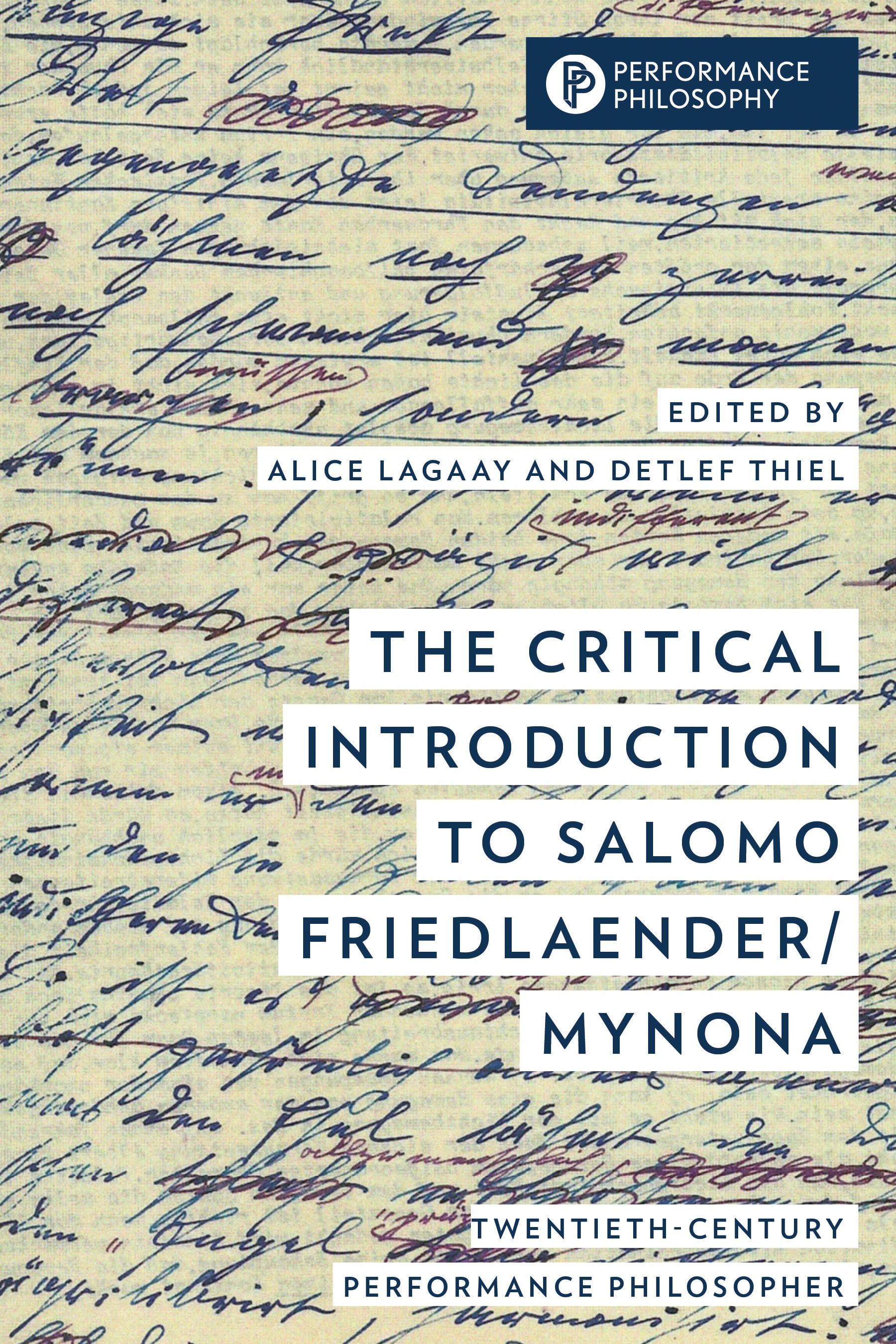
Salomo Friedlaender/Mynona (1871–1946) was a prominent, eccentric and influential figure in late Imperial Germany, Expressionism, Dadaism, and the Weimar Republic. He wrote and published works of philosophy, novels, parodies and satirical so-called grotesque tales, which he wrote under the pseudonym “Mynona”—the German word for anonymous, anonym, spelled backwards. Currently being rediscovered in his native language, F/M and his work are still generally unknown, and none of his philosophical texts have been translated.
The Critical Introduction to Salomo Friedlaender/Mynona: Twentieth-Century Performance Philosopher is the first English book introducing F/M’s philosophical works. The volume includes three introductory framing chapters of historical context, contemporary relevance and pertinence to the performance philosophy of F/M. The book also contains original translations of select passages from his most significant philosophical texts: Schöpferische Indifferenz/Creative Indifference, (first published in 1918), the later Das magische Ich/The Magic I (1935) and his very last essay Ideenmagie/Idea Magic (1945/46), as well as translations of select correspondence with well-known cultural personalities of the time.
Recognised as having inspired Walter Benjamin, F/M was also a forerunner of both performance philosophy and gender theory, and a major influence in the development of Gestalt therapy. Furthermore, not only did F/M belong to the first generation of avid Nietzsche readers, but he was also a lifelong tireless interpreter of Immanuel Kant and Schopenhauer. F/M’s extraordinary voice is of significant interest to Nietzsche and Kant Studies and sheds light on their respective relevance for a performance-oriented approach to philosophy.
The Critical Introduction to Salomo Friedlaender/Mynona: Twentieth-Century Performance Philosopher is the first English book introducing F/M’s philosophical works. The volume includes three introductory framing chapters of historical context, contemporary relevance and pertinence to the performance philosophy of F/M. The book also contains original translations of select passages from his most significant philosophical texts: Schöpferische Indifferenz/Creative Indifference, (first published in 1918), the later Das magische Ich/The Magic I (1935) and his very last essay Ideenmagie/Idea Magic (1945/46), as well as translations of select correspondence with well-known cultural personalities of the time.
Recognised as having inspired Walter Benjamin, F/M was also a forerunner of both performance philosophy and gender theory, and a major influence in the development of Gestalt therapy. Furthermore, not only did F/M belong to the first generation of avid Nietzsche readers, but he was also a lifelong tireless interpreter of Immanuel Kant and Schopenhauer. F/M’s extraordinary voice is of significant interest to Nietzsche and Kant Studies and sheds light on their respective relevance for a performance-oriented approach to philosophy.
Payez facilement par carte, Klarna, Apple Pay ou Google Pay. Pas satisfait ? Vous avez toujours une garantie de remboursement de 14 jours. En savoir plus dans nos conditions. Si vous avez des questions, envoyez-nous un e-mail à hello@memmo.org.
Memmo facilite tes études, où que tu sois dans le monde. On rassemble tes manuels de cours et des outils d'étude intelligents au même endroit : résumés, quiz, podcasts et flashcards. Et il y a Ted, ton compagnon d'étude qui répond à toutes tes questions. Plus de 50 000 étudiants étudient déjà ici – conçu pour t'aider à apprendre plus vite et à moins stresser.