
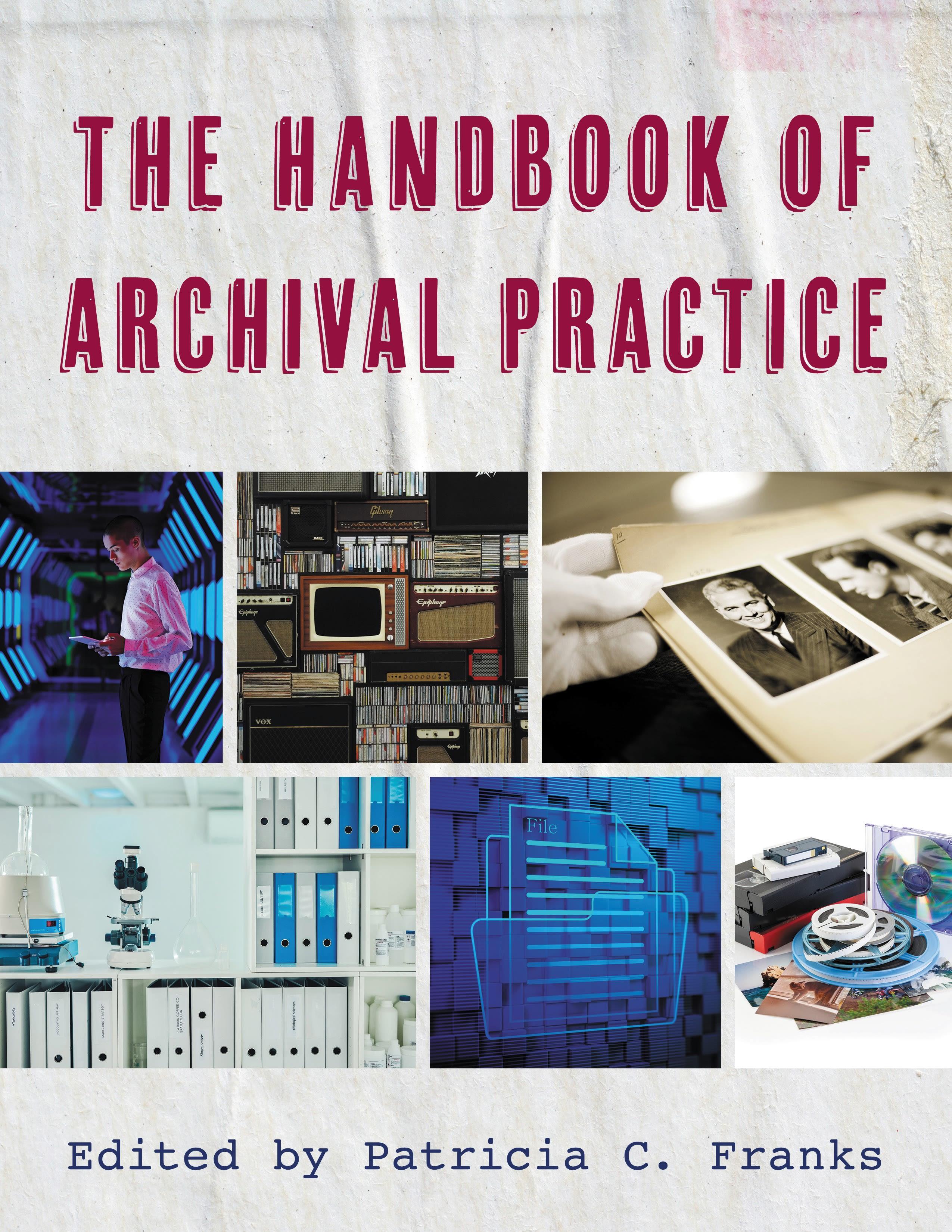
To meet the demands of archivists increasingly tasked with the responsibility for hybrid collections, this indispensable guide covers contemporary archival practice for managing analog and digital materials in a single publication.
Terms describing activities central to the archival process—such as appraisal, acquisition, arrangement, description, storage, access, and preservation—are included. In addition, responsibilities traditionally considered outside the purview of the archivist but currently impacting professional activities—such as cybersecurity, digital forensics, digital curation, distributed systems (e.g., cloud computing), and distributed trust systems (e.g., blockchain)—are also covered.
The Handbook is divided into ten sections: current environment; records creation and recordkeeping systems; appraisal and acquisition; arrangement and description; storage and preservation; digital preservation; user services; community outreach and advocacy; risk management, security and privacy; and management and leadership. Some terms touch on more than one category, which made sorting a challenge. Readers are encouraged to consult both the table of contents and the index, as a topic may be addressed in more than one entry.
A total of 111 entries by 105 authors are defined and described in The Handbook. The majority (79) of the contributors were from the US, 12 from Canada, 7 from the United Kingdom, 3 from Australia, 1 each from Germany, Jamaica, New Zealand, and the Russian Federation. Because archival practice differs among practitioners in different countries, this work represents an amalgamation.
The Handbook was written primarily for archival practitioners who wish to access desired information at the point of need. However, can also serve as a valuable resource for students pursuing careers in the archival profession and information professionals engaged in related fields.
Terms describing activities central to the archival process—such as appraisal, acquisition, arrangement, description, storage, access, and preservation—are included. In addition, responsibilities traditionally considered outside the purview of the archivist but currently impacting professional activities—such as cybersecurity, digital forensics, digital curation, distributed systems (e.g., cloud computing), and distributed trust systems (e.g., blockchain)—are also covered.
The Handbook is divided into ten sections: current environment; records creation and recordkeeping systems; appraisal and acquisition; arrangement and description; storage and preservation; digital preservation; user services; community outreach and advocacy; risk management, security and privacy; and management and leadership. Some terms touch on more than one category, which made sorting a challenge. Readers are encouraged to consult both the table of contents and the index, as a topic may be addressed in more than one entry.
A total of 111 entries by 105 authors are defined and described in The Handbook. The majority (79) of the contributors were from the US, 12 from Canada, 7 from the United Kingdom, 3 from Australia, 1 each from Germany, Jamaica, New Zealand, and the Russian Federation. Because archival practice differs among practitioners in different countries, this work represents an amalgamation.
The Handbook was written primarily for archival practitioners who wish to access desired information at the point of need. However, can also serve as a valuable resource for students pursuing careers in the archival profession and information professionals engaged in related fields.
Pages: 510
Catégorie: Samhällsvetenskap
e-ISBN: 9781538137352
Poids d'expédition: 1.2 kg
Expédié sous: 1-2 jours
Payez facilement par carte, Klarna, Apple Pay ou Google Pay. Pas satisfait ? Vous avez toujours une garantie de remboursement de 14 jours. En savoir plus dans nos conditions. Si vous avez des questions, envoyez-nous un e-mail à hello@memmo.org.
Memmo facilite tes études, où que tu sois dans le monde. On rassemble tes manuels de cours et des outils d'étude intelligents au même endroit : résumés, quiz, podcasts et flashcards. Et il y a Ted, ton compagnon d'étude qui répond à toutes tes questions. Plus de 50 000 étudiants étudient déjà ici – conçu pour t'aider à apprendre plus vite et à moins stresser.