
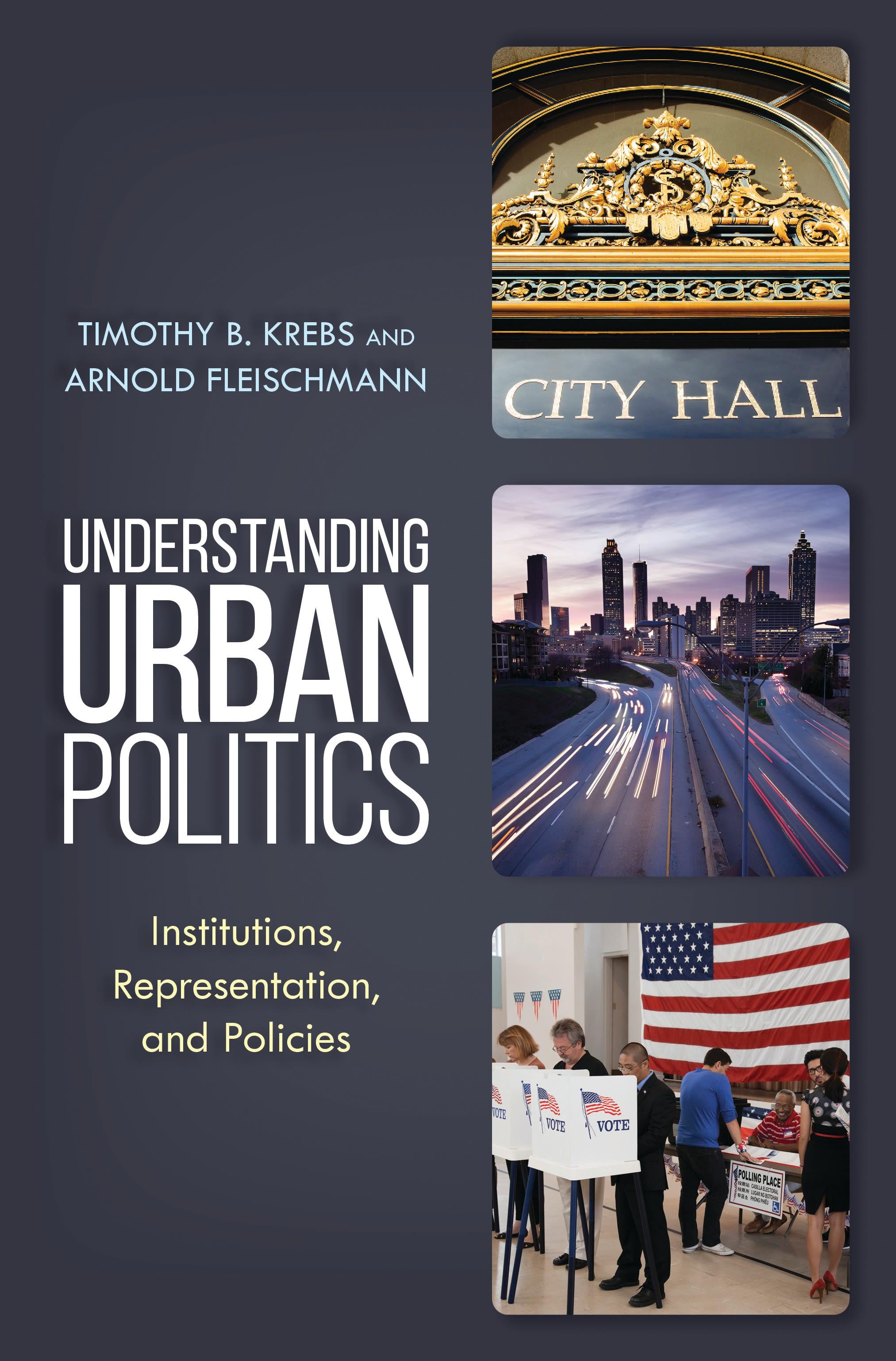
In Understanding Urban Politics: Institutions, Representation, and Policies, Timothy B. Krebs and Arnold Fleischmann introduce a framework that focuses on the role of institutions in establishing the political “rules of the game,” the representativeness of city government, the influence of participation in local democracy, and how each of these features influences the adoption and implementation of public policies. Part 1 lays the groundwork for the rest of the book by exploring the many meanings of “urban,” analyzing what local governments do, and providing a history of American urban development.
Part 2 examines the organizations and procedures that are central to urban politics and policy making: intergovernmental relations, local legislatures, and the local executive branch. Part 3 looks at elections and voting, local campaigns, and non-voting forms of participation. The four chapters in Part 4 focus on the policy process and the delivery of local services, local government finances, “Building the City” (economic development, land use, and housing), and policies affecting the quality of life (public safety, the environment, “morality” issues, and urban amenities).
Krebs and Fleischmann bolster students’ learning and skills with guiding questions at the start of each chapter, which ends with key terms, a summary, discussion questions, and research exercises. The appendix and website aid these efforts, as does a website for instructors.
Part 2 examines the organizations and procedures that are central to urban politics and policy making: intergovernmental relations, local legislatures, and the local executive branch. Part 3 looks at elections and voting, local campaigns, and non-voting forms of participation. The four chapters in Part 4 focus on the policy process and the delivery of local services, local government finances, “Building the City” (economic development, land use, and housing), and policies affecting the quality of life (public safety, the environment, “morality” issues, and urban amenities).
Krebs and Fleischmann bolster students’ learning and skills with guiding questions at the start of each chapter, which ends with key terms, a summary, discussion questions, and research exercises. The appendix and website aid these efforts, as does a website for instructors.
Pages: 368
Catégorie: Statsvetenskap & Politik
e-ISBN: 9781538105238
Poids d'expédition: 1.2 kg
Expédié sous: 1-2 jours
Payez facilement par carte, Klarna, Apple Pay ou Google Pay. Pas satisfait ? Vous avez toujours une garantie de remboursement de 14 jours. En savoir plus dans nos conditions. Si vous avez des questions, envoyez-nous un e-mail à hello@memmo.org.
Memmo facilite tes études, où que tu sois dans le monde. On rassemble tes manuels de cours et des outils d'étude intelligents au même endroit : résumés, quiz, podcasts et flashcards. Et il y a Ted, ton compagnon d'étude qui répond à toutes tes questions. Plus de 50 000 étudiants étudient déjà ici – conçu pour t'aider à apprendre plus vite et à moins stresser.