
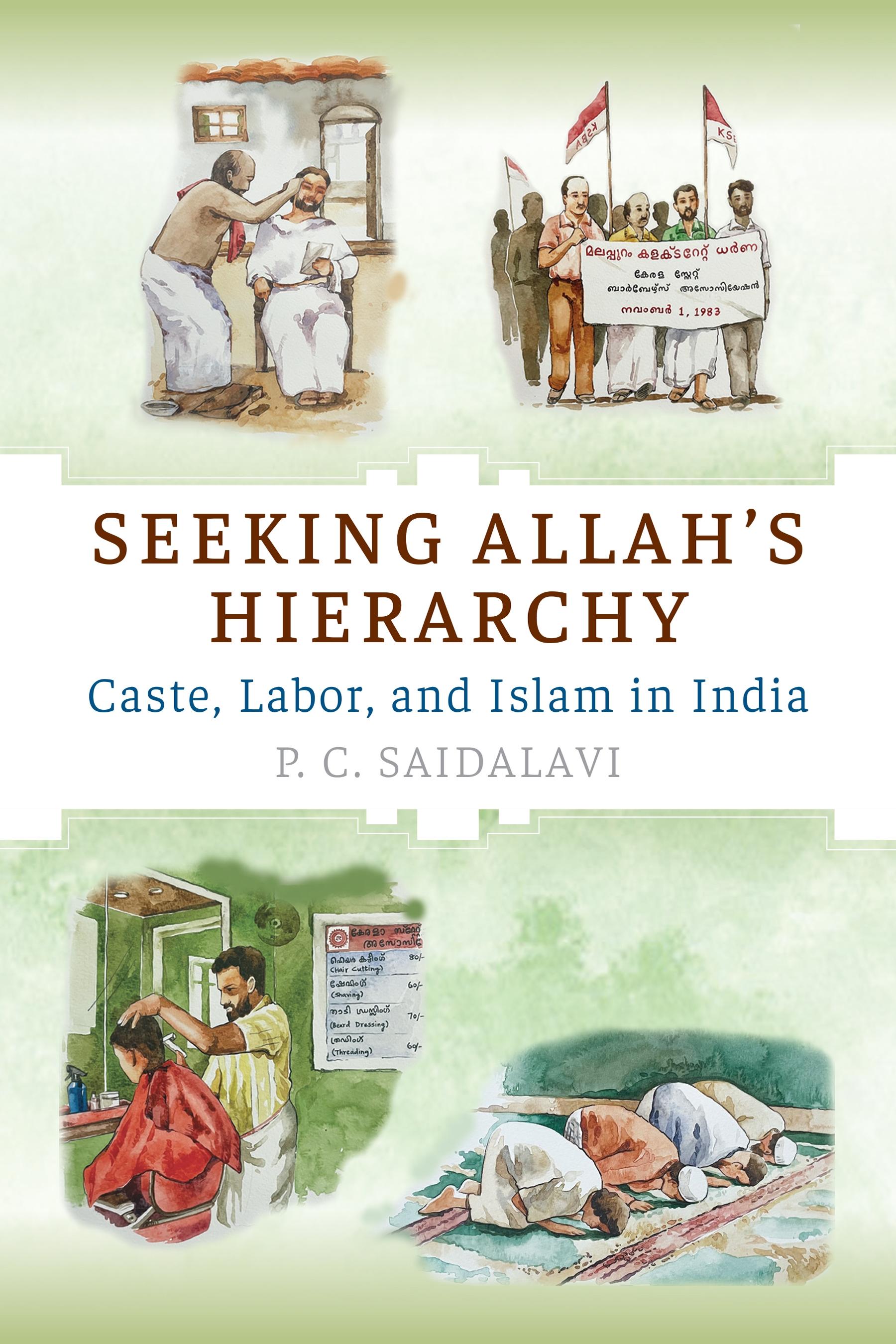
Why Muslims in South India observe hierarchical intra-communal relationships despite the egalitarianism of their religion
In Seeking Allah’s Hierarchy, P. C. Saidalavi provides an ethnographic study of a Muslim barber community in South India, unraveling how these barbers negotiated concepts of hierarchy through Islamic values of piety, genealogy, morality, and wealth. Through this close-drawn study, Saidalavi argues that Muslim hierarchy exists and it works on its own terms. It both draws upon Islamic jurisprudential and moral discourses and is shaped by the larger economic, cultural, and political environment, including that of Hinduism. Yet ultimately, Muslim hierarchy is neither a replica nor a watered-down version of caste in Hinduism.
Seeking Allah’s Hierarchy contends that the Islamization process in South Asia cannot be reduced to conceptual schemas or patterns dictating religious practice. Instead, this process works within a “lived tradition,” in which Muslims attempt to infuse and rationalize their practices using their interpretations of Islamic values, meanings, and purpose. In this case, barbers challenged other Muslims’ perception of them as hierarchically inferior by emphasizing their religious piety. Yet those same Muslims also drew on Islam to provide a rationale for categorizing barbers’ work as morally obligatory but undignified, thus rendering the barbers “lower.”
The barbers’ challenge to this perceptual hierarchical order was inspired by communist political activities in Kerala and commenced when they started unionizing in the 1970s. By establishing shops, instituting uniform pricing, and standardizing working hours, barbers successfully transformed their work relations into labor within the strictures of capitalist market relations. Recounting their story here, Saidalavi complicates the question of “caste” found in the Indian subcontinent by showcasing the specificity of hierarchical practices among Muslims, despite the egalitarianism of their religion.
Payez facilement par carte, Klarna, Apple Pay ou Google Pay. Pas satisfait ? Vous avez toujours une garantie de remboursement de 14 jours. En savoir plus dans nos conditions. Si vous avez des questions, envoyez-nous un e-mail à hello@memmo.org.
Memmo facilite tes études, où que tu sois dans le monde. On rassemble tes manuels de cours et des outils d'étude intelligents au même endroit : résumés, quiz, podcasts et flashcards. Et il y a Ted, ton compagnon d'étude qui répond à toutes tes questions. Plus de 50 000 étudiants étudient déjà ici – conçu pour t'aider à apprendre plus vite et à moins stresser.