
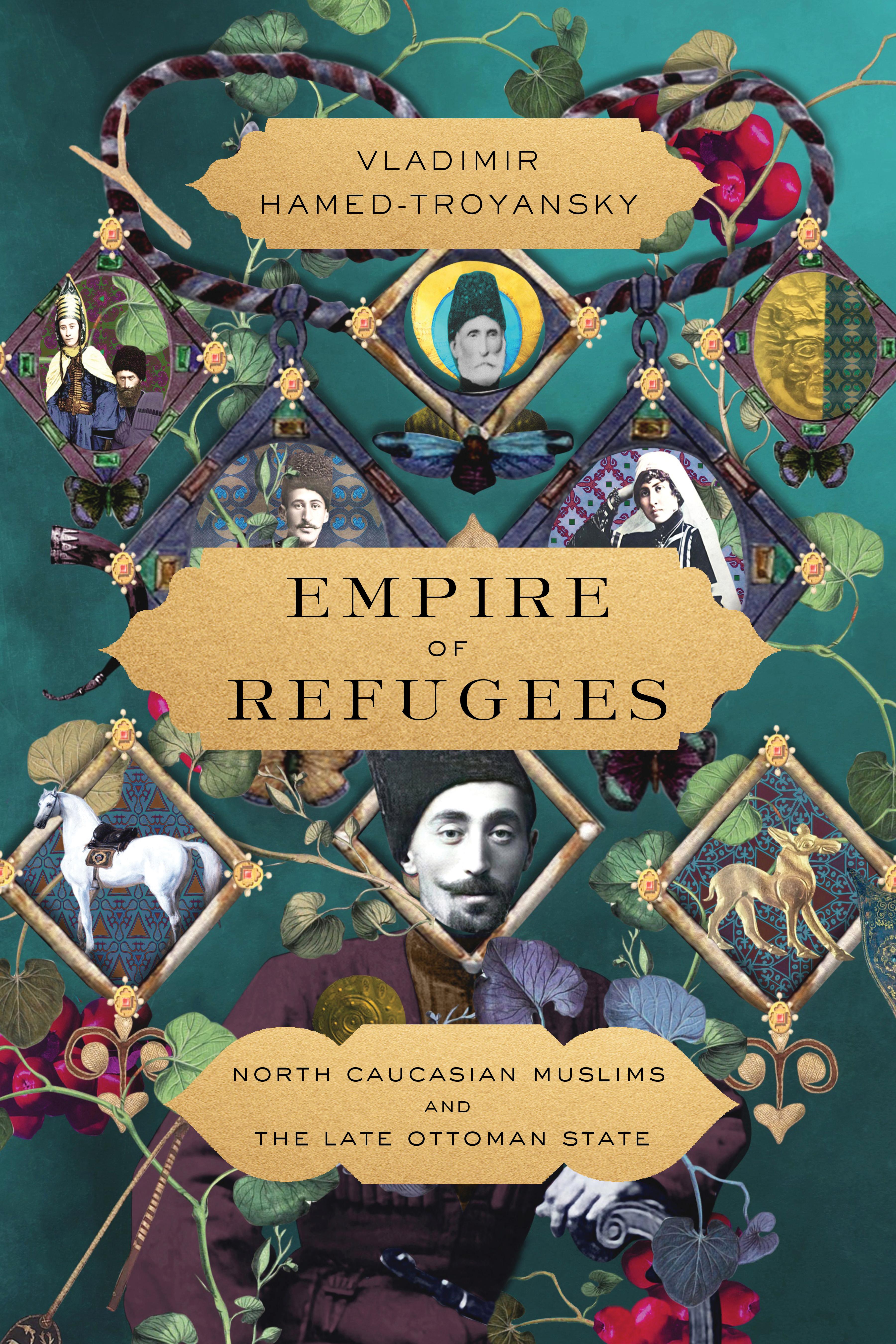
Between the 1850s and World War I, about one million North Caucasian Muslims sought refuge in the Ottoman Empire. This resettlement of Muslim refugees from Russia changed the Ottoman state. Circassians, Chechens, Dagestanis, and others established hundreds of refugee villages throughout the Ottoman Balkans, Anatolia, and the Levant. Most villages still exist today, including what is now the city of Amman. Muslim refugee resettlement reinvigorated regional economies, but also intensified competition over land and, at times, precipitated sectarian tensions, setting in motion fundamental shifts in the borderlands of the Russian and Ottoman empires.
Empire of Refugees reframes late Ottoman history through mass displacement and reveals the origins of refugee resettlement in the modern Middle East. Vladimir Hamed-Troyansky offers a historiographical corrective: the nineteenth-century Ottoman Empire created a refugee regime, predating refugee systems set up by the League of Nations and the United Nations. Grounded in archival research in over twenty public and private archives across ten countries, this book contests the boundaries typically assumed between forced and voluntary migration, and refugees and immigrants, rewriting the history of Muslim migration in the nineteenth and early twentieth centuries.
Payez facilement par carte, Klarna, Apple Pay ou Google Pay. Pas satisfait ? Vous avez toujours une garantie de remboursement de 14 jours. En savoir plus dans nos conditions. Si vous avez des questions, envoyez-nous un e-mail à hello@memmo.org.
Memmo facilite tes études, où que tu sois dans le monde. On rassemble tes manuels de cours et des outils d'étude intelligents au même endroit : résumés, quiz, podcasts et flashcards. Et il y a Ted, ton compagnon d'étude qui répond à toutes tes questions. Plus de 50 000 étudiants étudient déjà ici – conçu pour t'aider à apprendre plus vite et à moins stresser.