
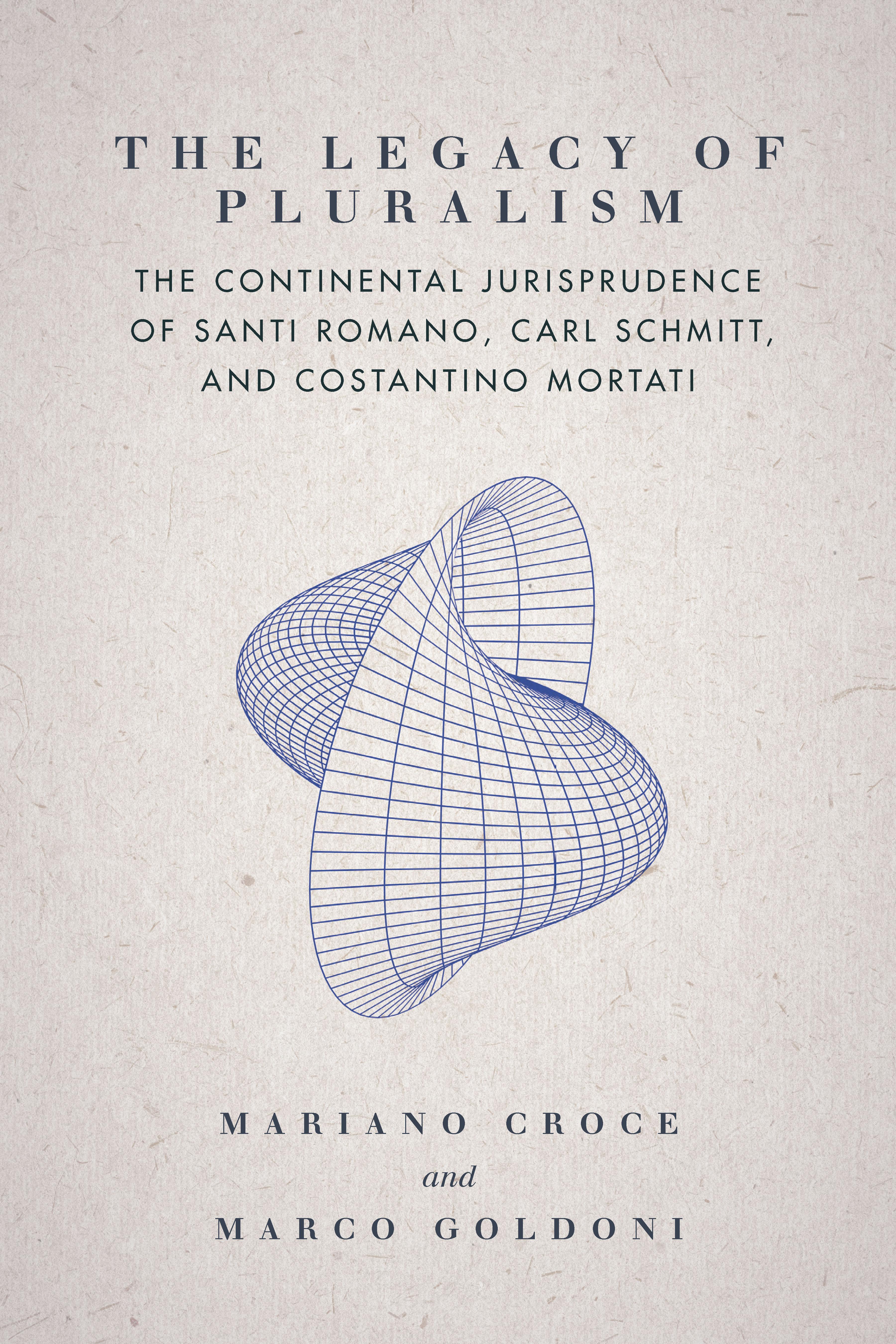
How should the state face the challenge of radical pluralism? How can constitutional orders be changed when they prove unable to regulate society? Santi Romano, Carl Schmitt, and Costantino Mortati, the leading figures of Continental legal institutionalism, provided three responses that deserve our full attention today. Mariano Croce and Marco Goldoni introduce and analyze these three towering figures for a modern audience. Romano thought pluralism to be an inherent feature of legality and envisaged a far-reaching reform of the state for it to be a platform of negotiation between autonomous normative regimes. Schmitt believed pluralism to be a dangerous deviation that should be curbed through the juridical exclusion of alternative institutional formations. Mortati held an idea of the constitution as the outcome of a basic agreement among hegemonic forces that should shape a shared form of life.
The Legacy of Pluralism explores the convergences and divergences of these towering jurists to take stock of their ground-breaking analyses of the origin of the legal order and to show how they can help us cope with the current crisis of national constitutional systems.
Payez facilement par carte, Klarna, Apple Pay ou Google Pay. Pas satisfait ? Vous avez toujours une garantie de remboursement de 14 jours. En savoir plus dans nos conditions. Si vous avez des questions, envoyez-nous un e-mail à hello@memmo.org.
Memmo facilite tes études, où que tu sois dans le monde. On rassemble tes manuels de cours et des outils d'étude intelligents au même endroit : résumés, quiz, podcasts et flashcards. Et il y a Ted, ton compagnon d'étude qui répond à toutes tes questions. Plus de 50 000 étudiants étudient déjà ici – conçu pour t'aider à apprendre plus vite et à moins stresser.