
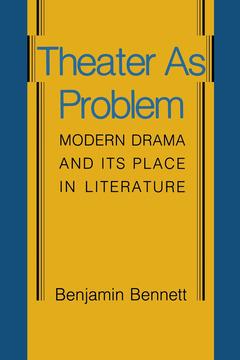
Using examples ranging from nineteenth-century Viennese comedy to Friedrich Dürrenmatt's atomic-age theater, Benjamin Bennett explores what is at stake in the theory of drama; what sort of questioning makes up that theory; and in what direction such questioning leads.
Bennett takes as his starting point the inescapably literary nature of theater in the European tradition, theater in its most concrete dimensions: as an institution, as a tradition of ritual or stylized behavior, as a particular type of physical space, as an economic venture. He maintains that, precisely because of its radical categorical disjunction from the domain of the literary, theater in the European tradition has been appropriated as the principal vehicle by which literature repeatedly problematizes itself. Theater, he says, is "the church of literature." Although he is concerned with drama as a literary type, therefore, Bennett does not treat the theory of drama as part of the theory of literature. For the special relation of drama to literature calls into question the whole idea of literary theory as a stable discourse divisible into parts.
Bennett considers plays by Nestroy, Schnitzler, Ibsen, Strindberg, Brecht, Ionesco, Genet, Pirandello, Artaud, and Dürrenmatt. He focuses on such theoretical issues as the idea of generic boundaries; the relation between drama and the culture of reading; the relevance between drama and the culture of reading; the relevance of hermeneutic and semiotic views of literature to drama; and the operation of fascism as a literary phenomenon. In conclusion, he frames a problem that his readings have brought to light: at least two separate historical accounts of modern drama are necessary—theories that imply each other, yet remain irreconcilable.
Payez facilement par carte, Klarna, Apple Pay ou Google Pay. Pas satisfait ? Vous avez toujours une garantie de remboursement de 14 jours. En savoir plus dans nos conditions. Si vous avez des questions, envoyez-nous un e-mail à hello@memmo.org.
Memmo facilite tes études, où que tu sois dans le monde. On rassemble tes manuels de cours et des outils d'étude intelligents au même endroit : résumés, quiz, podcasts et flashcards. Et il y a Ted, ton compagnon d'étude qui répond à toutes tes questions. Plus de 50 000 étudiants étudient déjà ici – conçu pour t'aider à apprendre plus vite et à moins stresser.