
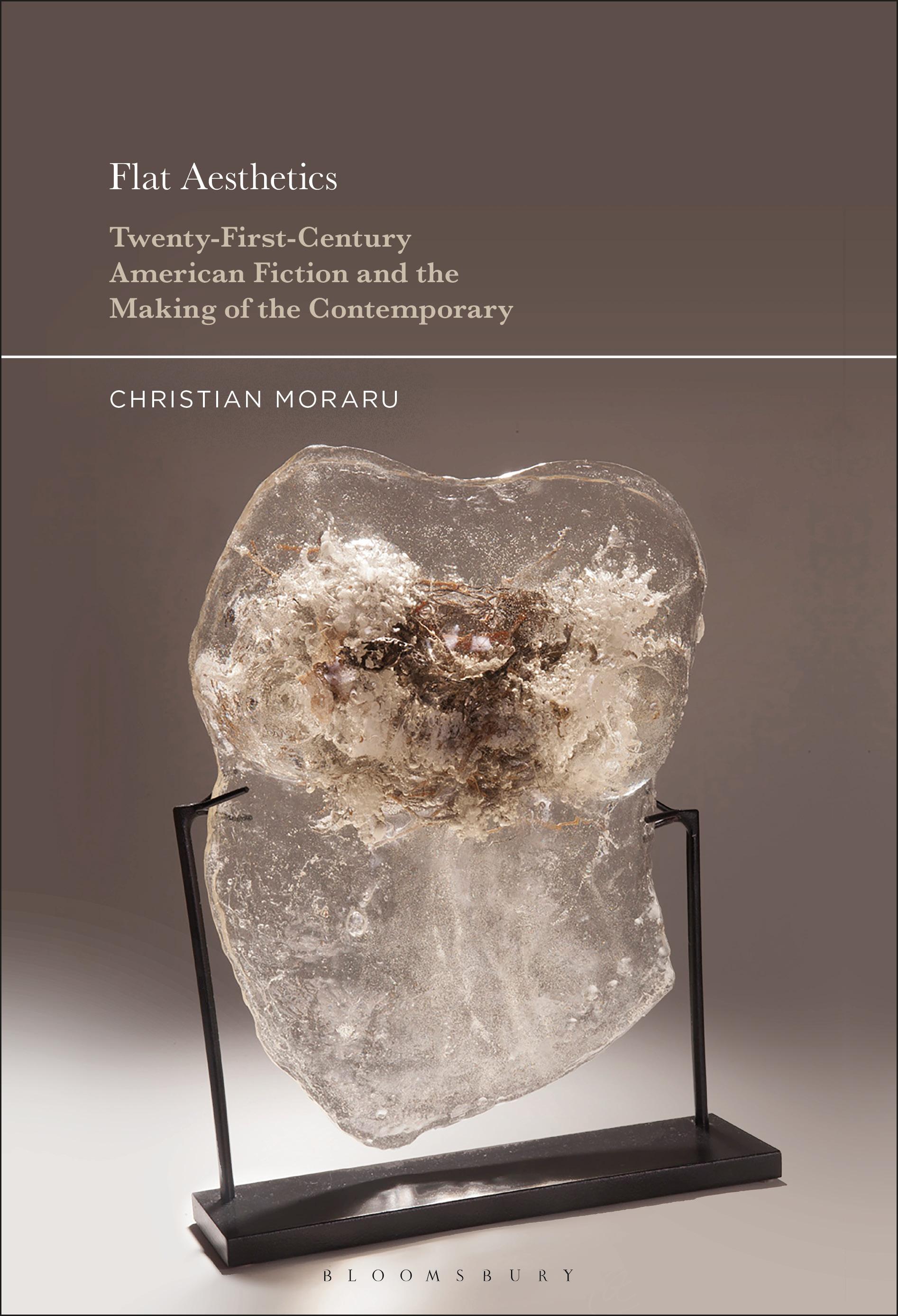
Flat Aesthetics seeks to secure a more granular and ontologically demotic handle on the contemporary in American literature. While contemporaneity can be viewed as “our” period, Christian Moraru approaches the contemporary as some-thing made by things themselves. The making of the contemporary is variously restaged by the body of fictional prose under scrutiny here. Thus, this corpus itself participates in the making of contemporaneity.
In dialogue with object-oriented ontology and various new materialisms, Moraru contends that the contemporary does not preexist objects or the novels featuring them; it is not their background but an outcome of things' self-presentation. As objects, beings, or existents present themselves in the present, in our “now,” they foster thing-configurations that together compose the form of, and essentially make, the contemporary - the present's cultural-material signature, as Moraru calls it.
To decipher this signature, Flat Aesthetics provides a cross-sectional reading of postmillennial American fiction. Discussed are solely post-2000 works by writers who have also established themselves over the past two decades or so, from Nicole Krauss, Michael Chabon, and Ben Lerner to Colson Whitehead and Emily St. John Mandel. Their output, Moraru claims, bears witness to the onset of a “flat” aesthetics in American letters after September 11, 2001. Organized into five parts, the books canvases objectual constellations of contemporaneity shaped by material dynamics of language, museality and display, spatiality, zombification and thing-rhetoric, and post-anthropocentric kinship.
In dialogue with object-oriented ontology and various new materialisms, Moraru contends that the contemporary does not preexist objects or the novels featuring them; it is not their background but an outcome of things' self-presentation. As objects, beings, or existents present themselves in the present, in our “now,” they foster thing-configurations that together compose the form of, and essentially make, the contemporary - the present's cultural-material signature, as Moraru calls it.
To decipher this signature, Flat Aesthetics provides a cross-sectional reading of postmillennial American fiction. Discussed are solely post-2000 works by writers who have also established themselves over the past two decades or so, from Nicole Krauss, Michael Chabon, and Ben Lerner to Colson Whitehead and Emily St. John Mandel. Their output, Moraru claims, bears witness to the onset of a “flat” aesthetics in American letters after September 11, 2001. Organized into five parts, the books canvases objectual constellations of contemporaneity shaped by material dynamics of language, museality and display, spatiality, zombification and thing-rhetoric, and post-anthropocentric kinship.
Payez facilement par carte, Klarna, Apple Pay ou Google Pay. Pas satisfait ? Vous avez toujours une garantie de remboursement de 14 jours. En savoir plus dans nos conditions. Si vous avez des questions, envoyez-nous un e-mail à hello@memmo.org.
Memmo facilite tes études, où que tu sois dans le monde. On rassemble tes manuels de cours et des outils d'étude intelligents au même endroit : résumés, quiz, podcasts et flashcards. Et il y a Ted, ton compagnon d'étude qui répond à toutes tes questions. Plus de 50 000 étudiants étudient déjà ici – conçu pour t'aider à apprendre plus vite et à moins stresser.