
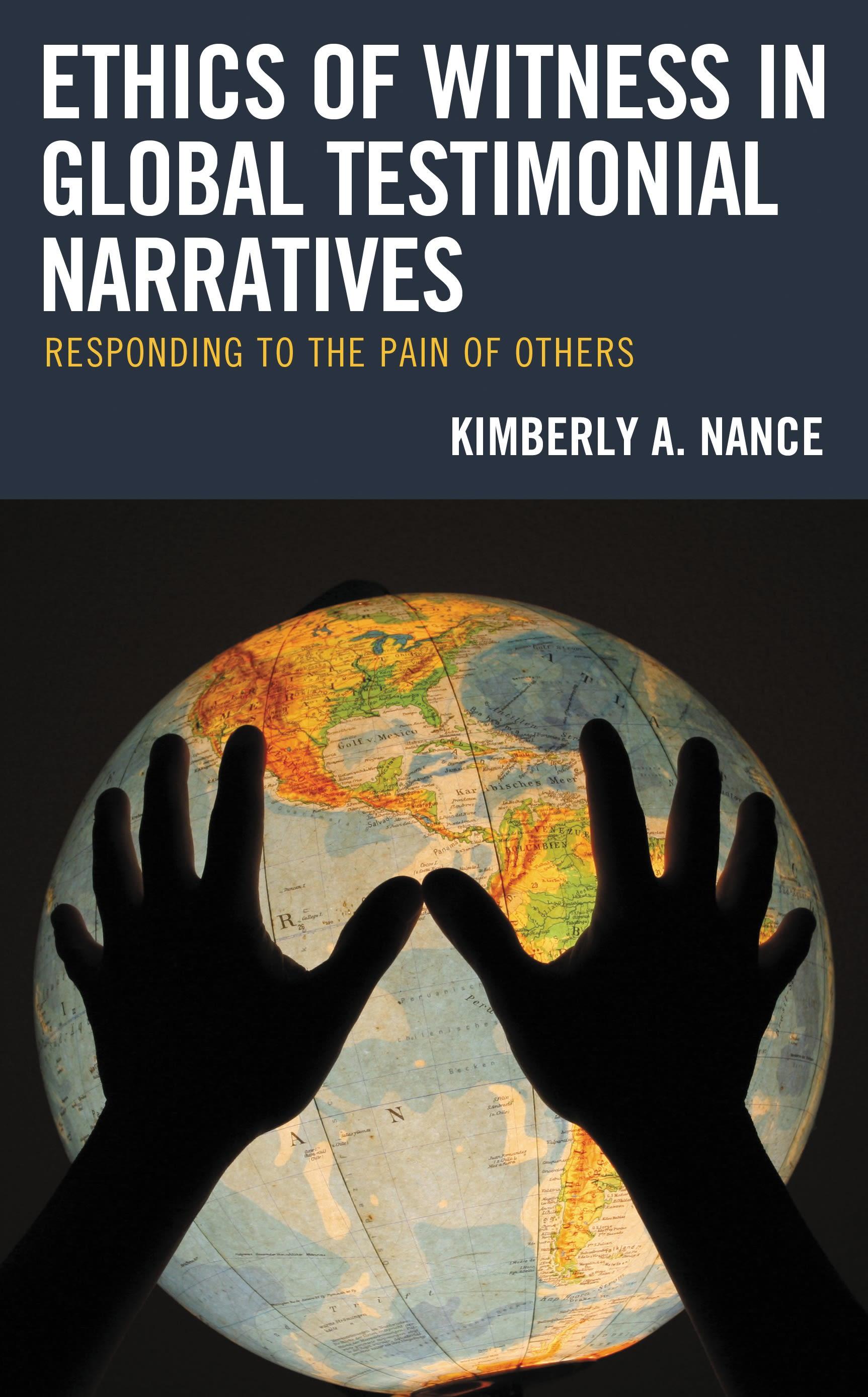
Inspired by Susan Sontag’s examination of the impact of “photography of conscience” in Regarding the Pain of Others, Kimberly A. Nance’s Responding to the Pain of Others: Ethics of Witness in Global Testimonial Narratives takes as its point of departure Sontag’s speculation that in combatting human rights abuse, “a narrative seems likely to be more effective than an image.” Building on her own earlier research on Aristotelian rhetorical theory and testimony, along with other interdisciplinary approaches, Nance analyzes the socio-literary narratives of Elvia Alvarado, Medea Benjamin, Peter Dickinson, Benjamin Alire Sáenz, Clea Koff, Delia Jarrett-Macauley, Valentino Achak Deng, Dave Eggers, Uwem Akpan, and Alicia Partnoy. Each of them, she finds, confronts a human rights discourse in which words—and witnesses—have become disconnected from actions. Recognizing that the genre’s own conventions have become an obstacle to its projects, these testimonialists draw on humor, irony, satire, parody, and innovative literary techniques, alongside strategies rooted in real-life organizing, in an effort to reactivate the discourse of human rights. They seek to persuade readers to exchange a solidarity of sentiment, a state Michael Vander Weele calls “an aesthetics in which the engine revs but the clutch is never engaged,” for actual social action.
Payez facilement par carte, Klarna, Apple Pay ou Google Pay. Pas satisfait ? Vous avez toujours une garantie de remboursement de 14 jours. En savoir plus dans nos conditions. Si vous avez des questions, envoyez-nous un e-mail à hello@memmo.org.
Memmo facilite tes études, où que tu sois dans le monde. On rassemble tes manuels de cours et des outils d'étude intelligents au même endroit : résumés, quiz, podcasts et flashcards. Et il y a Ted, ton compagnon d'étude qui répond à toutes tes questions. Plus de 50 000 étudiants étudient déjà ici – conçu pour t'aider à apprendre plus vite et à moins stresser.