
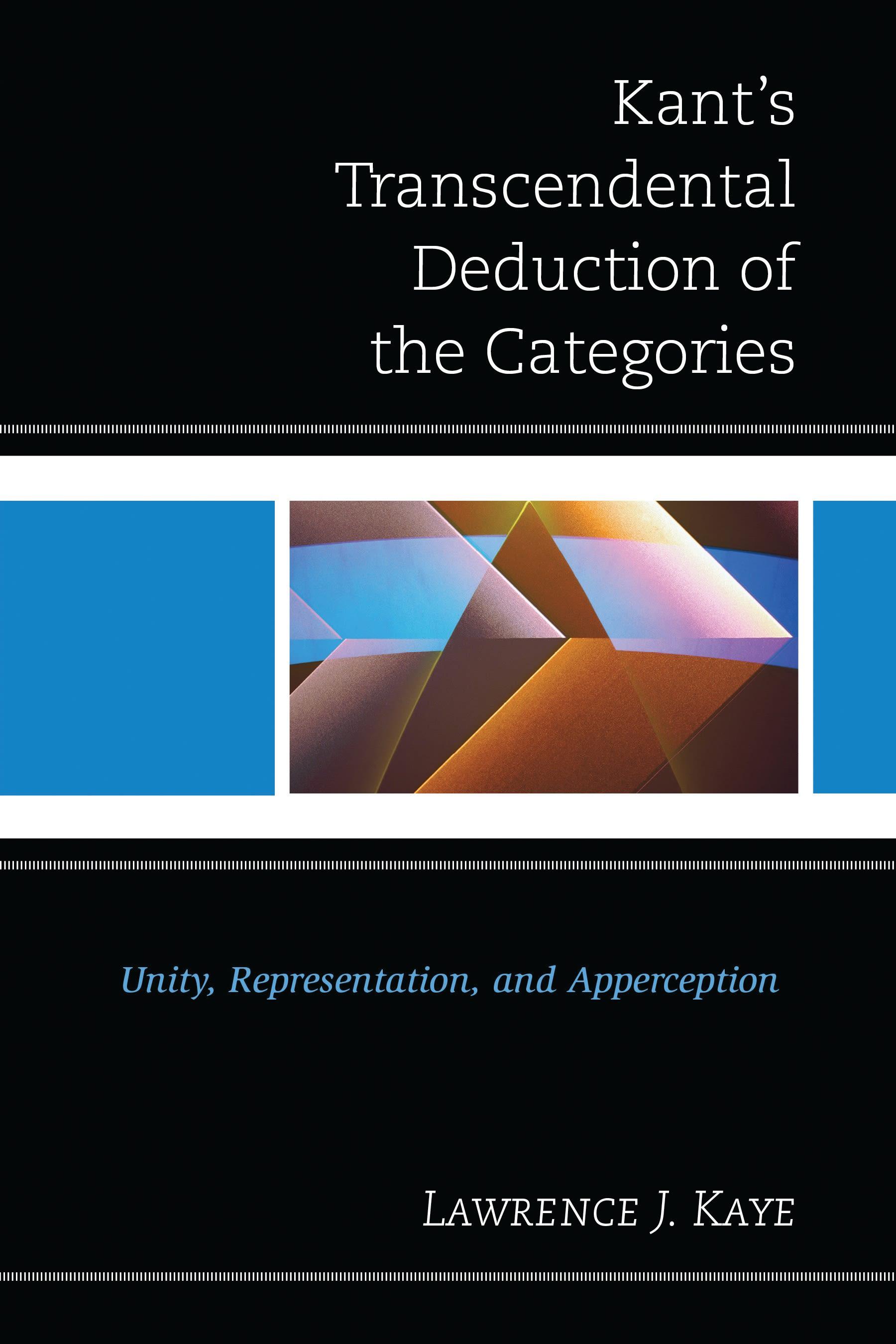
Kant’s Transcendental Deduction of the Categories: Unity, Representation, and Apperception is a distinctively new reading of the Transcendental Deduction of the Categories in the Critique of Pure Reason. Lawrence J. Kaye has discovered a number of previously overlooked arguments and explanations, one of the most significant being an argument that demonstrates that the use of concepts requires the necessary unity of consciousness. He also provides a detailed investigation of Kant’s account of representation in the first edition of the Transcendental Deduction of the Categories and shows how it can be understood as a unique type of functional role view. This view of representation leads to a new understanding of Kant’s blend of realism and idealism.
Kant’s notion of transcendental apperception (a priori self-awareness) is also carefully explained. Kaye shows that there is an extremely tight inter-relation between the unity of consciousness, representation, and apperception that constitutes a well-supported framework, one that offers a surprisingly strong set of replies to Hume’s skeptical challenges. He applies this framework to produce a coherent and detailed explanation of the Transcendental Deduction of the Categories, offering a thorough, paragraph-by-paragraph examination of the text in both editions.
This work should not only be of interest to Kant scholars, but also to any philosophers and cognitive scientists who are invested in any of the following topics: the unity and structure of consciousness, concepts, mental representation, self-awareness, and realism and idealism.
Kant’s notion of transcendental apperception (a priori self-awareness) is also carefully explained. Kaye shows that there is an extremely tight inter-relation between the unity of consciousness, representation, and apperception that constitutes a well-supported framework, one that offers a surprisingly strong set of replies to Hume’s skeptical challenges. He applies this framework to produce a coherent and detailed explanation of the Transcendental Deduction of the Categories, offering a thorough, paragraph-by-paragraph examination of the text in both editions.
This work should not only be of interest to Kant scholars, but also to any philosophers and cognitive scientists who are invested in any of the following topics: the unity and structure of consciousness, concepts, mental representation, self-awareness, and realism and idealism.
Payez facilement par carte, Klarna, Apple Pay ou Google Pay. Pas satisfait ? Vous avez toujours une garantie de remboursement de 14 jours. En savoir plus dans nos conditions. Si vous avez des questions, envoyez-nous un e-mail à hello@memmo.org.
Memmo facilite tes études, où que tu sois dans le monde. On rassemble tes manuels de cours et des outils d'étude intelligents au même endroit : résumés, quiz, podcasts et flashcards. Et il y a Ted, ton compagnon d'étude qui répond à toutes tes questions. Plus de 50 000 étudiants étudient déjà ici – conçu pour t'aider à apprendre plus vite et à moins stresser.