
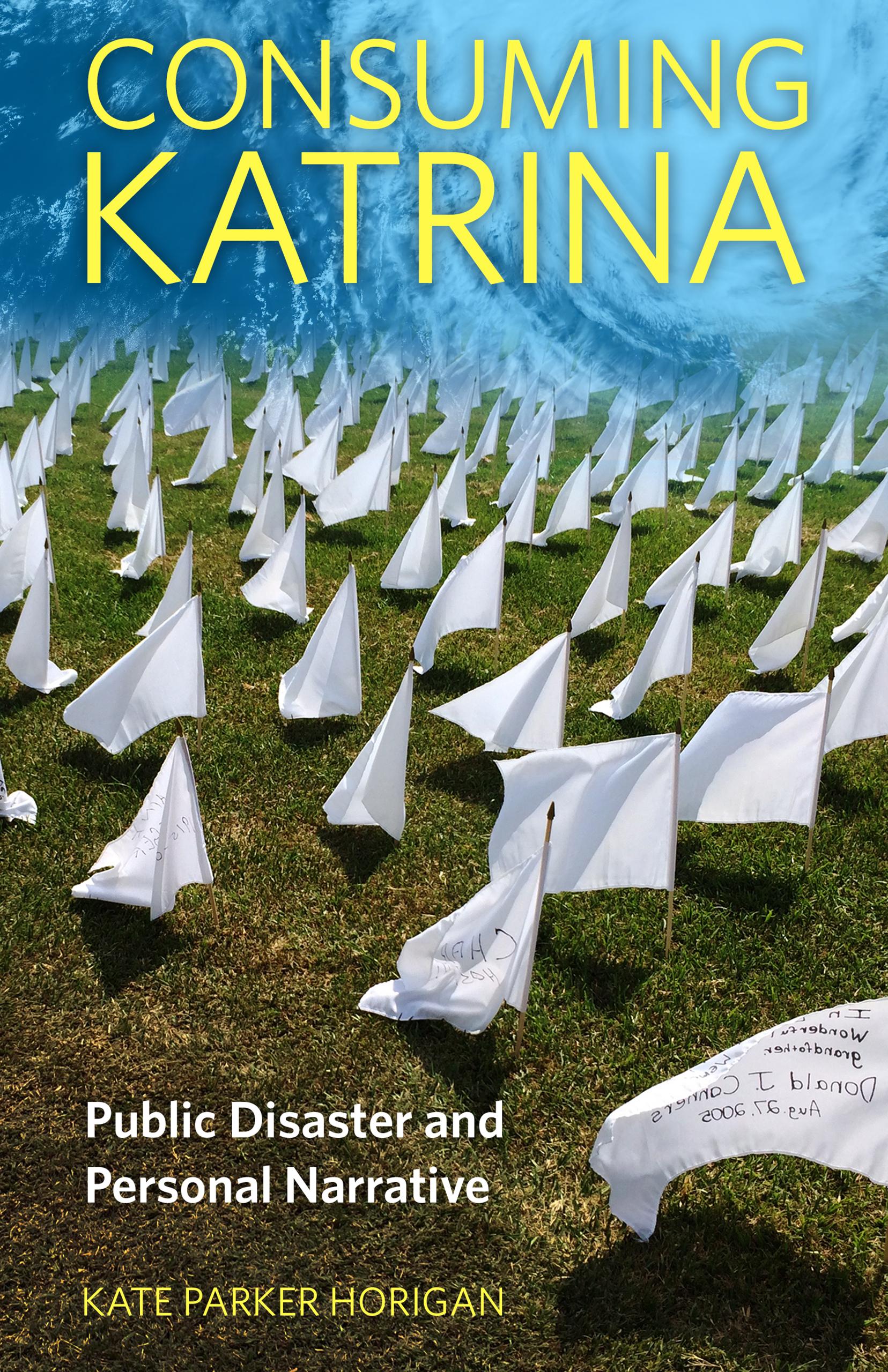
When and under what circumstances are disaster survivors able to speak for themselves in the public arena? In Consuming Katrina: Public Disaster and Personal Narrative, author Kate Parker Horigan shows how the public understands and remembers large-scale disasters like Hurricane Katrina, outlining which stories are remembered and why, as well as the impact on public memory and the survivors themselves.
Horigan discusses unique contexts in which personal narratives about the storm are shared, including interviews with survivors, Dave Eggers's Zeitoun, Josh Neufeld's A.D.: New Orleans After the Deluge, Tia Lessin and Carl Deal's Trouble the Water, and public commemoration during Hurricane Katrina's tenth anniversary in New Orleans. In each case, survivors initially present themselves in specific ways, counteracting negative stereotypes that characterize their communities. However, when adapted for public presentation, their stories get reduced back to those stereotypes. As a result, people affected by Katrina continue to be seen in limited terms, as either undeserving or incapable of managing recovery.
This project is rooted in Horigan's experiences living in New Orleans before and after Katrina, but it is also a case study illustrating an ongoing problem and an innovative solution: survivors' stories should be shared in a way that includes their own engagement with the processes of narrative production, circulation, and reception. When survivors are seen as agents in their own stories, they will be seen as agents in their own recovery. Having a better grasp on the processes of narration and memory is critical for improved disaster response because the stories that are most widely shared about disaster determine how communities recover.
Horigan discusses unique contexts in which personal narratives about the storm are shared, including interviews with survivors, Dave Eggers's Zeitoun, Josh Neufeld's A.D.: New Orleans After the Deluge, Tia Lessin and Carl Deal's Trouble the Water, and public commemoration during Hurricane Katrina's tenth anniversary in New Orleans. In each case, survivors initially present themselves in specific ways, counteracting negative stereotypes that characterize their communities. However, when adapted for public presentation, their stories get reduced back to those stereotypes. As a result, people affected by Katrina continue to be seen in limited terms, as either undeserving or incapable of managing recovery.
This project is rooted in Horigan's experiences living in New Orleans before and after Katrina, but it is also a case study illustrating an ongoing problem and an innovative solution: survivors' stories should be shared in a way that includes their own engagement with the processes of narrative production, circulation, and reception. When survivors are seen as agents in their own stories, they will be seen as agents in their own recovery. Having a better grasp on the processes of narration and memory is critical for improved disaster response because the stories that are most widely shared about disaster determine how communities recover.
Payez facilement par carte, Klarna, Apple Pay ou Google Pay. Pas satisfait ? Vous avez toujours une garantie de remboursement de 14 jours. En savoir plus dans nos conditions. Si vous avez des questions, envoyez-nous un e-mail à hello@memmo.org.
Memmo facilite tes études, où que tu sois dans le monde. On rassemble tes manuels de cours et des outils d'étude intelligents au même endroit : résumés, quiz, podcasts et flashcards. Et il y a Ted, ton compagnon d'étude qui répond à toutes tes questions. Plus de 50 000 étudiants étudient déjà ici – conçu pour t'aider à apprendre plus vite et à moins stresser.
Tu pourrais aussi aimer
Acheter le livre0