
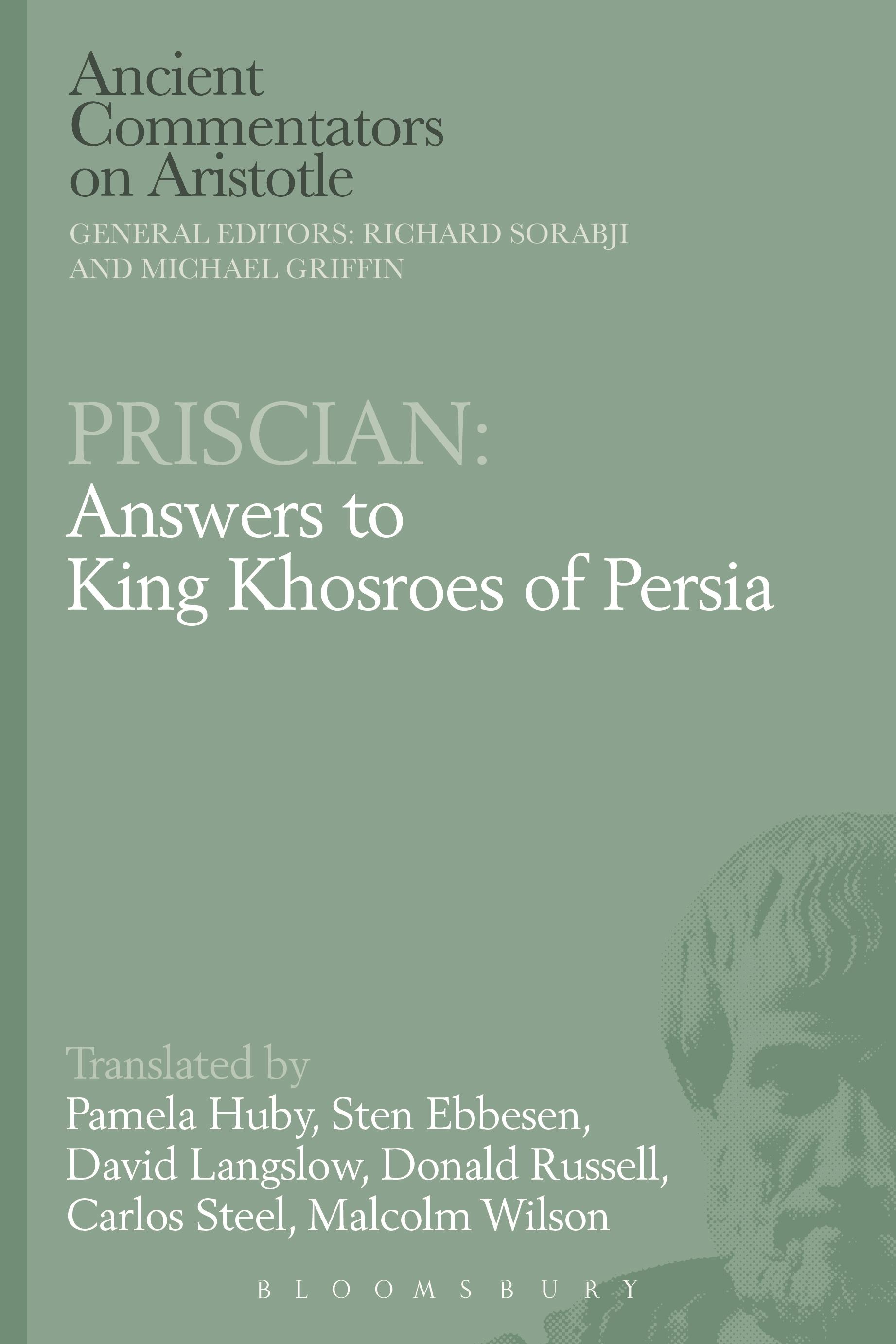
Priscian of Lydia was one of the Athenian philosophers who took refuge in 531 AD with King Khosroes I of Persia, after the Christian Emperor Justinian stopped the teaching of the pagan Neoplatonist school in Athens. This was one of the earliest examples of the sixth-century diffusion of the philosophy of the commentators to other cultures.
Tantalisingly, Priscian fully recorded in Greek the answers provided by the Athenian philosophers to the king's questions on philosophy and science. But these answers survive only in a later Latin translation which understood both the Greek and the subject matter very poorly. Our translators have often had to reconstruct from the Latin what the Greek would have been, in order to recover the original sense.
The answers start with subjects close to the Athenians' hearts: the human soul, on which Priscian was an expert, and sleep and visions. But their interest may have diminished when the king sought their expertise on matters of physical science: the seasons, celestial zones, medical effects of heat and cold, the tides, displacement of the four elements, the effect of regions on living things, why only reptiles are poisonous, and winds. At any rate, in 532 AD, they moved on from the palace, but still under Khosroes' protection. This is the first translation of the record they left into English or any modern language.
This English translation is accompanied by an introduction and comprehensive commentary notes, which clarify and discuss the meaning and implications of the original philosophy. Part of the Ancient Commentators on Aristotle series, the edition makes this philosophical work accessible to a modern readership and includes additional scholarly apparatus such as a bibliography, glossary of translated terms and a subject index.
Tantalisingly, Priscian fully recorded in Greek the answers provided by the Athenian philosophers to the king's questions on philosophy and science. But these answers survive only in a later Latin translation which understood both the Greek and the subject matter very poorly. Our translators have often had to reconstruct from the Latin what the Greek would have been, in order to recover the original sense.
The answers start with subjects close to the Athenians' hearts: the human soul, on which Priscian was an expert, and sleep and visions. But their interest may have diminished when the king sought their expertise on matters of physical science: the seasons, celestial zones, medical effects of heat and cold, the tides, displacement of the four elements, the effect of regions on living things, why only reptiles are poisonous, and winds. At any rate, in 532 AD, they moved on from the palace, but still under Khosroes' protection. This is the first translation of the record they left into English or any modern language.
This English translation is accompanied by an introduction and comprehensive commentary notes, which clarify and discuss the meaning and implications of the original philosophy. Part of the Ancient Commentators on Aristotle series, the edition makes this philosophical work accessible to a modern readership and includes additional scholarly apparatus such as a bibliography, glossary of translated terms and a subject index.
Payez facilement par carte, Klarna, Apple Pay ou Google Pay. Pas satisfait ? Vous avez toujours une garantie de remboursement de 14 jours. En savoir plus dans nos conditions. Si vous avez des questions, envoyez-nous un e-mail à hello@memmo.org.
Memmo facilite tes études, où que tu sois dans le monde. On rassemble tes manuels de cours et des outils d'étude intelligents au même endroit : résumés, quiz, podcasts et flashcards. Et il y a Ted, ton compagnon d'étude qui répond à toutes tes questions. Plus de 50 000 étudiants étudient déjà ici – conçu pour t'aider à apprendre plus vite et à moins stresser.