
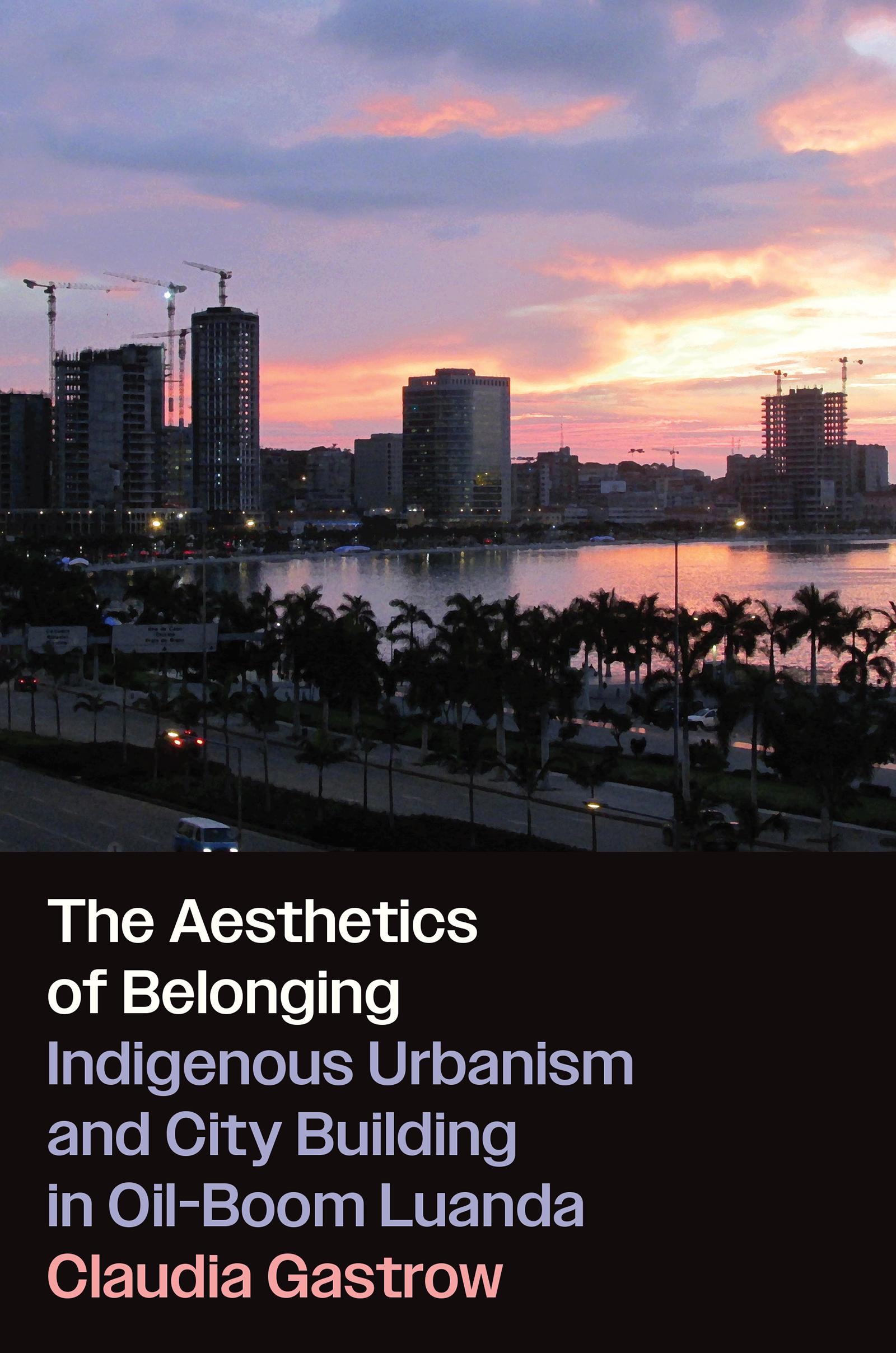
After centuries of colonial rule, the end of Angola’s three-decade civil war in 2002 provided an irresistible opportunity for the government to reimagine the Luanda cityscape. Awash with petrodollars cultivated through strategic foreign relationships, President José Eduardo dos Santos rolled out a national reconstruction program that sought to transform Angola’s capital into what he considered to be a modern, world-class metropolis. Until funds dried up in 2014, the program—in conjunction with sweeping private investments in real estate—involved mass demolitions of vernacular architecture to make way for high-rise buildings, large-scale housing projects, and commercial centers. The program thus underestimated the values enshrined in the materials and designs of Luanda’s existing “informally” constructed neighborhoods, or musseques.
The Aesthetics of Belonging explores the political significance of aesthetics in the remaking of the city. Claudia Gastrow’s archival and ethnographic work, which includes interviews with city planners, architects, nonprofit leaders, and urban dwellers, shows how government infrastructure projects and foreign-inspired designs came to embody displacement and exclusion for many. This, Gastrow argues, catalyzed a countermovement, an aesthetic dissent rooted in critically reframing informal urbanism as Indigenous—a move that enabled the possibility of recognizing the political potential of informal settlements as spaces that produce belonging.
The Aesthetics of Belonging explores the political significance of aesthetics in the remaking of the city. Claudia Gastrow’s archival and ethnographic work, which includes interviews with city planners, architects, nonprofit leaders, and urban dwellers, shows how government infrastructure projects and foreign-inspired designs came to embody displacement and exclusion for many. This, Gastrow argues, catalyzed a countermovement, an aesthetic dissent rooted in critically reframing informal urbanism as Indigenous—a move that enabled the possibility of recognizing the political potential of informal settlements as spaces that produce belonging.
Payez facilement par carte, Klarna, Apple Pay ou Google Pay. Pas satisfait ? Vous avez toujours une garantie de remboursement de 14 jours. En savoir plus dans nos conditions. Si vous avez des questions, envoyez-nous un e-mail à hello@memmo.org.
Memmo facilite tes études, où que tu sois dans le monde. On rassemble tes manuels de cours et des outils d'étude intelligents au même endroit : résumés, quiz, podcasts et flashcards. Et il y a Ted, ton compagnon d'étude qui répond à toutes tes questions. Plus de 50 000 étudiants étudient déjà ici – conçu pour t'aider à apprendre plus vite et à moins stresser.
Tu pourrais aussi aimer
Acheter le livre0