
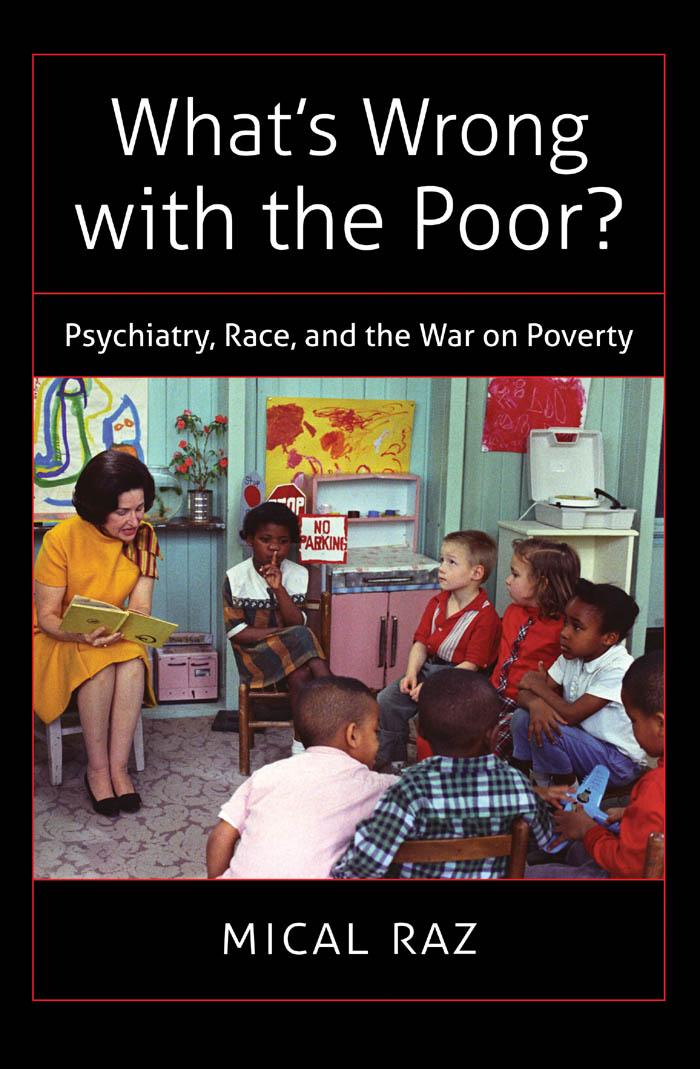
In the 1960s, policymakers and mental health experts joined forces to participate in President Lyndon Johnson’s War on Poverty. In her insightful interdisciplinary history, physician and historian Mical Raz examines the interplay between psychiatric theory and social policy throughout that decade, ending with President Richard Nixon’s 1971 veto of a bill that would have provided universal day care. She shows that this cooperation between mental health professionals and policymakers was based on an understanding of what poor men, women, and children lacked. This perception was rooted in psychiatric theories of deprivation focused on two overlapping sections of American society: the poor had less, and African Americans, disproportionately represented among America’s poor, were seen as having practically nothing.
Raz analyzes the political and cultural context that led child mental health experts, educators, and policymakers to embrace this deprivation-based theory and its translation into liberal social policy. Deprivation theory, she shows, continues to haunt social policy today, profoundly shaping how both health professionals and educators view children from low-income and culturally and linguistically diverse homes.
Raz analyzes the political and cultural context that led child mental health experts, educators, and policymakers to embrace this deprivation-based theory and its translation into liberal social policy. Deprivation theory, she shows, continues to haunt social policy today, profoundly shaping how both health professionals and educators view children from low-income and culturally and linguistically diverse homes.
Payez facilement par carte, Klarna, Apple Pay ou Google Pay. Pas satisfait ? Vous avez toujours une garantie de remboursement de 14 jours. En savoir plus dans nos conditions. Si vous avez des questions, envoyez-nous un e-mail à hello@memmo.org.
Memmo facilite tes études, où que tu sois dans le monde. On rassemble tes manuels de cours et des outils d'étude intelligents au même endroit : résumés, quiz, podcasts et flashcards. Et il y a Ted, ton compagnon d'étude qui répond à toutes tes questions. Plus de 50 000 étudiants étudient déjà ici – conçu pour t'aider à apprendre plus vite et à moins stresser.
Tu pourrais aussi aimer
Acheter le livre0