
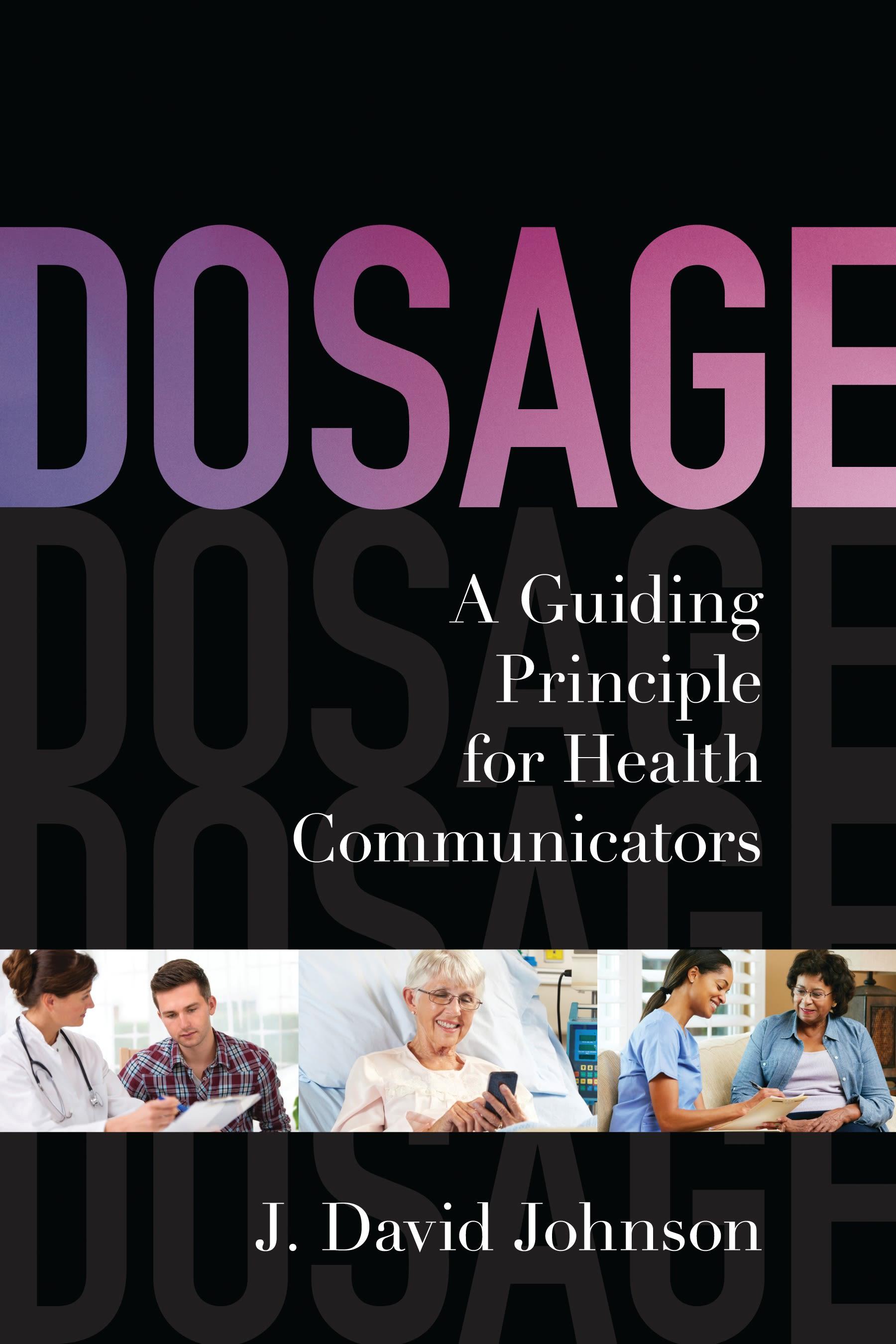
Dosage: A Guiding Principle for Health Communicators uses “dosage” as a metaphor to help all healthcare professionals apply basic communication principles to their work.
After a general overview of communication and its paramount importance in the health care setting, J. David Johnson, a professor of communications and former media research analyst for the U.S. Information Agency and author of five previous books, outlines the best practices for
Interpersonal communication in health care relationships, including that between physician and patient. He answers questions such as “How Much Do I Reveal and When?”;Interprofessional teams, including teamwork, interdependence, stress and burnout, and communication in decision-making;Mass Media, including searching for information and gaps in knowledge;Knowledge diffusion and dissemination;Change in communication, including social media;Health information technology and how to handle the flood of communications we receive today.
Johnson effectively expands his metaphor of dosage, detailing its many elements (amount, frequency, delivery system, sequencing, interaction with what other agents, and contraindications) as well as discussing the use and limits of metaphor generally. He explicitly addresses the following contexts: interpersonal communication, with a focusing on health professional-client interactions; inter-professional teams; mass media that are increasingly important for broader approaches to public health; how change is adopted and implemented within health care organizations and individuals; and the new technologies for health communication.
The book’s final chapter turns to broader policy issues raised by application of the metaphor of dosage as well as detailing its implications for methods of communication research. It concludes with a discussion of how dosage can serve as a bridging metaphor to close the gap between researchers and practitioners which is fundamental to clinical and translational science.
After a general overview of communication and its paramount importance in the health care setting, J. David Johnson, a professor of communications and former media research analyst for the U.S. Information Agency and author of five previous books, outlines the best practices for
Interpersonal communication in health care relationships, including that between physician and patient. He answers questions such as “How Much Do I Reveal and When?”;Interprofessional teams, including teamwork, interdependence, stress and burnout, and communication in decision-making;Mass Media, including searching for information and gaps in knowledge;Knowledge diffusion and dissemination;Change in communication, including social media;Health information technology and how to handle the flood of communications we receive today.
Johnson effectively expands his metaphor of dosage, detailing its many elements (amount, frequency, delivery system, sequencing, interaction with what other agents, and contraindications) as well as discussing the use and limits of metaphor generally. He explicitly addresses the following contexts: interpersonal communication, with a focusing on health professional-client interactions; inter-professional teams; mass media that are increasingly important for broader approaches to public health; how change is adopted and implemented within health care organizations and individuals; and the new technologies for health communication.
The book’s final chapter turns to broader policy issues raised by application of the metaphor of dosage as well as detailing its implications for methods of communication research. It concludes with a discussion of how dosage can serve as a bridging metaphor to close the gap between researchers and practitioners which is fundamental to clinical and translational science.
Payez facilement par carte, Klarna, Apple Pay ou Google Pay. Pas satisfait ? Vous avez toujours une garantie de remboursement de 14 jours. En savoir plus dans nos conditions. Si vous avez des questions, envoyez-nous un e-mail à hello@memmo.org.
Memmo facilite tes études, où que tu sois dans le monde. On rassemble tes manuels de cours et des outils d'étude intelligents au même endroit : résumés, quiz, podcasts et flashcards. Et il y a Ted, ton compagnon d'étude qui répond à toutes tes questions. Plus de 50 000 étudiants étudient déjà ici – conçu pour t'aider à apprendre plus vite et à moins stresser.